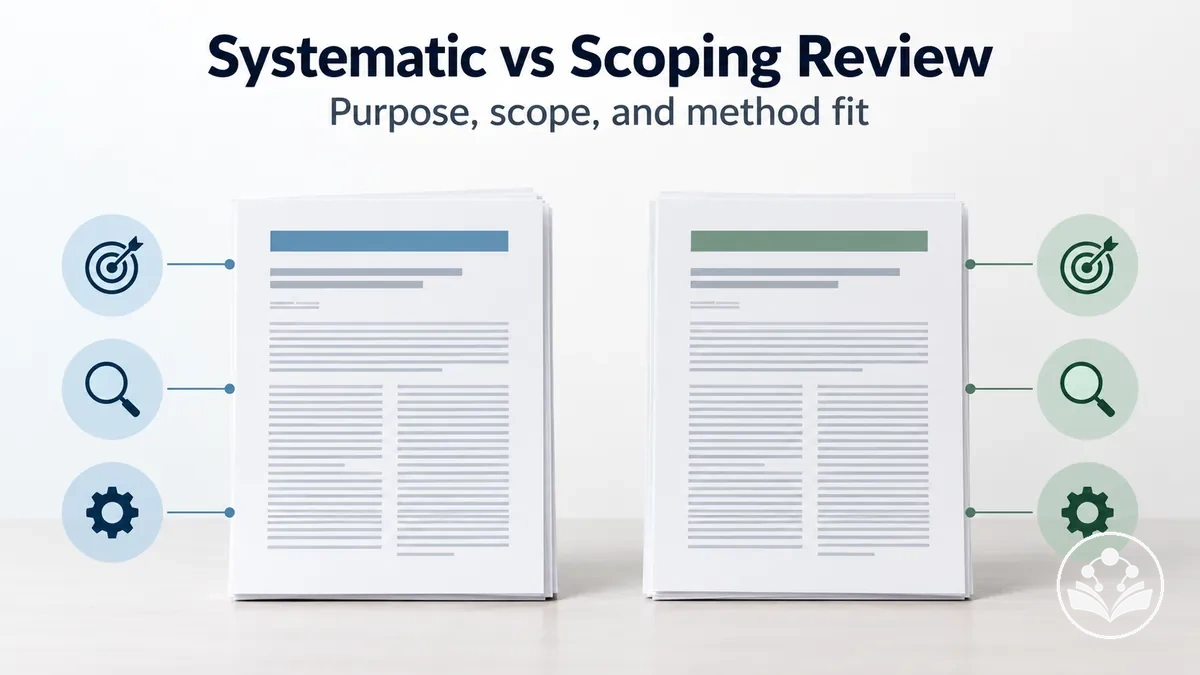
Systematic Review vs Scoping Review: Matching the Review Method to Its Purpose
Choose a systematic review when the main objective is to answer a focused research question by systematically identifying and synthesising eligible evidence within predefined criteria; choose a scoping review when the objective is to map the breadth, characteristics, concepts or gaps in a broader evidence field. The key decision boundary is review purpose and question breadth: meta-analysis is not a defining requirement for a systematic review, while formal critical appraisal in a scoping review is purpose-dependent.
Systematic or scoping? Match the method to the review purpose
Start with the job the review must do. Question breadth, eligibility, evidence handling, and workload should follow that purpose rather than replace it.
Focused answer
Systematic review
Use it when the objective is to answer a specific, answerable question by identifying and synthesising eligible evidence within predefined criteria.
Question
Focused and bounded enough to support a specific synthesis.
Evidence handling
Structured selection followed by qualitative synthesis, quantitative synthesis, or both as appropriate.
Appraisal
Critical appraisal or risk-of-bias assessment typically informs interpretation.
Output
A focused evidence synthesis; meta-analysis is used only when the evidence and method support pooling.
Evidence map
Scoping review
Use it when the objective is to map the breadth or nature of evidence, clarify concepts, describe evidence characteristics, or identify knowledge gaps across a wider field.
Question
Commonly broader or exploratory when wider coverage is needed.
Evidence handling
Evidence is charted, categorised, and mapped across relevant source types and contexts.
Appraisal
Formal critical appraisal is purpose-dependent rather than a defining requirement.
Output
A mapped account of evidence extent, characteristics, concepts, patterns, or gaps.
Primary decision rule: choose by purpose and question breadth. If those signals conflict, revise the question or scope before choosing by convenience; resources test feasibility after methodological fit.
Neither method is inherently superior. A systematic review need not include meta-analysis, and a scoping review can still use transparent, predefined, and systematic methods.
The sections below trace how that purpose-first choice changes eligibility, evidence handling, appraisal, expected output, and resource demands.
Table of Contents⌄
Purpose and Question Breadth Define the Core Difference
A systematic review generally works from a focused research question aimed at answering a specific evidence-synthesis need, while a scoping review commonly addresses a broader question intended to map a topic, concept, or evidence field.
Question breadth follows review purpose rather than an absolute rule that every systematic review must be narrow or every scoping review must be broad.
The table aligns review purpose and question breadth under the same criteria, showing how question specificity, evidence objectives, and scope affect method choice.
Dimension
Systematic Review
Scoping Review
Method-Fit Implication
Question specificity
Usually addresses a focused, answerable question.
Commonly addresses a broader or exploratory question.
Choose the scope that matches the specificity required by the review purpose.
Primary purpose
Synthesizes evidence for a specific research question.
Maps the extent, characteristics, or range of evidence around a broader topic or concept.
A synthesis objective points toward a systematic review; a mapping objective can favour a scoping review.
Evidence-field maturity
Can suit a sufficiently defined body of evidence that supports focused synthesis.
Can suit emerging evidence or a field whose boundaries and characteristics need exploration.
The state of the evidence field can influence how narrowly the review question can be framed.
Gap or concept mapping need
Knowledge gaps may emerge from synthesis but are not usually the primary mapping objective.
Can explicitly map concepts, evidence characteristics, and knowledge gaps.
A primary need to map gaps or clarify concepts can support scoping-review suitability.
Expected breadth
Typically narrower around a specific purpose and focused research question.
Typically broader across a topic, concept, population, or evidence field.
Question breadth should match the evidence objective rather than serve as an absolute classification rule.
The method-fit implication is that review purpose determines what the question must accomplish before breadth is set.
A focused synthesis objective requires boundaries capable of supporting a specific answer, whereas an evidence-mapping objective may require wider boundaries so that relevant concepts, evidence patterns, or knowledge gaps remain visible.
For example, the same topic could support a systematic review asking whether a defined intervention affects a specified outcome in a particular population, or a scoping review asking what evidence exists about interventions, outcomes, and research activity across that topic.
This contrast demonstrates question-method fit rather than a fixed rule about breadth; researchers who need to develop the question itself can separately formulate the review question.
The focused-versus-broad distinction can also be understood visually as a narrow question funnel for systematic review compared with a wider evidence field for scoping review.
As question breadth expands, the potential scope of relevant evidence also expands, so eligibility boundaries generally need to accommodate that wider evidence objective.
A more focused question supports correspondingly tighter boundaries, making question breadth the natural bridge from review purpose to the breadth of eligibility criteria.
How Scope and Inclusion Criteria Shape Study Selection
A systematic review and a scoping review can both use predefined eligibility criteria and structured screening, but their inclusion criteria may differ in breadth according to the review question and protocol.
A systematic review may define tighter eligibility boundaries around a focused synthesis objective, while a scoping review may allow a broader range of eligible evidence when its purpose is to map a wider field.
This difference in scope shapes which evidence types can enter study selection without implying that broader criteria are less systematic.
The comparison below organizes scope, eligible evidence types, inclusion and exclusion criteria, and the resulting selection implications.
It shows how eligibility breadth can shape both the composition and heterogeneity of the selected evidence set.
Selection Dimension
Systematic Review
Scoping Review
Selection Implication
Scope breadth
Often bounded around a focused review question and synthesis objective.
May use wider boundaries when the objective is to map a broader topic or evidence field.
Scope determines how widely potentially relevant evidence can be considered.
Eligible evidence types
Evidence types are defined according to the focused question and protocol.
A broader range of empirical or, where relevant, non-empirical evidence may be eligible when required by the mapping objective.
The protocol determines which source or study types can enter screening.
Inclusion and exclusion precision
Criteria may tightly specify characteristics needed for the intended evidence synthesis.
Criteria may retain wider categories when broader coverage is necessary for the review purpose.
Eligibility boundaries constrain which records can become included evidence.
Heterogeneity of included evidence
A focused scope can produce a more closely defined evidence set.
Broader eligibility can produce greater heterogeneity across included evidence.
Greater breadth can increase variation in the evidence selected for the review.
Screening volume
The volume of eligible records depends on the question, criteria, search results, and protocol.
Broader eligibility may increase the range of records requiring an inclusion decision.
Selection burden follows the breadth and composition of the candidate evidence rather than review type alone.
Both review methods can therefore apply structured study selection; the distinction lies in how the review purpose and protocol define the eligibility boundaries.
The scope-to-selection relationship can be visualized as two review paths in which narrower and broader eligibility boundaries produce differently composed selected-evidence sets without implying a difference in rigor.
For example, on the same research topic, a systematic review might restrict eligibility to a specifically defined population, intervention, outcome, and study design when those characteristics are necessary to answer its focused question.
A scoping review of the same topic might use wider inclusion criteria to capture multiple evidence types or contexts when its objective requires broader mapping.
The resulting evidence sets can therefore differ in scope and heterogeneity because their eligibility boundaries serve different review purposes.
This comparison stops at the consequences of eligibility breadth rather than the mechanics of reviewing individual records.
The procedural stages of study selection and screening are a separate topic; here, the relevant consequence is that wider eligibility boundaries can expand the range and heterogeneity of evidence requiring selection decisions.
How Evidence Appraisal, Synthesis, and Review Outcomes Differ
Systematic reviews and scoping reviews both organize included evidence systematically, but they usually process that evidence toward different review outcomes.
A systematic review uses evidence synthesis to answer a focused question, using qualitative synthesis, quantitative synthesis, or both as appropriate to the evidence.
A scoping review primarily uses evidence mapping to describe the extent, characteristics, concepts, or knowledge gaps within a broader evidence field.
The synthesis approach and resulting output therefore follow the review purpose rather than a hierarchy in which one method is inherently superior.
The comparison below aligns synthesis objective, evidence handling, the high-level role of critical appraisal, and typical outputs under the same criteria.
It distinguishes focused synthesis from mapping-oriented evidence processing without treating meta-analysis as synonymous with systematic review.
Evidence Dimension
Systematic Review
Scoping Review
Outcome Implication
Synthesis objective
Synthesizes included evidence to address a focused research question.
Maps the extent, characteristics, concepts, or knowledge gaps within an evidence field.
The review purpose determines whether the output primarily answers a focused question or characterizes a broader evidence landscape.
Treatment of heterogeneity
May use qualitative synthesis or another appropriate approach when differences between studies limit quantitative pooling.
Can organize varied evidence into categories, themes, concepts, or characteristics to show the structure of the field.
Differences across included evidence influence how findings can be combined, summarized, or mapped.
Critical appraisal
Critical appraisal commonly informs assessment and interpretation of included research.
The role of critical appraisal depends on the review purpose and methodological approach.
Appraisal should be interpreted in relation to the review's intended methodological endpoint.
Quantitative pooling
Meta-analysis may be used when quantitative evidence and methodological conditions support statistical pooling, but it is not required for every systematic review.
Quantitative information may be summarized or mapped, but producing a single pooled effect estimate is not the defining objective.
Meta-analysis is a conditional synthesis technique rather than a synonym for systematic review.
Typical outputs
A focused evidence summary or synthesis addressing the specified review question.
A mapped account of evidence extent, characteristics, concepts, patterns, or knowledge gaps.
Different outputs reflect different review objectives rather than different levels of inherent value.
After evidence has been included, the central contrast is focused evidence synthesis versus broader evidence mapping.
A systematic review may integrate findings through qualitative synthesis, quantitative synthesis, or meta-analysis when appropriate, whereas a scoping review can summarize and categorize findings to reveal the shape of an evidence field rather than merely list sources.
This synthesis-versus-mapping relationship is visible as two evidence-processing pathways leading to a focused synthesis output and a categorized evidence map.
Critical appraisal is relevant to understanding how evidence is interpreted, but its exact methodological role should be considered separately rather than used here as a simple dividing line between review types.
Likewise, systematic review does not necessarily mean meta-analysis, and scoping review does not necessarily mean simple listing without synthesis or interpretation.
The appropriate review outcome follows the review purpose and the evidence-processing objective it is designed to support.
The Role of Critical Appraisal in Each Review Type
In a systematic review, critical appraisal or risk-of-bias assessment typically informs interpretation because methodological limitations can affect how confidently findings contribute to a focused evidence synthesis.
In a scoping review, formal critical appraisal is purpose-dependent rather than a defining requirement when the main objective is to map the extent, characteristics, concepts, or gaps within an evidence field.
Whether appraisal is included therefore depends on the review objective, protocol, methodological approach, and applicable guidance rather than on a universal rule for every review of that type.
The key distinction is appraisal as an interpretive checkpoint versus appraisal whose use depends on the purpose of the review.
Risk-of-bias or quality assessment examines methodological limitations that may change the interpretation of included evidence.
Methodological transparency is a separate requirement: a review should clearly report how evidence was identified, selected, and handled even when formal critical appraisal is not part of the protocol.
Not routinely required is not equivalent to never performed. In scoping reviews, the absence of formal quality assessment does not by itself mean that the review lacks transparent methods.
When critical appraisal is performed, identified weaknesses can qualify how individual studies or groups of studies contribute to interpretation rather than simply determining whether evidence exists.
In scoping reviews that include appraisal, the findings may similarly help readers understand limitations within the mapped evidence, but the role of that assessment should remain aligned with the stated review objective and protocol.
Time, Team, and Resource Demands Across the Two Methods
Time, team, and resource demands depend on review scope, search breadth, screening volume, critical appraisal requirements, and synthesis complexity, so neither systematic reviews nor scoping reviews are inherently fast or easy.
Their workload arises from different combinations of discovery and selection demands and appraisal and synthesis demands.
A broad evidence base can make a scoping review resource-intensive, while additional appraisal and synthesis requirements can add substantial effort to a systematic review.
The table organizes the main workload drivers according to the tasks performed and the conditions that increase effort.
It distinguishes search and screening demands from data extraction or data charting, critical appraisal, synthesis complexity, and team or verification needs without assigning fixed durations or staffing rules.
Workload Driver
Systematic Review
Scoping Review
Why Effort Varies
Search breadth
A focused question can constrain the search, although comprehensive retrieval across relevant sources can still require substantial work.
A broad mapping objective can require searching across a wider range of concepts, evidence types, or sources.
Broader concepts and evidence coverage can increase the number and diversity of records that must be retrieved and managed.
Screening volume
Screening workload increases when searches retrieve many potentially eligible records or the protocol requires detailed eligibility decisions.
Broad searches can produce a large and heterogeneous record set requiring substantial screening.
More candidate records and more varied evidence increase the number or complexity of selection decisions.
Extraction or charting
Data extraction can become intensive when many variables or detailed study characteristics and results must be captured consistently.
Data charting can require substantial effort when heterogeneous evidence must be categorized across multiple characteristics or concepts.
The number of included sources, amount of information captured, and heterogeneity of evidence influence workload.
Critical appraisal
Critical appraisal can add methodological assessment and verification work when risk of bias or study quality must inform interpretation.
Appraisal effort depends on whether critical appraisal is included for the review objective and protocol.
Resource demand increases when formal appraisal is required and must be applied consistently across included evidence.
Synthesis complexity
Qualitative or quantitative synthesis can require substantial effort when evidence is heterogeneous or complex to integrate.
Organizing and mapping varied evidence can require extensive categorization and interpretation even without a pooled synthesis objective.
Greater heterogeneity, more complex evidence relationships, and more demanding analytical methods increase synthesis or mapping effort.
Team or verification needs
Team workload can increase when the protocol uses duplicate or independent review processes and verification across review tasks.
Team workload can increase when broad screening, extensive charting, or verification procedures require work to be distributed and checked.
Staffing demand depends on evidence volume, protocol requirements, verification procedures, and the amount of work assigned across review stages.
Search breadth and screening volume primarily create discovery and selection workload, while data extraction or data charting determine how much information must be captured and organized after selection.
A scoping review does not necessarily mean less work. A broad search that retrieves heterogeneous evidence can increase both screening and data-charting effort.
These different task combinations also create different demands across searching, screening, extraction or charting, appraisal, synthesis, and team collaboration.
Critical appraisal and synthesis complexity can add another layer of resource demand, particularly when a protocol requires detailed methodological assessment, verification, or complex integration of findings.
Team involvement likewise depends on the volume and complexity of the work and the verification procedures specified by the protocol rather than on a universal staffing rule.
For example, a scoping review covering a broad and heterogeneous evidence field may require extensive screening and data charting even when its appraisal or synthesis requirements differ from those of a systematic review.
Resource feasibility therefore follows the combination of scope, evidence volume, protocol requirements, and analytical tasks rather than a fixed duration or an assumption that either method is automatically easier.
Choosing the Review Method by Research Situation
Method selection should begin with the research objective and question breadth rather than convenience or available resources.
A focused objective that requires a specific evidence synthesis can support systematic-review method fit, whereas an objective centred on mapping a broader evidence field can favour a scoping review.
Evidence maturity, heterogeneity, critical appraisal needs, desired output, and feasibility then refine that decision without replacing the purpose-question match.
These selection criteria are prioritized rather than treated as equally weighted: purpose and question breadth establish the methodological direction first, followed by evidence characteristics and the desired output, with resources considered as a secondary feasibility constraint.
Each criterion links a research condition to its implication for method fit.
Research objective
when the objective is to answer a focused question through evidence synthesis, a systematic review can fit that purpose; when the objective is to map the extent, characteristics, concepts, or gaps in a broader evidence field, a scoping review can fit that purpose.
Question breadth
a sufficiently specific and bounded question can support systematic-review suitability, while a broader or exploratory question can favour a scoping review when wider coverage is necessary to address the objective.
Evidence maturity and heterogeneity
a sufficiently defined evidence base can support focused synthesis, whereas emerging, uncertain, or highly heterogeneous evidence can favour scoping when the immediate need is to clarify the field before attempting a narrower synthesis.
Critical appraisal
when the review objective requires methodological quality or risk-of-bias assessment to inform interpretation of a focused synthesis, that need supports systematic-review method fit; when the primary objective is evidence mapping, the role of critical appraisal depends on the scoping review's protocol and intended use.
Desired output
an intended output centred on answering a focused research question supports systematic evidence synthesis, while an output intended to characterize evidence distribution, concepts, patterns, or knowledge gaps supports scoping-review evidence mapping.
Resources and feasibility
available time, team capacity, and workload can determine whether the planned review is feasible, but resource constraints should prompt adjustment of scope or planning rather than override a mismatch between the research objective and the chosen method.
Resources remain a secondary feasibility constraint after methodological fit has been established.
In a borderline case where the evidence base or question is not yet sufficiently defined for focused synthesis, a scoping review may help clarify evidence characteristics or gaps and may inform a later systematic review if a sufficiently focused question subsequently becomes viable; this is a conditional possibility rather than a required sequence.
Reducing workload does not convert a method that mismatches the research objective into a suitable one.
These criteria define the decision boundary specifically between systematic and scoping reviews; research questions that point beyond that comparison may require consideration of other types of review articles.
Within this boundary, the criteria can be applied to the specific research situations addressed next.
When a Systematic Review Is the Better Method Fit
A systematic review is the stronger method fit when the research objective can be expressed as a focused question, defined eligibility criteria can identify the relevant evidence, and the purpose is to conduct evidence synthesis that answers that specific question.
The synthesis may be qualitative, quantitative, or a combination of both, depending on the evidence base.
Critical appraisal can then inform how study limitations and risk of bias affect interpretation without making meta-analysis a defining requirement.
The following situations apply those criteria to common systematic-review fit conditions:
A specific evidence question can be bounded clearly: when the relevant population, intervention or exposure, outcome, context, or other study characteristics can be translated into defined eligibility criteria, a systematic review can support focused evidence selection and synthesis.
The research objective requires an integrated answer from selected evidence: when the purpose is to compare, estimate, explain, or otherwise synthesize findings across eligible studies, systematic-review methods can support qualitative synthesis, quantitative synthesis, or both as the evidence permits.
Interpretation depends on methodological limitations: when critical appraisal of study quality or risk of bias is needed to judge how confidently findings contribute to a conclusion, a systematic review provides a suitable structure for incorporating that assessment into interpretation.
The evidence base is sufficiently defined for focused analysis: when relevant studies can be identified within coherent eligibility boundaries and the available evidence supports a specific synthesis objective, systematic-review fit strengthens.
If the research objective remains broad, exploratory, or centred on mapping concepts, evidence characteristics, or gaps, a systematic review may not yet fit because the question and eligibility boundaries are not sufficiently focused for the intended synthesis.
In that situation, method suitability should remain aligned with the actual research objective rather than forcing a focused review design onto an exploratory evidence need.
When a Scoping Review Is the Better Method Fit
A scoping review is the stronger method fit when the review objective is to map the breadth or nature of evidence, clarify key concepts, examine emerging evidence or heterogeneous evidence, or identify knowledge gaps.
A broad question can support this method when the evidence field is not yet sufficiently defined for a narrower synthesis objective.
The resulting output is evidence mapping that describes the evidence landscape rather than forcing a single focused conclusion from a broad or uncertain field.
The following situations apply those criteria to common scoping-review fit conditions:
The evidence landscape needs to be mapped: when the aim is to establish the extent, range, or characteristics of available evidence across a broad evidence field, a scoping review can organize that evidence into a mapped overview aligned with the review objective.
Key concepts or definitions need clarification: when terminology, concepts, populations, interventions, or contextual boundaries are used inconsistently across the literature, a scoping review can clarify how those key concepts are represented and where important distinctions remain uncertain.
The field contains emerging or heterogeneous evidence: when research activity spans varied study designs, evidence types, contexts, or developing lines of inquiry, evidence mapping can characterize that heterogeneity without requiring the evidence to fit a narrowly defined synthesis question.
Knowledge gaps need to be identified: when the objective is to determine where evidence exists, where research activity is limited, or which questions remain insufficiently examined, a scoping review can map those knowledge gaps and show where further focused investigation may be useful.
A scoping review may also inform whether a later systematic review is feasible when the mapped evidence reveals a sufficiently focused question and a suitable evidence base.
That sequence is not required: method fit remains determined by the immediate review objective, and evidence mapping can be a complete outcome in its own right rather than an easier or lower-quality substitute for a systematic review.