How to Identify Research Gaps From Reviewed Literature
To identify a research gap from reviewed literature, compare synthesised evidence across studies for a meaningful unresolved absence, insufficiency, inconsistency, or coverage problem, then verify that the issue persists in relevant literature and limits what can reasonably be concluded. A single missing study, study limitation, or author recommendation is a lead—not a defensible gap by itself.
Evidence-to-gap decision path
Move from a signal to a defensible research gap
Use the reviewed literature in this order. The output should become more specific—not more certain—unless the evidence justifies it.
1
Synthesise comparable evidenceAlign findings, populations, settings, methods, theoretical lenses, and conclusion certainty across studies that address sufficiently similar questions.
2
Detect a candidate signalLook for relevant absence or insufficiency, materially inconsistent findings, consequential coverage limits, or an unresolved relationship or mechanism.
3
Verify that it remains unresolvedTest relevance, recurrence, study comparability, evidence quality, plausible alternative explanations, and whether later evidence has already addressed or narrowed the issue.
4
Classify the gap from the evidence patternUse the unresolved attribute to distinguish knowledge or evidence gaps and, where appropriate, methodological, empirical, theoretical, population, or contextual gaps.
5
Frame only the supported claimState what is already supported, what remains unresolved, the relevant scope, and the practical or evidentiary implication.
Verification boundary: study count, abstract skimming, one study limitation, or one author’s future-research recommendation cannot establish a literature-level gap on their own.
The sections below show how to distinguish a research gap from a study limitation, identify and test gap signals, select a proportionate gap type, and write a claim that stays within the evidence.
Table of Contents⌄
What Counts as a Research Gap in Reviewed Literature
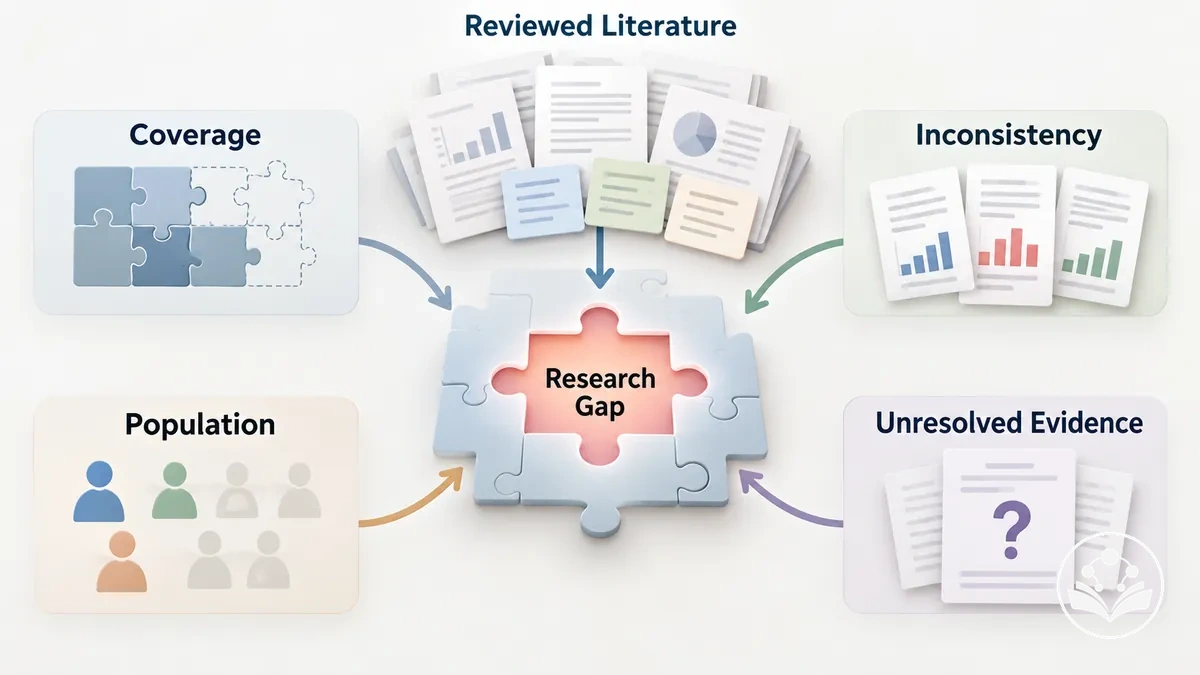
A research gap is an important unresolved absence, insufficiency, inconsistency, or unanswered issue supported by the body of reviewed literature.
It represents a literature-level problem when the state of the evidence limits what can reasonably be concluded, rather than simply indicating that one study or topic is missing.
The relevant attributes may include coverage, consistency, precision, population, setting, method, or theory.
A weakness in one of these attributes qualifies as a potential research gap only when its state creates a meaningful insufficiency in the evidence base or leaves a relevant conclusion unresolved.
For example, limited population coverage may matter when the available evidence cannot support a conclusion about the population relevant to the review, whereas a narrow sample in one study does not by itself establish a research gap.
The distinction is therefore between missing information and an evidence-supported unresolved question: finding no study on a narrowly defined combination of variables is merely an absence unless the reviewed literature shows that the missing evidence matters to a relevant conclusion.
Literature-level support is required before an absence or inconsistency can be treated as a research gap.
Distinguishing Research Gaps From Study Limitations
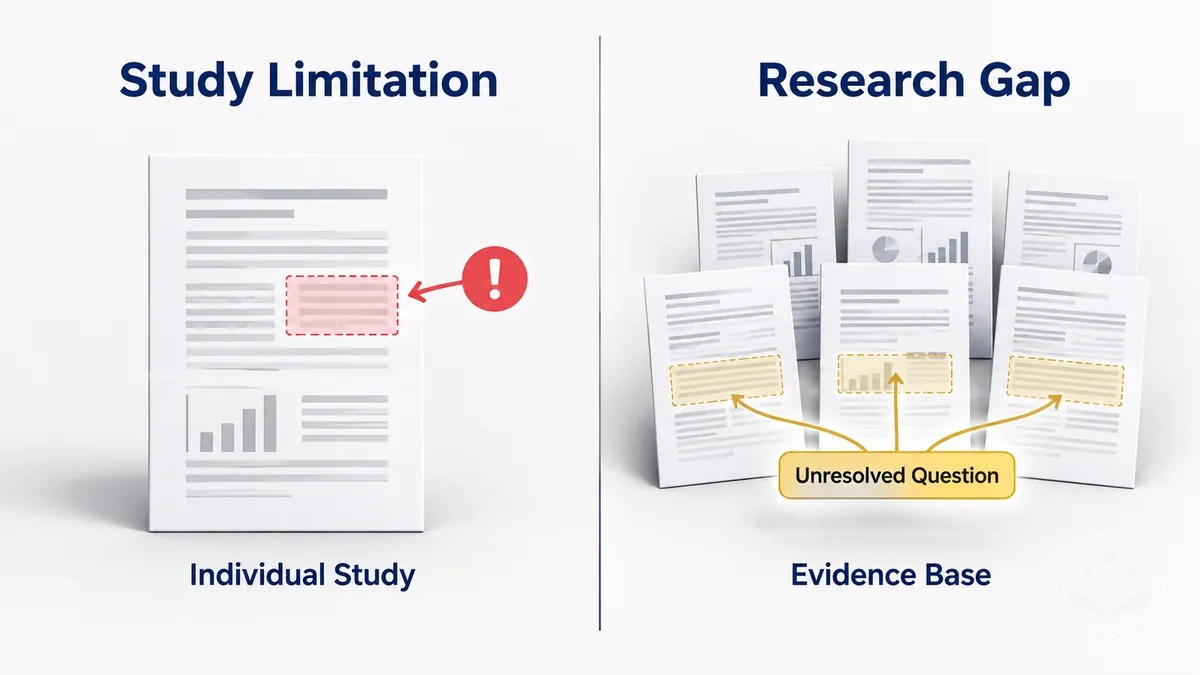
A study limitation constrains an individual study, whereas a research gap concerns an unresolved question in the wider evidence base.
Both can have implications for further research, but they differ in their unit of analysis and in the evidence required to support the claim.
The comparison separates a study-level constraint from a literature-level gap by showing the different unit of analysis, evidence burden, and implication for further research.
Comparison basis
Study limitation
Research gap
Unit of analysis
An individual study and the constraints affecting its design, findings, interpretation, or applicability.
The wider evidence base and an important question that remains unresolved across relevant literature.
Evidence required
Evidence that a constraint applies to the individual study and may affect its findings or conclusions.
Evidence across the reviewed literature showing that an important insufficiency, inconsistency, or unresolved question persists.
Implication for further research
May justify improving or testing a particular design, sample, method, or setting in subsequent research.
Supports further research directed at resolving the literature-level insufficiency or unanswered question.
A recurring constraint may contribute to a research gap when the wider literature shows that the same limitation repeatedly restricts what can be concluded or leaves an important question unresolved.
For example, one study using a narrowly defined population has a study limitation; if comparable studies repeatedly exclude the population needed to answer a relevant question, that repeated pattern may support a literature-level gap.
A single study limitation is therefore not sufficient evidence of a research gap.
Use Synthesized Evidence to Find Gap Signals
Synthesized evidence makes gap signals visible by allowing you to compare studies across findings, populations, settings, methods, theoretical lenses, and the certainty of their conclusions.
Isolated source summaries can show individual shortcomings, but synthesis can reveal whether an absence, inconsistency, weak coverage pattern, or unresolved relationship recurs across comparable evidence and matters to the review question.
The method moves from aligned evidence to candidate gap signals and then to verification:
Align comparable studies. Group evidence that addresses sufficiently similar questions or relationships, then align relevant findings, populations, settings, methods, theoretical lenses, and conclusion certainty.
Compare patterns and differences. Examine where comparable evidence converges or diverges and where relevant coverage is absent or insufficient; recurrence alone does not make a pattern significant to the review question.
Identify candidate gap signals. Mark recurring absences, inconsistencies, weak coverage, or unresolved relationships as candidate signals when they could materially limit what the synthesized evidence can establish.
Verify unresolved status. Test each candidate against the wider evidence base for relevance, comparability, and evidence quality before treating it as a defensible research gap.
For example, several study-level observations about an underrepresented population become a candidate gap only when cross-study comparison shows that the missing coverage leaves a relevant question unresolved; disconnected shortcomings do not establish the same implication.
This is why it is necessary to distinguish synthesis from summary: the defensible gap comes from an interpreted and verified cross-study pattern, not from counting how often a limitation appears.
Look for Missing or Insufficient Evidence
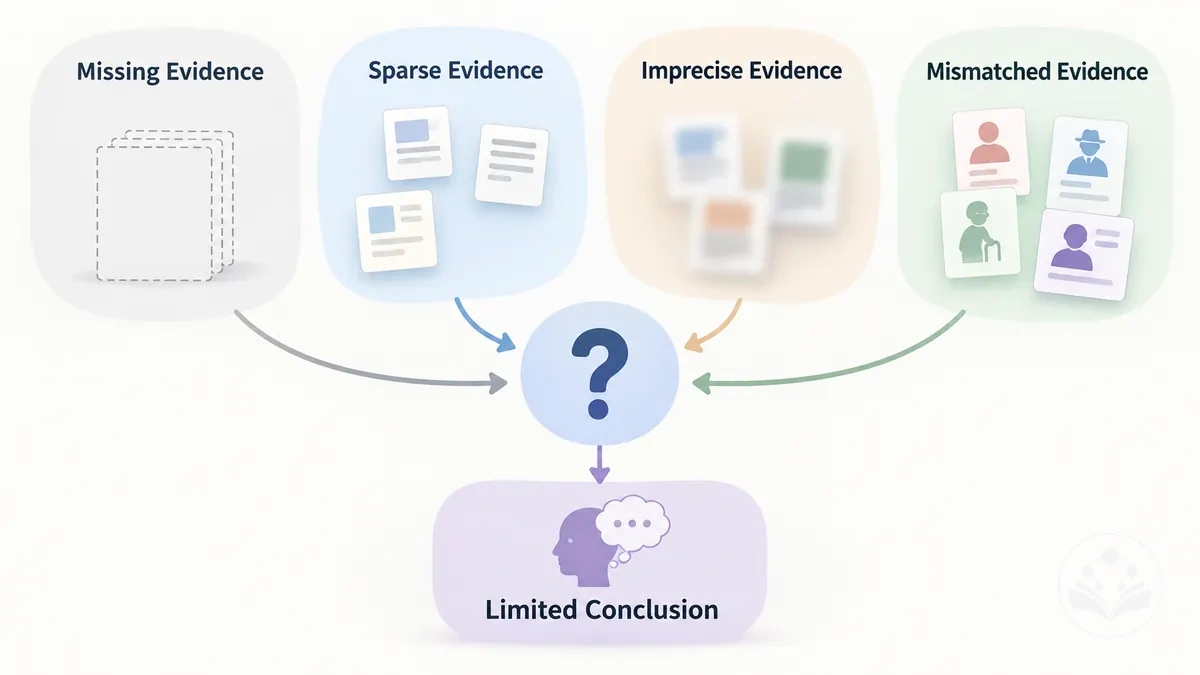
Missing or insufficient evidence is a candidate gap signal only when the evidence state prevents a reliable conclusion about a defined question.
Different forms of insufficiency can limit conclusions in different ways, including absent evidence, inadequate coverage, imprecise evidence, or evidence that does not address the required population, exposure, outcome, or context.
No relevant evidence: the reviewed literature lacks evidence that directly addresses the defined question, so a conclusion about that question cannot be supported from the available evidence.
Too little relevant evidence: the available evidence is insufficient for a reliable conclusion when its quantity, study quality, relevance, or consistency does not adequately resolve the question.
Imprecise evidence: relevant evidence exists, but uncertainty or lack of precision leaves the direction, magnitude, or applicability of the conclusion insufficiently resolved.
Mismatched evidence: the evidence addresses a different population, exposure, outcome, or context from the one required by the review question, so it does not directly support the needed conclusion.
These evidence states are candidate gap signals rather than automatic proof of a research gap because their significance depends on the conclusion the review needs to support.
A small body of highly relevant, consistent, high-quality evidence may be more informative for a defined question than a larger body of indirect or inconsistent evidence.
There is no universal minimum study count that by itself defines a research gap; evidence quantity must be interpreted together with study quality, relevance, consistency, and whether the review question remains unresolved.
Trace Contradictory or Unresolved Findings
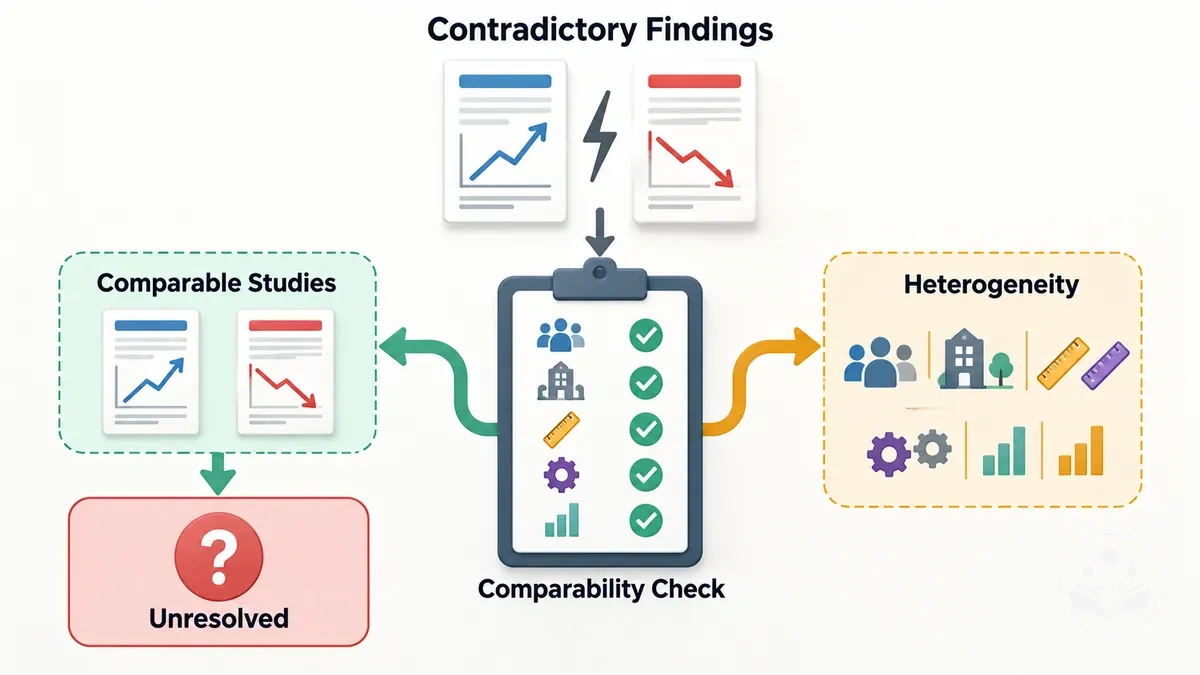
Contradictory findings can indicate a research-gap signal only when sufficiently comparable studies remain materially inconsistent after plausible differences between them have been examined.
Observed disagreement should therefore be interpreted through study comparability rather than treated as an unresolved contradiction by default.
Observed disagreement
Comparability check
Interpretation
Comparable studies support materially different conclusions.
Population, setting, measurement, design, and analytic choices are sufficiently similar or do not provide a plausible explanation for the difference.
The inconsistent evidence remains unresolved and may signal a research gap requiring further investigation.
Studies report different findings under meaningfully different conditions.
Differences in population, setting, measurement, design, or analytic choices provide a plausible basis for the observed variation.
The disagreement may reflect explainable heterogeneity rather than an unresolved contradiction.
Comparability checks should establish whether the studies address sufficiently similar questions and whether contextual or methodological differences can reasonably explain their conflicting findings.
For example, different results from studies using different populations or measurement approaches may reflect heterogeneity, whereas materially inconsistent conclusions among otherwise comparable studies can remain unresolved when those differences do not explain the disagreement.
The gap signal is therefore conditional on the contradiction remaining unresolved after population, setting, measurement, design, and analytic choices have been considered.
Check for Understudied Populations, Settings, or Contexts
An underrepresented population, setting, or context becomes a research-gap signal only when the missing coverage materially limits interpretation, applicability, understanding of a relevant mechanism, or a decision supported by the review.
Underrepresentation alone is not enough; the omitted dimension must have a plausible evidentiary consequence for what can reasonably be concluded.
Representation: identify the population, setting, or context that is underrepresented in the reviewed evidence rather than treating any unstudied subgroup or location as a gap.
Relevance: determine whether the missing dimension is relevant to the review question and to the conclusion, mechanism, or decision being evaluated.
Plausible effect on findings: assess whether differences in the population, setting, or context could plausibly affect the findings or their interpretation; without a relevant reason, the omission alone does not establish a meaningful gap signal.
Evidentiary consequence: specify what the missing evidence constrains, such as confidence in a conclusion, applicability to the omitted setting, generalizability to the relevant population, or interpretation of a mechanism.
A meaningful diagnosis connects representation and relevance to a specific evidentiary consequence rather than merely counting omitted demographic groups, locations, institutions, or environments.
The underrepresentation matters when it prevents a confident conclusion or transferability claim that is relevant to the review question.
Without that consequence, an understudied population, setting, or context should not be treated as a research gap simply because coverage is limited.
Use Study Limitations and Future-Research Recommendations as Leads
Study limitations and future-research recommendations are useful leads for identifying a candidate gap, but they are not proof that the gap exists.
An author's recommendation requires independent verification because the broader literature may not show the same problem, or subsequent research may already have addressed it.
Use a two-stage check to move from a source-level lead to an evidence-supported interpretation.
The method tests recurrence and relevance across the broader literature before assigning a status to the proposed gap.
Extract recurring leads. Record limitations and future-research recommendations that recur across relevant studies, noting the specific unresolved issue each statement proposes rather than copying the authors' wording as a conclusion.
Verify the candidate gap. Compare the proposed issue with the broader literature for recurrence and relevance, then check later evidence to determine whether subsequent studies have addressed, partly resolved, or left the issue unresolved.
When you search the literature, verify whether later evidence has already addressed the proposed gap and whether the remaining issue is still relevant to the review question.
Confirmed
The unresolved issue persists after comparison with the broader and later literature.
Narrowed
Later evidence resolves part of the issue, so the remaining gap must be stated more narrowly.
Rejected
Broader or later evidence shows that the proposed issue no longer remains unresolved.
Determine What Type of Research Gap the Evidence Supports
A research-gap type should be classified from the unresolved evidence pattern rather than chosen in advance.
The classification should reflect what remains incomplete, restricted, inconsistent, or insufficiently supported in the evidence base.
Different evidence states can correspond to different gap types, and the labels may overlap across disciplines.
Use the unresolved attribute as the basis for classification:
Knowledge: missing or incomplete understanding supports a knowledge-oriented classification when the evidence does not adequately answer the relevant question.
Inconsistent evidence: materially conflicting findings may support a classification centred on unresolved evidence when sufficiently comparable studies do not support the same conclusion.
Methodological: recurring restrictions in research design, measurement, sampling, or analysis may support a methodological classification when those restrictions limit what can be established.
Empirical: limited direct testing or observation may support an empirical classification when a proposition, relationship, or condition remains insufficiently examined in practice.
Theoretical: incomplete explanatory relationships, constructs, or mechanisms may support a theoretical classification when the current framework does not adequately account for the evidence pattern.
Population: limited coverage of a relevant population may support a population classification when the omission constrains applicability or generalizability.
Contextual: limited evidence from a relevant setting, environment, institution, or context may support a contextual classification when that missing coverage restricts interpretation or transferability.
These classification dimensions are not fixed or exhaustive, and one supported gap may fit more than one category when unresolved attributes overlap.
The most useful gap type is the label that most precisely reflects the evidence pattern and the conclusion the reviewed literature cannot yet support.
Differentiate Evidence Gaps From Knowledge Gaps
A knowledge gap concerns missing understanding or an unanswered question, whereas an evidence gap concerns inadequate, inconsistent, or insufficiently decision-supporting evidence for a conclusion.
The practical distinction is therefore based on what is missing and what conclusion remains unavailable, although terminology and classification may overlap across disciplines.
Comparison basis
Knowledge gap
Evidence gap
What is absent
Missing understanding, explanation, or a sufficiently resolved answer about the subject.
Adequate, consistent, relevant, or sufficiently robust evidence needed to support a conclusion.
What the literature looks like
The literature may contain evidence, but an important relationship, mechanism, concept, or answer remains insufficiently understood.
The literature may address the question, but the available evidence is sparse, inconsistent, indirect, imprecise, or otherwise inadequate for the required conclusion.
What remains unresolved
What is known or understood about the question remains incomplete.
Whether the available evidence has sufficient consistency and relevance to support the required conclusion remains unresolved.
The two labels are not perfect synonyms, but their boundaries are not fixed across all fields.
A question may involve both missing understanding and inadequate evidence, so classification should follow the actual evidence state and the terminology used in the relevant discipline rather than assume the categories are universally distinct.
Identify Methodological, Empirical, and Theoretical Gaps
Methodological, empirical, and theoretical gaps differ by where the unresolved evidence problem lies.
A methodological gap reflects a consequential constraint in research design or approach, an empirical gap reflects insufficient observation or testing, and a theoretical gap reflects a relationship or mechanism that existing theory does not adequately explain.
Gap category
Defining signal
Evidence pattern
Implication
Methodological gap
A research design, method, measurement approach, or analytic constraint restricts what can be learned.
Relevant studies use approaches whose recurring limitations leave an important question insufficiently resolved.
The constraint limits what can reasonably be concluded until an approach capable of addressing the unresolved issue is applied.
Empirical gap
A relevant proposition, relationship, condition, or outcome lacks sufficient direct observation or testing.
Empirical evidence is absent or insufficient to establish whether the relevant relationship or proposition has been tested adequately under the conditions in question.
The claim remains insufficiently observed or tested, limiting the conclusion that can be supported by the evidence.
Theoretical gap
Existing theory does not adequately explain a relevant relationship, mechanism, or observed pattern.
The evidence reveals an explanatory issue that available theoretical accounts leave unresolved.
The mechanism or relationship remains insufficiently explained, limiting the theoretical interpretation that can reasonably be supported.
Each label requires an evidence pattern with a consequential implication, not merely a design variation, missing dataset, or theoretical disagreement.
The classification is appropriate when the unresolved methodological, empirical, or theoretical state materially limits what can be learned, observed, tested, explained, or concluded.
Recognize Population and Contextual Gaps
A population gap concerns who is studied, whereas a contextual gap concerns the setting or conditions in which a phenomenon has been examined.
This distinction classifies an already-supported coverage gap; it does not by itself establish that missing group or setting coverage is consequential.
Gap category
Missing dimension
Evidence signal
Implication
Population gap
Coverage of a relevant participant group or population.
The evidence base reflects missing or limited coverage of who is studied.
The omission may limit transferability or applicability to the underrepresented population when that population is relevant to the review question.
Contextual gap
Coverage of a relevant setting, geography, institution, environment, or research condition.
The evidence base reflects missing or limited coverage of where or under what conditions the phenomenon has been studied.
The omission may limit interpretation or transferability to settings or conditions not adequately represented in the evidence.
The key classification question is whether the supported coverage gap concerns the people represented in the evidence or the context in which the evidence was generated.
Either label should be used only after the gap has already been supported; this subsection classifies the missing dimension rather than proving that a population gap or contextual gap exists.
Test Whether the Research Gap Is Supported by the Literature
Verify a candidate research gap before stating it as a research need by checking its relevance, recurring pattern, persistence in current literature, and unresolved status.
The claim should also remain defensible after plausible alternative explanations and later evidence are considered.
The checklist tests the conditions that affect confidence in a supported gap rather than treating a small study count as sufficient evidence.
Each criterion evaluates whether the observed pattern is relevant, persistent, and proportionate to the claim being made.
Current and relevant coverage: Verify that the literature considered is sufficiently current for the topic and relevant to the review question; there is no universal recency cutoff that applies across research fields.
Recurring pattern: Check whether the candidate gap is visible across appropriate evidence rather than depending on one source or one author's recommendation.
Importance to the review question: Establish that the unresolved issue materially limits an answer, interpretation, or conclusion relevant to the review.
Alternative explanation: Consider whether differences in methods, populations, settings, definitions, or other study conditions plausibly explain the apparent gap instead of indicating a persistent unresolved issue.
Later evidence: Verify that newer relevant evidence has not already addressed or substantially narrowed the candidate gap.
Proportional claim: Match the gap claim to the evidence strength and consistency. For example, finding few studies is weaker support than showing that the limited evidence is relevant yet insufficient and leaves a consequential question unresolved.
Support status after verification
Well-supported gap
Relevant evidence consistently supports an important unresolved issue.
Plausible but weak
The candidate remains possible, but the evidence is limited, mixed, or not yet strong enough for a firm claim.
Unsupported
The apparent pattern does not persist when the literature is verified or alternative explanations are considered.
Mixed evidence should therefore produce a qualified support status rather than a binary verdict.
Frame the Supported Research Gap Precisely
A precise evidence-supported research-gap statement should name the evidence baseline, the unresolved issue, the relevant scope, and the implication of that unresolved state.
Keeping these elements explicit helps make the gap statement proportional to the reviewed literature rather than implying that the entire field is unexplored.
Frame the statement in sequence so that the claim remains tied to the verified evidence pattern.
Begin by establishing what the literature already supports, then state the unresolved issue that remains after synthesis and verification.
Establish the evidence baseline. State the relevant findings, relationships, or conclusions that the reviewed literature already supports so the gap begins from known evidence rather than from a generic claim of absence.
State the unresolved issue. Specify the missing, inconsistent, insufficiently tested, or inadequately explained element that remains after synthesis and verification.
Bound the scope. Limit the claim by the population, setting, method, condition, or other relevant boundary when the evidence does not support a field-wide statement.
State the implication. Connect the unresolved issue to the knowledge or evidence limitation it creates, such as a conclusion that cannot yet be supported confidently within the defined scope.
The scope and implication keep the final gap statement aligned with the strength of the evidence.
A claim about one population, setting, method, or condition should remain bounded to that context unless the reviewed literature supports a broader conclusion.
Avoid an unbounded absence claim
“There is little research on this topic” does not identify what is known, what remains unresolved, or why the absence matters.
Prefer an evidence-bounded claim
State that existing evidence supports a defined finding within a specified scope, but a particular relationship, mechanism, or conclusion remains unresolved under the relevant population, setting, method, or condition, limiting what can currently be concluded.
Once the evidence-supported gap statement is established, the next task is to develop the discussion and conclusion without expanding the gap beyond what the reviewed evidence supports.
Examples of Research Gaps Derived From Reviewed Literature
Evidence-derived research-gap examples should move from an observed evidence pattern to an interpretation, a supported gap classification, and a proportionate gap statement.
The examples below are illustrative scenarios rather than universal templates; the reviewed evidence determines the scope and certainty of each final claim.
Insufficient evidence + contradictory findings
Suppose a review finds that relevant evidence addresses the question but remains insufficient for a reliable conclusion, while otherwise comparable studies also report contradictory findings that cannot be adequately explained by differences in population, setting, measurement, or method.
This evidence pattern indicates that the conclusion remains unresolved and can support a gap centred on insufficient or inconsistent evidence.
An overclaimed gap statement such as “This area is unexplored” would exceed the scenario; a proportionate gap statement can instead state that available evidence is insufficient and inconsistent for resolving the specified question under the reviewed conditions.
Methodological constraint + theoretical gap
Consider reviewed studies in which a recurring methodological constraint restricts what can be established about an important relationship, while the available theoretical account does not adequately explain the pattern that has been observed.
The methodological evidence supports a gap claim only to the extent that the recurring constraint leaves the relevant conclusion unresolved, while the explanatory incompleteness can be classified as a theoretical gap when the existing theory does not adequately account for the relationship or mechanism.
The resulting gap statement should preserve these boundaries rather than imply that all methods are inadequate or that the subject lacks theory altogether.
Population or context coverage
Suppose the reviewed literature provides evidence for a relationship in one population or context but offers inadequate coverage of another population or setting that is relevant to the review question.
The evidence pattern can support a population or context gap when that missing coverage limits transferability, applicability, or interpretation for the underrepresented group or setting.
The gap statement should therefore identify the missing coverage and its consequence within that scope, demonstrating that evidence-to-claim reasoning—not a reusable wording formula—determines how strongly and broadly the supported gap can be stated.