Formulating a Clear and Answerable Review Question for a Review Article
A clear, answerable review question names the subject, states the relationship or outcome to be examined, and adds only the scope boundaries that change which evidence is relevant. Choose a framework that matches the question form—such as PICO for intervention or effect questions—then verify clarity, feasibility, scope, search concepts, and study-selection boundaries before planning the literature search.
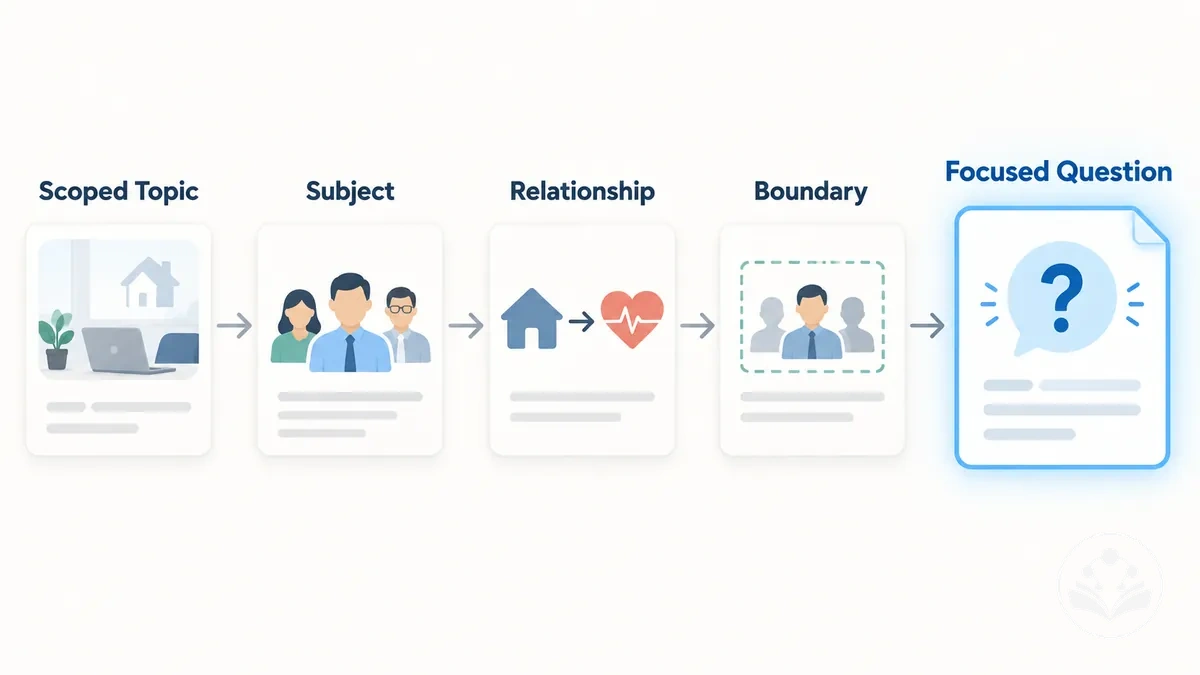
Build and verify a focused review question
Use four passes. Each pass closes a different part of the question without adding detail that does not change the intended answer.
1
Fix the subjectIdentify the population, problem, phenomenon, or concept that determines which evidence belongs in the inquiry.
2
State the relationshipSpecify the effect, association, experience, context, or other relationship the review is intended to examine.
3
Add only necessary boundariesLimit population, setting, timeframe, comparison, or outcome only when the boundary changes the relevant evidence or intended answer.
4
Fit and verifyUse a framework whose components match the question form, then check clarity, answerability, feasibility, search concepts, and study-selection boundaries.
Framework cue: intervention or effect questions often fit PICO; mapping or context questions may fit PCC; exposure or association questions may fit PEO; experience-focused questions may fit SPIDER; and service or evaluation questions may fit SPICE or ECLIPSE when their components match the inquiry.
The sections below show how to apply those decisions, select a fitting framework, adjust an over-broad or over-restrictive scope, and confirm that the final question is ready to guide searching and study selection.
Table of Contents⌄
Criteria for a Clear and Answerable Review Question
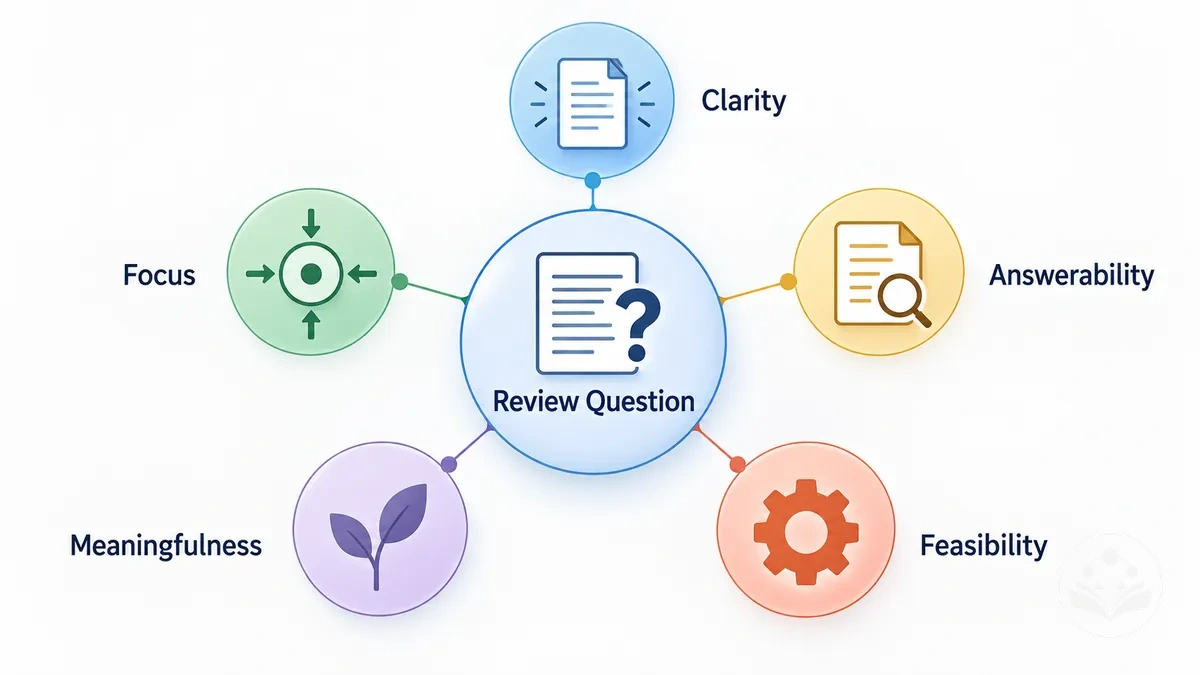
A review question is usable for planning when its clarity, focus, answerability, meaningfulness, and feasibility can each be evaluated against the intended review purpose.
These review question criteria test distinct properties rather than applying one universal test of quality.
Clarity, specificity, focus, and answerability primarily concern how the question is expressed and bounded, while meaningfulness and feasibility address whether the question is worthwhile and workable.
The relative importance of these criteria can vary with the review purpose and methodological context, so they guide practical planning rather than act as rigid thresholds.
The diagram groups the criteria around a draft review question to show them as parallel considerations, while the list states the acceptable condition and planning implication for each criterion.
Clarity and specificity: The review question uses defined concepts and makes the intended inquiry understandable, reducing ambiguity when the question is interpreted for later planning decisions.
Focus: The review question has a scope and boundaries that keep the inquiry centred on the intended review purpose, helping prevent unrelated evidence from broadening the task.
Answerability: The review question asks something that can reasonably be addressed with relevant evidence within its stated scope, allowing the review to work toward a meaningful answer rather than remain at the level of a topic.
Meaningfulness: The review question addresses an issue whose answer is relevant to the stated review purpose, giving the planned review a clear reason for addressing that inquiry.
Feasibility: The review question is workable under the review's actual methodological and practical conditions, so its scope does not require evidence or review activity that those conditions cannot reasonably support.
These basic question-quality criteria establish whether the review question is usable for planning; the narrower FINER appraisal can examine viability and value in more detail.
Keep the Question Specific, Focused, and Meaningful
A focused review question names the subject and relationship precisely enough to constrain interpretation without adding irrelevant detail.
Useful specificity defines what or who is being examined and what relationship or phenomenon the review will address.
Focus sets the scope closely enough to establish a meaningful evidence boundary.
Precision therefore comes from information that changes interpretation, not from merely lengthening the question or making its wording more technical.
A focused question must also be meaningful for its review purpose: answering it should resolve the inquiry the review is intended to address.
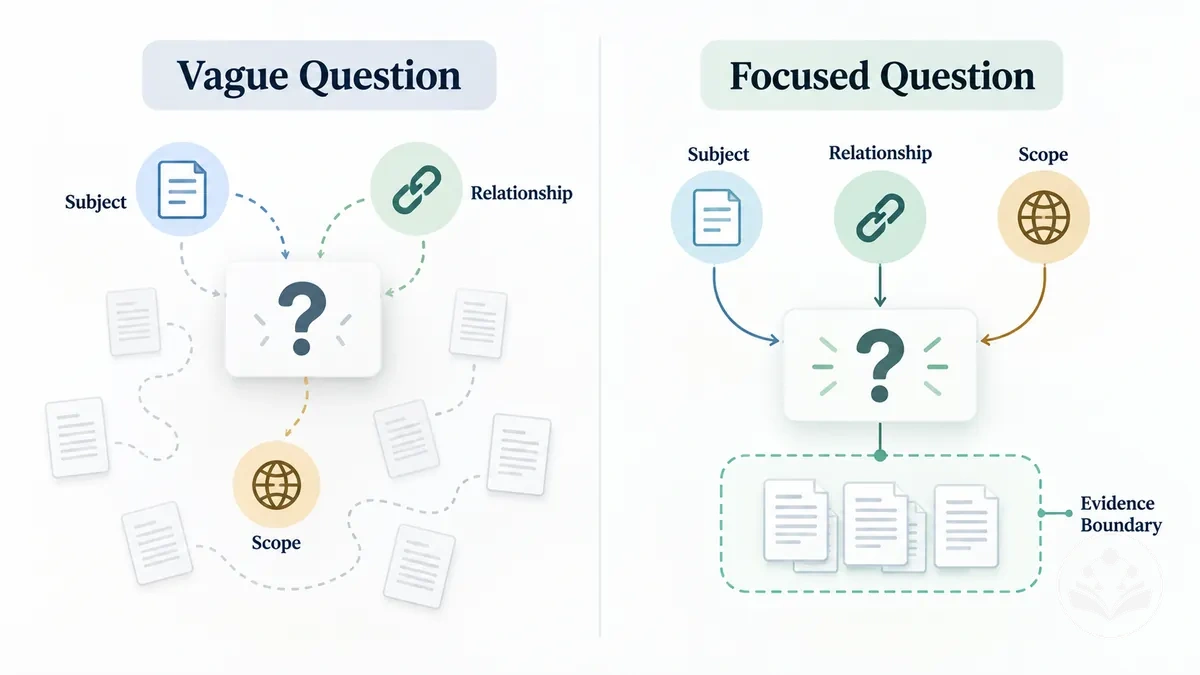
A vague topic-like formulation can leave the subject, relationship, or scope open to several interpretations, whereas a focused question makes those elements explicit without requiring unnecessary detail.
The comparison graphic contrasts these states by highlighting the subject, relationship, and scope cues that make the intended evidence boundary clearer.
These checks reveal whether the wording constrains the intended inquiry through useful precision rather than unnecessary detail.
Subject or population: The subject, population, or main concept is identifiable when that distinction affects which evidence belongs within the question.
Relationship or phenomenon: The question defines the relationship, outcome, experience, or phenomenon clearly enough to distinguish the intended inquiry from the broader topic.
Scope: The question includes boundaries that materially change interpretation or the evidence boundary, while leaving out detail that does not alter what the review is asking.
Meaningful answer: The question seeks an answer relevant to the review purpose, so resolving the inquiry would address the reason for conducting the review.
Use FINER to Test Feasibility and Relevance
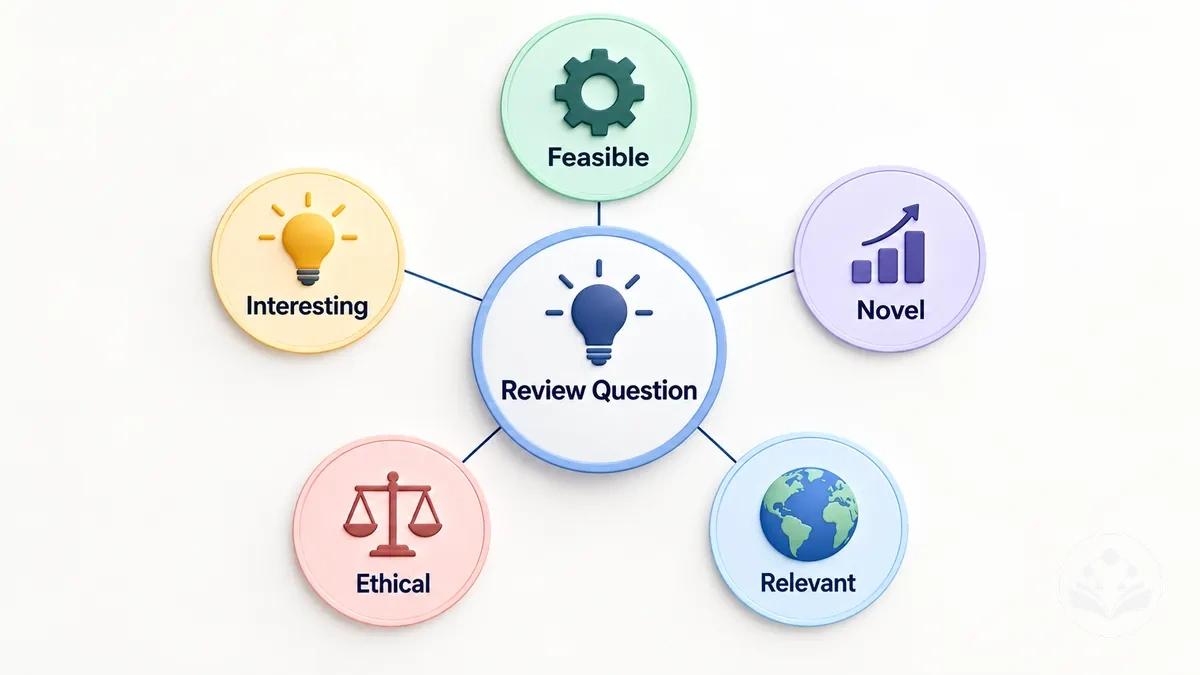
FINER is an appraisal framework for evaluating a review question as Feasible, Interesting, Novel, Ethical, and Relevant.
The FINER criteria help assess whether a proposed question is viable and worthwhile within the review context.
FINER appraises the viability and value of the review question rather than supplying its structural components.
A question-structure framework such as PICO serves a different function, so FINER should not be treated as its substitute or as a universally mandatory checklist.
The diagram connects the five FINER dimensions to the same review question, showing them as appraisal checks rather than scores or thresholds.
The five FINER dimensions test different conditions that can support retaining a review question or indicate where revision is needed.
Feasible: Assess whether the question can reasonably be addressed with the available resources, methods, time, and evidence; revise its scope when these conditions cannot support the proposed review.
Interesting: Assess whether the question addresses an issue that matters to the intended scholarly or practical purpose; reconsider the question when answering it would add little value to that purpose.
Novel: Assess whether the question has the potential to contribute a useful synthesis, perspective, clarification, or update in relation to existing knowledge; revise the question or clarify its contribution when that contribution is already adequately addressed.
Ethical: Assess whether the question and proposed review activity are appropriate within the relevant review context; revise the question or planned approach when an ethical concern makes the proposed inquiry inappropriate.
Relevant: Assess whether answering the question would address the stated review purpose and intended knowledge need; revise or reject the question when its answer would not serve that purpose.
For example, a clearly worded review question may still require revision if the evidence needed to address it is not reasonably available, or if answering it would not meaningfully serve the stated review purpose.
Turn a Scoped Review Topic Into One Focused Question
A scoped topic becomes a focused question by fixing the subject, specifying the relationship or outcome, adding only the boundaries needed for the review purpose, and expressing the result as one answerable question.
The starting point must already be scoped; if it is still broad, first narrow the review topic before beginning question formulation.
Each refinement should reduce ambiguity while keeping the original review purpose intact.
Consider the scoped topic of remote work and employee wellbeing among office workers.
The sequence below tracks the same topic as its main concept, relationship, context, and necessary boundaries become explicit, while the image shows the progression from the starting topic to the final question.
Identify the subject: Start with the main concept or population the question will examine. In the running example, make office workers the explicit subject rather than leaving the topic as the broader idea of remote work and wellbeing.
Specify the relationship or outcome: State what will be examined about the subject. For this example, specify the relationship between remote work and employee wellbeing, so the question is directed toward an outcome rather than simply naming two concepts.
Add only necessary boundaries: Limit the scope with context or other boundaries only when they change the intended inquiry. For example, retaining the office-worker context distinguishes the target population, while further detail is unnecessary unless the review purpose requires it.
Write and check one focused question: Combine the subject, relationship or outcome, and necessary boundaries into a single question, then check that each term contributes to the intended inquiry. The resulting focused question is: How is remote work related to employee wellbeing among office workers?
Identify the Main Population, Problem, or Concept
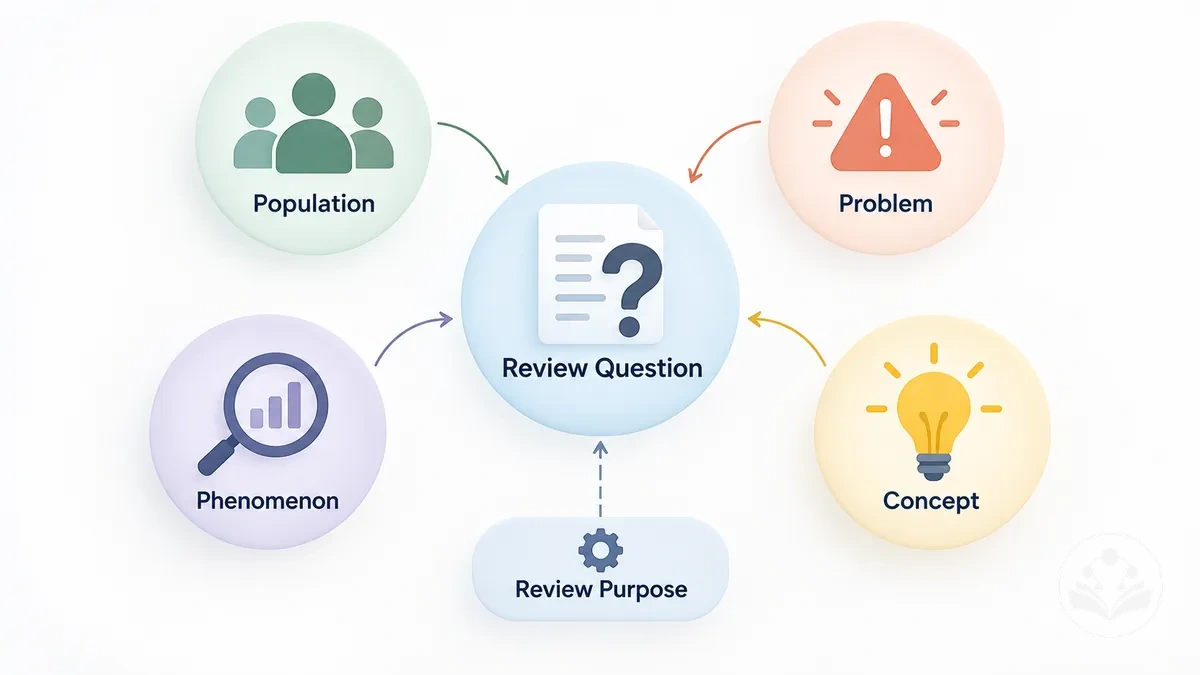
Identify the primary population, problem, phenomenon, or concept that the review question is actually about.
This focal subject defines the main entity the question will examine and helps establish its evidence boundary.
Add specificity only when a characteristic or context changes which evidence is relevant to the review purpose.
The appropriate subject type depends on the review purpose: some questions centre on a population, while others are better defined by a problem, phenomenon, or concept.
The image distinguishes these possible focal subjects without treating any one form as mandatory, and the subject should be specified only as far as the added detail changes the intended question boundary.
Population: Use a population as the focal subject when characteristics of the people or groups being examined determine which evidence belongs within the question.
Problem: Use a problem as the focal subject when the review is centred on a defined issue or condition and population detail is not the primary boundary.
Phenomenon: Use a phenomenon when an experience, event, process, or observable situation is the principal subject of the review.
Concept: Use a concept when the review examines an idea, construct, policy, exposure, or other non-population entity whose definition sets the relevant scope.
Specify the Outcome, Context, or Relationship That Matters
A review question should specify what is being examined about its focal subject: an outcome, context, experience, association, effect, or another relevant relationship.
This relationship acts as the question's predicate and defines the information the review is intended to produce.
Use an effect-oriented predicate only when the review purpose genuinely concerns an effect; use association, experience, or context wording when that more accurately represents the intended inquiry.
Choose the predicate that matches the intended answer
Outcome or effect
Use effect-oriented wording when the review genuinely asks what changes or differs under the relevant conditions.
Association
Ask how entities or conditions relate when the inquiry concerns a relationship; association wording does not imply causation.
Experience
Use experience wording when the review asks how a phenomenon is experienced, perceived, or interpreted by the relevant population.
Context
Specify context when circumstances such as setting or conditions materially shape which answer is relevant.
Retain only a relationship that materially changes what the review question asks and the answer it is intended to produce.
Write the Scope as a Single Answerable Question
Combine the selected subject, relationship, and only the boundaries needed for the review purpose into one grammatically complete, answerable review question.
The wording should make the scope explicit without adding detail that does not change the intended answer.
Express the inquiry as a single question rather than joining several loosely related tasks.
Framework labels belong in the wording only when they improve meaning.
Check whether the final question asks for one primary informational task.
If the wording contains several independent clauses, outcomes, or comparisons that could each be answered separately, revise it so the subject, relationship, and necessary boundaries point toward one coherent answer.
Choose a Question Framework That Fits the Review Purpose
A question framework is a structuring aid that organizes the components needed to express a review question clearly.
It supports the wording of the question without determining the entire review method.
Choose the framework according to the relationship the review question needs to express. A suitable framework should preserve that relationship, support clear wording and later search concepts, and avoid adding components that change the inquiry.
Match the framework to the question form
Intervention or effectiveness
Use components that distinguish the intervention or exposure, a comparison when the question requires one, and the outcome being examined.
Experience or phenomenon
Represent the experience or phenomenon together with the population or context needed to interpret it, rather than forcing an intervention-effect structure.
Exposure or association
Represent the exposure or condition and the relationship being investigated while keeping association distinct from causation.
Context or mapping
Preserve the concepts and contextual boundaries needed to describe or map evidence without requiring an outcome the review purpose does not call for.
Decision rule: framework fit follows the information relation being examined, not framework popularity or a universal ranking.
PICO for Questions With Intervention and Outcome Elements
The PICO framework organizes an intervention question into four components: Population or Problem, Intervention, Comparison, and Outcome.
These PICO components separate the subject being examined from the intervention, relevant alternative, and outcome that the review question seeks to address.
This structure helps frame a focused question when those relations match the review purpose.
PICO fits most directly when a review question can be expressed through intervention, comparison, and outcome relations.
The comparison component can be explicit when an alternative matters to the question, or absent or implicit when the review purpose does not require a separate comparator.
PICO should not be forced onto qualitative, exploratory, or broad mapping questions whose central relations require different components.
Population or Problem: Identifies the subject, group, or problem being examined and sets the relevant scope for the intervention question.
Intervention: Identifies the treatment, action, exposure, or other intervention of interest and specifies what is being examined in relation to the subject.
Comparison: Identifies the relevant alternative, such as another intervention or condition, when a comparison is part of the question; it may remain absent or implicit when no separate comparator is needed.
Outcome: Identifies the effect or measure the review question seeks to examine, defining what answer about the intervention is relevant.
Example: Among adults with chronic insomnia (Population/Problem), does cognitive behavioural therapy for insomnia (Intervention), compared with usual care (Comparison), improve sleep quality (Outcome)?
Frameworks for Questions That Do Not Fit PICO
Questions centred on context, experience, exposure, service evaluation, or evidence mapping may need component patterns that differ from PICO.
Alternative review-question frameworks organize these different relations without forcing them into an intervention-comparison-outcome pattern.
Framework fit should therefore follow the question form and the relationship the review needs to examine.
The framework name is less important than whether its components preserve the intended relationship and review purpose.
Representative alternatives include PCC, PEO, SPIDER, SPICE, and ECLIPSE, which organize different combinations of population, concept, context, exposure, experience, setting, perspective, or evaluation.
Choosing a framework can structure the review question, but it does not by itself determine the entire review method.
PCC: Population, Concept, and Context can frame questions in which a concept and its context are central, including questions intended to map or describe evidence rather than test an intervention effect.
PEO: Population, Exposure, and Outcome can organize a question form concerned with an exposure or condition and the outcome associated with it in a defined population.
SPIDER: Sample, Phenomenon of Interest, Design, Evaluation, and Research type can frame qualitative or mixed-methods questions focused on experiences, views, or phenomena within a defined sample.
SPICE: Setting, Perspective, Intervention, Comparison, and Evaluation can organize questions in which setting and perspective are important to evaluating an intervention, service, or practice.
ECLIPSE: Expectation, Client group, Location, Impact, Professionals, and Service can support questions in which a service context, the people involved, and the expected impact are central to the inquiry.
For example, the question How do dialysis patients experience treatment fatigue? becomes awkward if intervention and comparison components are imposed when the intended relation is experience rather than intervention effectiveness.
A framework whose components foreground population, experience, or context can represent that question relation more directly without changing what the review is intended to ask.
Refine Questions That Are Too Broad or Too Narrow
Review-question scope is too broad when the draft remains too open to be manageable for its intended review purpose, and too narrow when its restrictions make a meaningful answer unlikely.
A focused question balances breadth with the evidence coverage needed to address that purpose.
The appropriate scope therefore depends on the question form and intended inquiry rather than a fixed number of concepts, studies, or search results.
Refinement direction
If the question is too broad
Signal
A material population, outcome, setting, timeframe, or relationship remains too open to define which evidence belongs.
Action
Narrow the one dimension that most changes relevance rather than adding restrictions everywhere.
Example
How is remote work related to employee wellbeing? remains broad when the intended review is specifically about office workers; the population is the adjustable boundary.
If the question is too narrow
Signal
Restrictions exclude evidence that the review purpose still needs, even though those restrictions do not materially change the intended answer.
Action
Remove or relax the unnecessary constraint while retaining the boundaries required for a coherent inquiry.
Example
How is fully remote work related to sleep quality among full-time office workers aged 30–35 in Sydney during their first six months of employment? may be over-restrictive when age, setting, and timeframe are not required by the review purpose.
Narrow Broad Questions by Limiting the Most Relevant Dimensions
Narrow a broad review question by restricting only the dimensions that materially define the intended answer.
The aim is to reduce ambiguity with the smallest number of justified restrictions while retaining the question's significance.
Population, outcome, setting, timeframe, or relationship should be constrained only when that dimension changes what evidence is relevant to the review purpose.
Each restriction should have a clear reason tied to the review purpose rather than simply making the wording more specific.
Apply one change at a time so its effect on focus remains visible, and retain dimensions that do not need further restriction.
The sequence below applies restrictions selectively rather than cumulatively by default.
Restrict the population: Start with How is remote work related to employee wellbeing? If the review purpose concerns office workers, specify that population: How is remote work related to employee wellbeing among office workers? This restriction removes populations outside the intended answer.
Specify the outcome: If the review purpose specifically concerns psychological wellbeing, refine the outcome to How is remote work related to psychological wellbeing among office workers? This restriction improves focus while retaining the same population and relationship.
Check whether another boundary is necessary: Add a setting or timeframe only if it materially defines the intended answer. If neither changes the review purpose, retain the broader boundary rather than narrowing those dimensions by default.
The focused resulting question is How is remote work related to psychological wellbeing among office workers?
Broaden Overly Restrictive Questions by Removing Unnecessary Constraints
Broaden an overly restrictive review question by removing an unnecessary constraint that does not materially serve the review purpose.
The goal is to relax the scope enough to improve answerability while preserving the boundaries needed for coherence.
A restriction should remain only when removing it would change the intended answer or make the question too ambiguous.
Test each existing restriction against the intended answer before removing it.
A population, setting, timeframe, comparison, or outcome limit may be unnecessary when it was inherited from an earlier draft rather than required by the review purpose.
Remove or relax that limit only if the remaining scope still identifies a coherent subject and relationship.
The options below distinguish constraints that may be removed from boundaries that still need to be retained.
Population restriction: Remove an age, occupation, or subgroup limit when that characteristic does not materially alter the intended question, while retaining the broader population boundary needed for coherence.
Setting restriction: Relax a location or institutional setting when the review purpose is not specific to that context, while preserving any setting boundary that changes interpretation.
Timeframe restriction: Remove a narrow observation or publication period when the intended answer does not depend on that period, while retaining a timeframe when temporal context is central to the question.
Comparison restriction: Remove a specific comparator when the question does not require a direct comparison, while keeping the principal relationship or intervention explicit.
Outcome restriction: Broaden an outcome only when the narrower measure excludes relevant forms of the intended construct, while retaining enough outcome definition to keep the question focused and answerable.
Verify the Question Before Planning the Literature Search
Verify the completed review question before literature-search planning by checking whether its concepts and boundaries are stable enough to guide the next stages.
Readiness means the question has sufficient clarity, answerability, and scope to identify what information belongs to the inquiry.
It should also support consistent decisions about search concepts and study-selection boundaries without requiring the question to be reformulated during each downstream task.
A failed check is a reason to revise the question, not automatic evidence that the review topic should be rejected.
Framework fit should be checked where a framework is relevant to the question form, while other checks apply directly to the question's wording, meaning, and boundaries.
The checklist moves from question quality to downstream readiness.
Clarity: Verify that the principal subject and relationship are unambiguous; if either can be interpreted in materially different ways, revise the wording.
Answerability: Check that the question asks for an answer that relevant evidence could reasonably address; if the intended answer remains undefined, revise the question.
Scope: Confirm that the boundaries preserve a meaningful inquiry without unnecessary breadth or restriction; if the scope obscures the intended answer, revise the relevant boundary.
Framework fit: Where a question framework is being used, verify that its components represent the actual question relation; if the framework introduces or omits a necessary relation, revise the framework choice or question structure.
Search concepts: Confirm that the question contains identifiable concepts that can later be translated into search terms; if the main concepts cannot be distinguished, revise the question before search planning.
Study-selection boundaries: Check that the question provides defensible boundaries for deciding which evidence is relevant to the inquiry; if those boundaries would support inconsistent interpretations, revise the question before defining detailed eligibility criteria.
When these readiness conditions are met, the verified question is ready to support the next planning stage: build the literature search.
Check Fit With the Intended Review Type
Check whether the review question's breadth, specificity, and relationship are compatible with the intended review purpose and review type.
A question can fit its methodological context when its wording expresses the level of focus and relation that the planned review needs to examine.
Wording alone, however, does not determine methodological validity or automatically assign a review type.
Different review purposes can justify different question breadth and structures.
A question intended to examine a tightly defined relationship may require greater specificity, whereas a broader evidence-mapping purpose may justify wider conceptual or contextual boundaries.
The key test is whether the existing question form supports the intended inquiry without introducing unnecessary precision or leaving the relationship too open to interpret consistently.
Question breadth: Check whether the scope is compatible with the intended review purpose; revise it if the question is materially broader or narrower than the inquiry the review type is meant to address.
Specificity: Confirm that the level of detail is sufficient for the intended methodological context without adding boundaries that the review purpose does not require.
Relationship structure: Verify that the question expresses the kind of relationship the review is intended to examine; revise it if the wording implies a different informational task.
Overall fit: Treat compatibility as one part of review planning rather than proof of methodological validity; a mismatch may require revising the question or reconsidering the intended approach.
Check That the Question Defines Search Concepts and Study-Selection Boundaries
The finalized review question should expose concepts precise enough to become search concepts and boundaries clear enough to support consistent study selection.
Population, concept, intervention, outcome, and context should be identifiable when they are relevant to the question type and review purpose.
These elements act as an upstream specification for later retrieval and study-selection decisions without guaranteeing complete retrieval or determining final eligibility automatically.
Ambiguity in a question element creates ambiguity in its downstream use.
An undefined population can leave both the retrieval concept and eligibility boundary open, while an unclear intervention, outcome, concept, or context can make it difficult to distinguish relevant evidence consistently.
The required level of definition depends on the question type and review purpose, but each material element should be clear enough to support the same interpretation when later used for searching or study selection.
The criteria below distinguish elements that need to be identifiable for retrieval from boundaries that need to constrain later eligibility decisions.
Population: Define the population when it determines relevance, so it can function as an identifiable search concept and a consistent study-selection boundary.
Concept or intervention: Identify the concept or intervention being examined precisely enough to distinguish relevant evidence from materially different concepts or interventions during later retrieval and selection.
Outcome: Specify the outcome when it is part of the intended question, so its meaning can guide retrieval and prevent inconsistent interpretation of outcome relevance during study selection.
Context: Define the context when setting, circumstances, or another contextual condition changes which evidence belongs within the question; otherwise, avoid creating an unnecessary eligibility boundary.
Study-selection boundaries: Confirm that the question establishes defensible limits for later eligibility decisions; if different readers could apply those limits in materially different ways, revise the ambiguous question element before you define study selection.
Examples of Vague and Focused Review Questions
A focused question makes the subject, relationship, and necessary scope boundaries explicit enough to be answerable.
The examples below revise only the dimensions needed to remove ambiguity or clarify what the review is intended to examine.
Vague → focused
Intervention question
VagueDoes exercise help older adults?
FocusedAmong adults aged 65 years and older, does regular aerobic exercise, compared with usual activity, improve physical functioning?
Why it is clearer: the population, intervention, comparison, and outcome are explicit; unrelated boundaries are not added.
Association question
VagueHow does remote work affect employees?
FocusedHow is remote work related to psychological wellbeing among office workers?
Why it is clearer: the population and relationship are defined, and association wording avoids implying an effect the question has not established.
Experience question
VagueWhat is it like to live with chronic pain?
FocusedHow do adults with chronic pain describe its effect on everyday social participation?
Why it is clearer: the population, experience-related relationship, and aspect of daily life are specified without forcing an intervention or comparison into the inquiry.
Mapping or context question
VagueWhat is known about telehealth?
FocusedWhat barriers and facilitators to telehealth use are reported in rural primary-care settings?
Why it is clearer: the relationship and setting create a clearer evidence boundary while preserving enough breadth for the mapping purpose.
Across these examples, focus comes from clarifying the subject, relationship, and only the scope boundaries needed for the intended inquiry—not from simply adding more detail.