
Review Article Types and How to Choose the Right Approach
Choose the review type by matching the research question to the synthesis task and evidence conditions. Use a narrative review for broad interpretation, a systematic review for a focused question requiring explicit reproducible methods, a scoping review to map a field, a rapid review when justified streamlining is needed, an umbrella review to synthesise existing reviews, and an integrative review to combine diverse evidence for conceptual understanding.

Review type decision guide
Start with the job the review must do. Then confirm that the evidence base, scope, time constraints, and transparency requirements support that method.
Decision rule: no review label is inherently “best”. The defensible choice is the method whose purpose and evidence handling match the question you need to answer.
The final choice should also account for intended scope, the available evidence base, and the required level of methodological rigor and transparency. Review labels vary across disciplines, so similar names do not always imply identical methods; method fit—purpose, scope, evidence handling, and synthesis logic—matters more than the label or a presumed hierarchy.
Table of Contents
Common Review Article Types
Common review article types are methodological categories distinguished by their purpose, fit with the research question, breadth of evidence, and structure of the methodology used for evidence synthesis.
The six common categories covered here are the narrative review, systematic review, scoping review, rapid review, umbrella review, and integrative review.
These categories perform different analytical jobs, so their defining methodological features provide the useful basis for distinguishing one review approach from another.
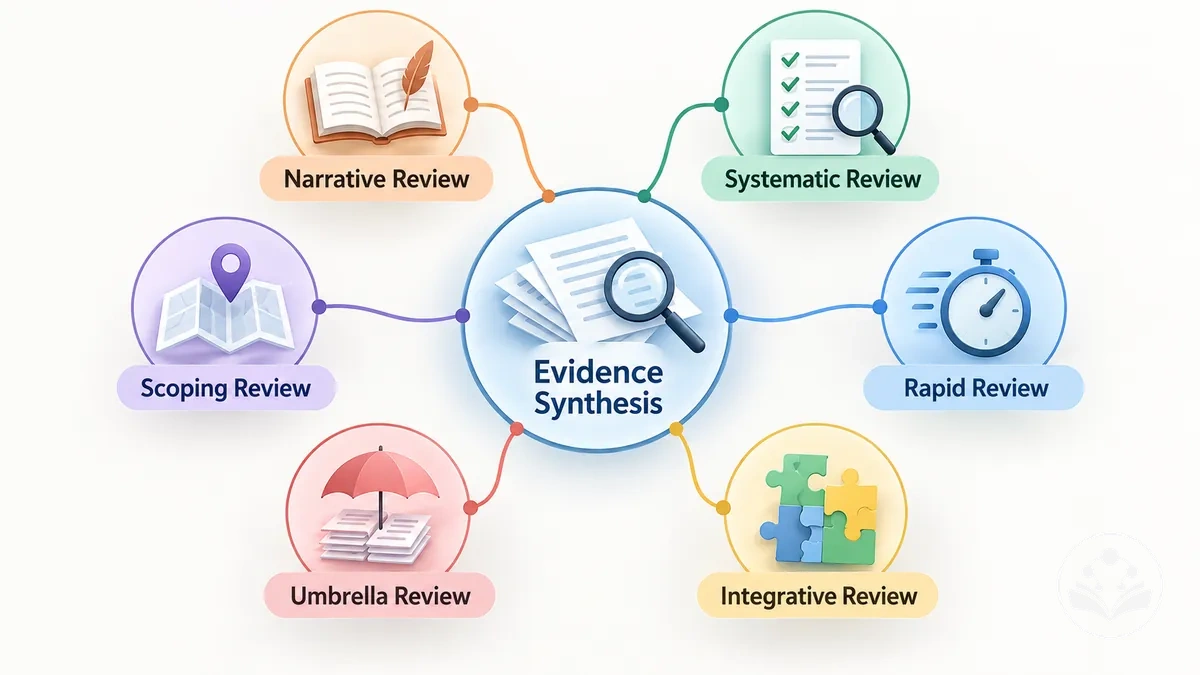
Review taxonomies differ across disciplines, so these six approaches represent common categories rather than an exhaustive universal classification.
A category name is most informative when interpreted through its purpose, methodology, evidence scope, and suitable application rather than through terminology alone.
These functional distinctions provide a consistent basis for understanding how review types relate to different evidence-synthesis needs.
Narrative Reviews
A narrative review is a flexible interpretive synthesis that brings together literature to describe, interpret, and critically discuss a topic.
It may fit a broad question when understanding themes, perspectives, or the overall state of knowledge is more important than exhaustive, protocol-driven identification of every eligible study.
Narrative reviews can therefore accommodate a broad scope and varied forms of evidence while using author judgment to shape the synthesis.

Systematic Reviews
A systematic review is a structured evidence synthesis that answers a focused research question using explicit, reproducible methods.
The review specifies its methodological decisions in advance so that relevant evidence is identified and handled according to predefined criteria rather than ad hoc choices.
Reproducibility and a clearly bounded question make this approach suitable when transparent evidence identification, appraisal, and synthesis are required.

- 1Define eligibility
Use predefined criteria to determine which evidence can enter the review.
- 2Search systematically
Identify relevant evidence with an explicit search approach aligned to the focused question.
- 3Appraise included evidence
Evaluate the evidence using stated procedures rather than ad hoc judgement.
- 4Synthesise findings
Bring the included evidence together using a method appropriate to the question and evidence characteristics.
Documenting these steps makes evidence handling traceable and can reduce avoidable bias, although that benefit depends on how appropriately the review is designed and executed.
A systematic review may include meta-analysis, but quantitative pooling is not required; meta-analysis is a synthesis technique rather than a synonym for systematic review.
The broader narrative versus systematic review distinction involves methodological differences beyond these defining signals, and systematic methods can reduce avoidable bias only when they are well designed and executed for the research question and evidence base.
Scoping Reviews
A scoping review is a structured evidence-mapping approach used to map the breadth of a field, clarify key concepts, characterize available evidence, and identify potential research gaps.
It is oriented toward an exploratory question and broad scope rather than only a narrowly focused effect question.
Evidence mapping can describe study types and evidence characteristics across a field without assuming that an apparent absence of evidence proves that no research exists.

A scoping review is particularly suited to exploratory questions when the available literature spans heterogeneous evidence, concepts, study types, or methods that need to be mapped before narrower conclusions are considered.
Its broad scope allows the review to characterize how evidence is distributed across these dimensions and may identify research gaps that warrant further investigation.
Suitability therefore follows from the mapping purpose and evidence conditions, not from treating a scoping review as an easier form of another review design.
Scoping reviews map and characterize evidence, whereas a narrowly focused effect question may require a different review design; the deeper systematic versus scoping review distinction depends on the purpose and methodological requirements of the question.
Evidence mapped as sparse or absent within the defined scope may indicate a research gap, but it does not by itself establish that no relevant research exists.
Rapid Reviews
A rapid review is an evidence synthesis that streamlines or adapts selected systematic-review methods when a decision must be supported under a time constraint or resource constraint.
The decision need determines which streamlined methods are appropriate rather than speed alone defining the review.
Methodological adaptations can affect how comprehensively evidence is identified or handled, so a rapid review involves an explicit trade-off between timeliness or resource use and the characteristics of the resulting evidence synthesis.

Streamlining changes the evidence process, not the need for transparency
- Search limits
- May reduce the evidence considered and therefore affect comprehensiveness and the certainty the synthesis can support.
- Selection or appraisal adaptations
- Can change how evidence is identified or evaluated, with consequences for transparency and reproducibility.
- Documentation
- State what was streamlined, why it was changed, and what the change means for interpretation; different shortcuts are not interchangeable.
Umbrella Reviews
An umbrella review synthesizes review-level evidence from existing systematic reviews or meta-analyses that address related questions.
At a glance: what an umbrella review works with
- Evidence unit
- Existing systematic reviews or meta-analyses, rather than individual primary studies.
- Best-fit evidence condition
- The relevant evidence base already contains several reviews that collectively address the broader question.
- Interpretive checks
- Assess methodological quality, overlap, scope, and consistency across the included reviews.
- Overlap implication
- The same primary studies may contribute repeatedly across reviews, so apparent agreement can partly reflect shared underlying evidence.
- Conflicting conclusions
- Examine differences in review scope and methodological quality before combining or comparing conclusions.
Review-level synthesis is therefore most appropriate when the purpose is to evaluate conclusions across existing reviews rather than conduct a new synthesis of individual primary studies.
Integrative Reviews
An integrative review combines diverse evidence to develop broader conceptual understanding or theoretical insight through synthesis.
Qualitative, quantitative, and conceptual evidence can contribute when each form is relevant to the review question.
Explain how evidence that differs in design, purpose, or knowledge type is related within one coherent synthesis.
Conclusions must remain compatible with the evidence and the integration method; heterogeneous findings cannot automatically be collapsed into one conclusion.
How Review Article Types Differ by Purpose, Scope, Method, and Rigor
Review article types differ most usefully by purpose, scope, method, and rigor or transparency, because these dimensions determine how well a review approach fits a research question.
Purpose describes what the review is trying to achieve, while scope and method determine how tightly the evidence base and synthesis process are bounded.
| Review type | Purpose | Scope | Method | Rigor and transparency |
|---|---|---|---|---|
| Narrative review | Interpret and critically discuss a topic or body of literature. | Often broad and able to accommodate varied evidence relevant to the topic. | Uses an interpretive synthesis in which search, selection, and organisation may be less standardised. | Transparency depends on clearly reporting the review boundaries, source-selection basis, and synthesis choices; reproducibility may be limited where these procedures are not predefined. |
| Systematic review | Answer a focused research question using explicit, predefined methods. | Bounded by predefined eligibility criteria and the focused question. | Uses a systematic search, explicit study selection, appraisal, and structured synthesis. | Requires transparent methodological reporting to support reproducibility and assessment of how the review was conducted. |
| Scoping review | Map the extent, characteristics, concepts, or gaps within an evidence base. | Typically broader than a narrowly focused systematic review and suited to heterogeneous evidence. | Uses a structured approach to identifying, selecting, charting, and presenting evidence relevant to the mapped scope. | Uses explicit and transparent methods, although methodological requirements depend on the review purpose and applicable guidance. |
| Rapid review | Produce a timely evidence synthesis for a defined decision or information need. | Usually focused, with scope constrained by the question and the need for faster completion. | Uses systematic-review principles while streamlining or limiting selected processes to reduce completion time. | Transparency requires reporting which methods were streamlined or omitted so the resulting limitations can be interpreted. |
| Umbrella review | Synthesise conclusions from multiple existing systematic reviews or meta-analyses addressing related questions. | Bounded at the level of eligible reviews rather than individual primary studies. | Compares and integrates review-level evidence while considering methodological quality, overlap, scope, and consistency. | Interpretive rigor depends on transparent review selection and assessment of differences, overlap, and methodological quality among included reviews. |
| Integrative review | Develop broader conceptual understanding or theoretical insight by integrating diverse evidence. | Can include heterogeneous qualitative evidence, quantitative evidence, and conceptual evidence relevant to the review question. | Uses an explicit integration logic to connect different evidence forms within the synthesis. | Transparency depends on making the integration method and interpretive logic explicit; reproducibility can vary with the chosen synthesis approach and reporting practice. |
The main distinction is methodological fit rather than a hierarchy of quality. Focused questions tend to require tighter scope and more predefined methods, while mapping, interpretive, or conceptual purposes can require broader or more flexible evidence handling.
Rigor therefore reflects how appropriately and transparently a review's methods are applied to its purpose and scope, with specific reporting expectations varying by review approach and disciplinary convention.
Match the Review Type to the Research Question
The research question should guide the review type because its purpose and specificity determine the evidence need and synthesis task before a method is selected.
Broad interpretive questions, focused evaluative questions, and exploratory mapping questions require different kinds of evidence handling.
Scope, available evidence, and methodological expectations should then confirm whether the initial method fit is practical and defensible.
A usable review approach therefore follows a sequence from research question to evidence need, synthesis task, and conditional method fit.
A clearly formulated question helps define those requirements, so researchers should develop a review question before committing to a method.
- Broad interpretive: When the research question seeks explanation, interpretation, themes, or an overall understanding of a broad topic, the evidence need may include varied literature and the synthesis task is primarily interpretive; a narrative review or, where explicit integration of diverse evidence is central, an integrative review may fit.
- Focused evaluative: When the research question asks a specific evaluative question with clearly bounded concepts or outcomes, the evidence need is narrower and the synthesis task requires explicit, reproducible handling of eligible evidence; a systematic review, or a rapid review when justified methodological streamlining is required, may fit.
- Exploratory mapping: When the research question asks what evidence exists, how a field is structured, or where gaps occur, the evidence need is broad enough to capture variation and the synthesis task is to map rather than estimate a narrowly defined effect; a scoping review may fit.
These branches indicate likely directions rather than absolute matches.
The final review type can change when the planned scope is too broad or narrow for the proposed method, when the available evidence does not support the intended synthesis task, or when disciplinary methodology imposes additional requirements.
Broad Questions That Need Interpretive Synthesis
A broad question seeks themes, concepts, developments, or interpretation rather than a tightly bounded effect, so its evidence need is usually wider and more conceptually diverse.
When the literature is heterogeneous, the relevant analytic task is often interpretive synthesis: identifying patterns, relationships, meanings, or developments across evidence that cannot be reduced to one narrowly specified estimate.
A focused effectiveness question asks for a different information task because it requires more tightly bounded evidence and a more specific evaluative synthesis.
Broad questions may therefore suit a narrative review when the analytic task is to interpret a varied body of literature, or an integrative review when qualitative, quantitative, or conceptual evidence must be explicitly connected within one synthesis.
The suitability of either approach depends on the structure of the heterogeneous literature and on whether the chosen method makes its interpretive logic clear.
A broad question does not require a narrative review by default; method fit should follow the intended analytic task and the way the available evidence needs to be integrated.
Focused Questions That Need Systematic Evidence Assessment
A focused question about an effect, association, accuracy, or other specific outcome often calls for explicit methods to identify and assess relevant evidence reproducibly.
Its specificity creates narrower boundaries for eligibility and makes a reproducible search and transparent appraisal important to the intended inference.
A systematic review may fit this evidence need when the objective, available evidence, and feasibility support systematic evidence assessment.
Narrower eligibility boundaries allow evidence identification and appraisal to remain aligned with the specific outcome or relationship defined by the focused question.
Systematic evidence handling can then support a synthesis in which the search, inclusion decisions, and appraisal are explicit enough for readers to evaluate how the inference was reached.
The suitability of a systematic review therefore depends on whether the available evidence can address the question, whether the planned methods are feasible, and whether the intended inference requires this level of structured assessment; meta-analysis is not required for every focused question.
Exploratory Questions That Need Evidence Mapping
An exploratory question aims to clarify concepts, characterize evidence distribution, or identify potential research gaps rather than estimate one narrowly defined effect.
This information need shifts the task toward evidence mapping, where the review describes what kinds of studies, populations, methods, or topics appear within the defined scope.
A mapping-oriented approach may therefore fit when the goal is to understand the shape and coverage of a field rather than evaluate a single bounded outcome.
Exploratory research questions often require broad inclusion so that diverse study characteristics can be organized through descriptive categorization and mapped across the evidence base.
A scoping review may suit this purpose when its methodology supports systematic evidence mapping and transparent interpretation of the resulting patterns.
Research gaps identified through this process should remain bounded by the review's scope: an apparent gap indicates absence or sparsity within the mapped evidence, not proof that no relevant research exists anywhere.
Other Criteria That Influence Review Type Selection
Research-question fit remains the primary criterion for review type selection, but evidence and project conditions can change which approach is feasible and methodologically defensible.
These modifying criteria should be evaluated according to how they affect the evidence task and intended synthesis rather than treated as equally weighted selection factors.
- Research question and purpose: The research question establishes the primary method fit by defining the kind of answer the review must produce. Other constraints may modify feasibility, but they should not replace alignment between the question, purpose, and review approach.
- Evidence breadth and heterogeneity: A broad or heterogeneous evidence base may favor a method suited to mapping, interpreting, or integrating varied evidence, whereas more narrowly bounded evidence may support a focused synthesis. The implication depends on whether heterogeneity is part of the question or a constraint the selected method must manage.
- Time and resources: Limited time, staffing, expertise, or access to research resources can constrain feasibility and may favor a method with a more achievable scope or streamlined process. Practical constraints should modify the review approach only when the resulting method can still answer the research question transparently and defensibly.
- Transparency requirements: When the intended use requires explicit documentation of searching, selection, appraisal, and synthesis decisions, methods with stronger procedural transparency may be more suitable. The required level of transparency depends on the review purpose and methodological expectations rather than representing a universal hierarchy of review types.
- Synthesis aim: The intended synthesis influences whether the method must interpret themes, map evidence distribution, integrate heterogeneous evidence, or assess a more narrowly specified relationship or outcome. Review type selection should therefore preserve alignment between the synthesis task and the inference the research question is intended to support.
- Disciplinary and reporting expectations: Disciplinary conventions, methodological guidance, and reporting expectations can influence which approaches are feasible or adequately documented in a particular context. These expectations may constrain method choice, but they do not override the underlying research-question fit.
The criteria do not carry the same weight in every project.
Evidence breadth, resources, transparency, synthesis aims, and reporting expectations modify feasibility and defensibility, while the research question remains the primary reference point for selecting the review type.
Scope and Boundaries of the Evidence
Evidence scope can change which review method is workable because breadth, heterogeneity, and boundary choices define the evidence that the review must accommodate.
A wider population, concept range, or mix of study designs broadens the review scope and may require a method suited to mapping or integrating heterogeneous evidence.
Narrower boundaries can support a more focused review method when they remain aligned with the review purpose.
- Topic or population breadth: A question spanning multiple populations or broad topic areas increases evidence breadth, which may favor a review method designed to characterize variation rather than resolve one narrowly bounded relationship.
- Concept or intervention range: Multiple related concepts or interventions broaden the evidence boundaries and can increase heterogeneity, making a mapping or integrative synthesis more suitable when comparison across that range is part of the purpose.
- Study-design diversity: Evidence distributed across different study designs increases methodological heterogeneity, so the review method must be capable of organizing or synthesizing those designs without assuming that they provide directly equivalent evidence.
- Time span: A longer time span can expand the evidence scope and introduce changes in concepts, methods, or research contexts, whereas a justified narrower period constrains coverage and may produce a more temporally specific synthesis.
- Coverage aim: A review seeking systematically defined coverage requires boundaries and evidence handling consistent with that aim, while representative interpretation may use a more selective scope only when that limitation is explicit and appropriate to the review purpose.
These scope variables influence review-method suitability through their combined effect on breadth, heterogeneity, and coverage rather than through any single boundary alone.
Broader coverage is not inherently preferable: the appropriate evidence boundaries are those that allow the selected review method to address the question while making the limits of the resulting synthesis clear.
Required Methodological Rigor and Transparency
Methodological rigor and transparency describe how explicitly a review defines and documents its methods so that decisions can be traced, assessed, and, where appropriate, reproduced.
Greater requirements for reproducibility and auditability increase the need for predefined methods, protocol specification, search transparency, explicit appraisal procedures, and clear documentation of the synthesis.
These expectations influence review-method suitability because different purposes require different levels of methodological formalization.
- 1Specify the planned protocol
Connect the research question to planned eligibility, search, appraisal, and synthesis decisions.
- 2Define eligibility rules
Make evidence-selection decisions auditable rather than implicit.
- 3Report the search
Show how the evidence base was identified and where its boundaries came from.
- 4Document appraisal and synthesis
Show how evidence was evaluated and how conclusions were developed.
Greater formalisation increases traceability, but a review label or reporting framework alone does not guarantee methodological quality.
At the selection stage, the relevant question is how much predefined documentation and traceability the review purpose requires, not how every procedural step will be performed.
Detailed implementation, including how researchers select and screen studies, is separate procedural work and should follow after the review approach and its transparency requirements have been established.
Intended Form of Evidence Synthesis
The intended evidence synthesis should influence review-type selection because different synthesis aims support different forms of summary, interpretation, evidence mapping, integration, or quantitative synthesis.
Method fit depends on whether the desired synthesis output can be supported by the evidence characteristics available for analysis.
The relevant analytic approach should therefore follow the synthesis aim rather than an assumed hierarchy among review types.
- Interpretive synthesis: When the synthesis aim is to explain themes, concepts, perspectives, or relationships across evidence that may differ in form or context, an interpretive synthesis can support a review type designed for critical or conceptual interpretation rather than statistical combination.
- Evidence mapping: When the aim is to describe the distribution, characteristics, or gaps of a broad or heterogeneous evidence base, evidence mapping fits an analytic approach that categorizes and presents the available evidence without requiring findings to be combined into one effect estimate; this may support a scoping review.
- Integration: When qualitative, quantitative, or conceptual evidence must contribute to a broader conclusion, integration requires an analytic approach that can relate those evidence forms while preserving relevant differences; this may support an integrative review when the evidence characteristics and review purpose justify that form of synthesis.
- Quantitative synthesis: When the synthesis aim is to estimate a combined quantitative result, the evidence must be sufficiently comparable for the planned statistical analysis; where that condition is met, meta-analysis may be used within an appropriate review approach, including a systematic review.
The synthesis aim should therefore be evaluated together with evidence characteristics: interpretation requires evidence that can support meaningful thematic or conceptual analysis, mapping requires evidence that can be categorized within the defined scope, integration requires a defensible way to relate diverse evidence, and quantitative combination requires sufficient comparability for the intended analysis.
Heterogeneous evidence may still support interpretation, mapping, or integration even when statistical pooling is inappropriate.
Meta-analysis is an optional analytic technique, not a synonym for systematic review, and its suitability depends on the question, evidence characteristics, and planned quantitative synthesis.