
Structure of a Review Article Manuscript
A review article manuscript commonly follows title and keywords → abstract → introduction → methods or review approach → results or main synthesis → discussion → conclusion → references. Treat that sequence as the default, then adapt section labels, order, and separation to the review type and the target journal’s current author guidelines; IMRAD fits when methods, synthesis/results, and interpretation are meaningfully separable.
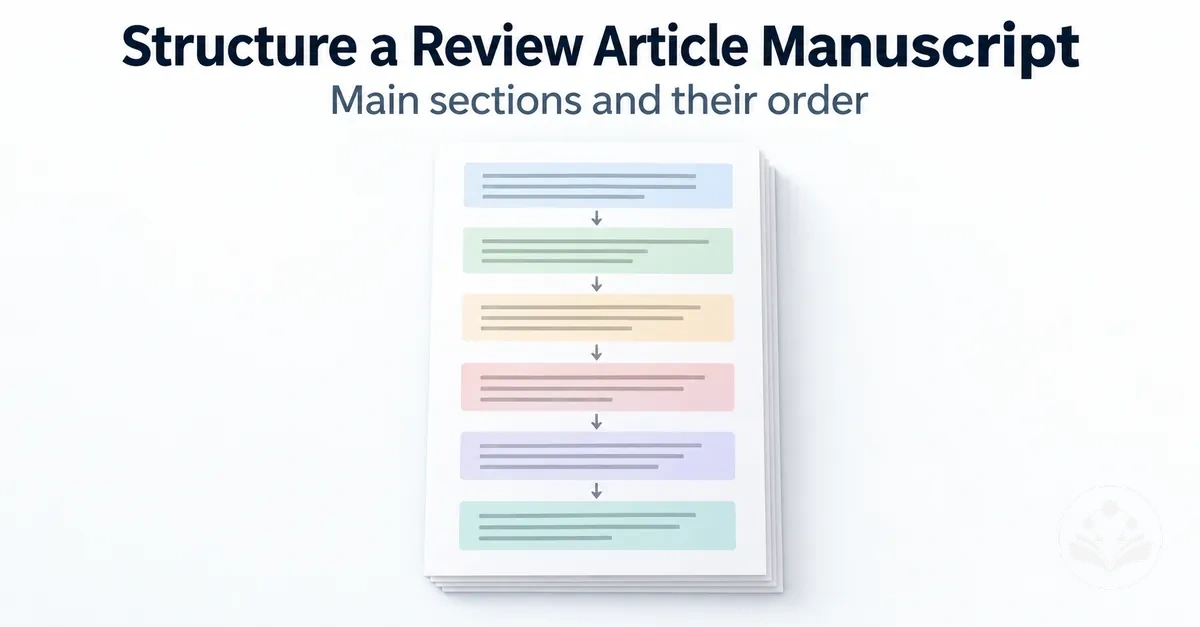
Review article structure at a glance
Use the manuscript structure as a reporting logic: first frame the review, then show how the evidence base was handled and synthesised, then interpret and document the outcome.
- Frame the reviewTitle and keywords define the topic and scope; the abstract condenses the whole review; the introduction establishes the problem, boundary, and purpose.
- Build and synthesise the evidenceMethods or a review approach explain how evidence was identified, selected, and handled; the results or main review body organises that evidence into coherent synthesis units.
- Interpret and documentThe discussion interprets patterns and limitations, the conclusion states supported takeaways and material gaps, and references make cited evidence traceable.
Choose the reporting logic
- IMRAD-aligned
- Use it when methods, results or synthesis, and discussion are meaningfully separable manuscript stages.
- Flexible structure
- Use thematic, conceptual, chronological, or other coherent units when synthesis is integrated through the main review body.
- Final structural check
- The target journal’s current author guidelines determine required section names, order, abstract format, heading limits, and related manuscript constraints.
Table of Contents
Review Article Components and Their Order
Review article components commonly follow an order from front matter through core analytical sections to references.
A typical sequence includes title and keywords, abstract, introduction, methods, results or main review body, discussion, conclusion, and references, although review type and journal requirements can change labels, placement, or whether sections are combined.
The sequence connects each component's position with its primary function in the manuscript.
The diagram shows the common progression visually, including where section naming or arrangement may change, while the table maps each component to its usual position, function, and structural variation.

| Component | Typical position | Primary function | Common variation |
|---|---|---|---|
| Title and keywords | Front matter | Identify the review topic and scope and provide terms for indexing and discovery. | Keywords may be listed separately, with their presentation determined by journal requirements. |
| Abstract | After the title and keywords | Summarizes the review scope, approach, main synthesis, and conclusion. | May use a structured format or a single paragraph, depending on the journal and review type. |
| Introduction | Beginning of the main text | Introduces the problem, establishes scope and rationale, and states the review purpose. | Section labels and the amount of background may differ by journal or review type. |
| Methods or review approach | Usually after the introduction | Documents how the evidence base was identified, selected, and handled. | May be a distinct methods section in structured reviews or described more flexibly in other review types. |
| Results or main review body | After the methods or review approach | Organizes and presents the evidence synthesis around the review question or topic. | May be labelled results or divided into thematic, conceptual, chronological, or other topic-based sections. |
| Discussion | After the results or main review body | Interprets the synthesis, its implications, and relevant limitations. | May appear separately or be integrated with the main synthesis, depending on review type and journal structure. |
| Conclusion | Near the end of the main text | States the main takeaway from the review in relation to its purpose and synthesis. | May be a separate section or combined with the discussion. |
| References | After the main text | Records the cited sources supporting the manuscript's evidence and claims. | Formatting and presentation follow the journal's reference requirements. |
IMRAD places introduction, methods, results, and discussion in a common core sequence, with front matter and references surrounding that core where applicable.
This remains a default structural pattern rather than a fixed order because review type and journal requirements determine the final section sequence and naming.
Title and Keywords: Identify the Review Topic and Scope
The title identifies the review topic and communicates its scope before readers reach the main text.
Keywords provide a related but different signal by supplying terminology for indexing the concepts actually treated in the manuscript.
Together, the title and keywords communicate the subject boundaries through complementary functions.

Title specificity should match the actual scope, while review-type wording can identify the review type when that distinction is informative.
Keywords should align with the manuscript's central concepts rather than introduce terminology for topics it does not substantively address.
Journal conventions determine title and keyword requirements, so accurate scope signaling and concept alignment take priority over generic search terms.
Abstract: Summarize the Review Scope, Approach, Main Synthesis, and Conclusion
A review article abstract is a stand-alone summary that condenses the review’s scope or objective, approach, main synthesis or findings, and conclusion.
These functions let readers understand what the review addresses, how its evidence base was approached, and what the synthesis concludes.
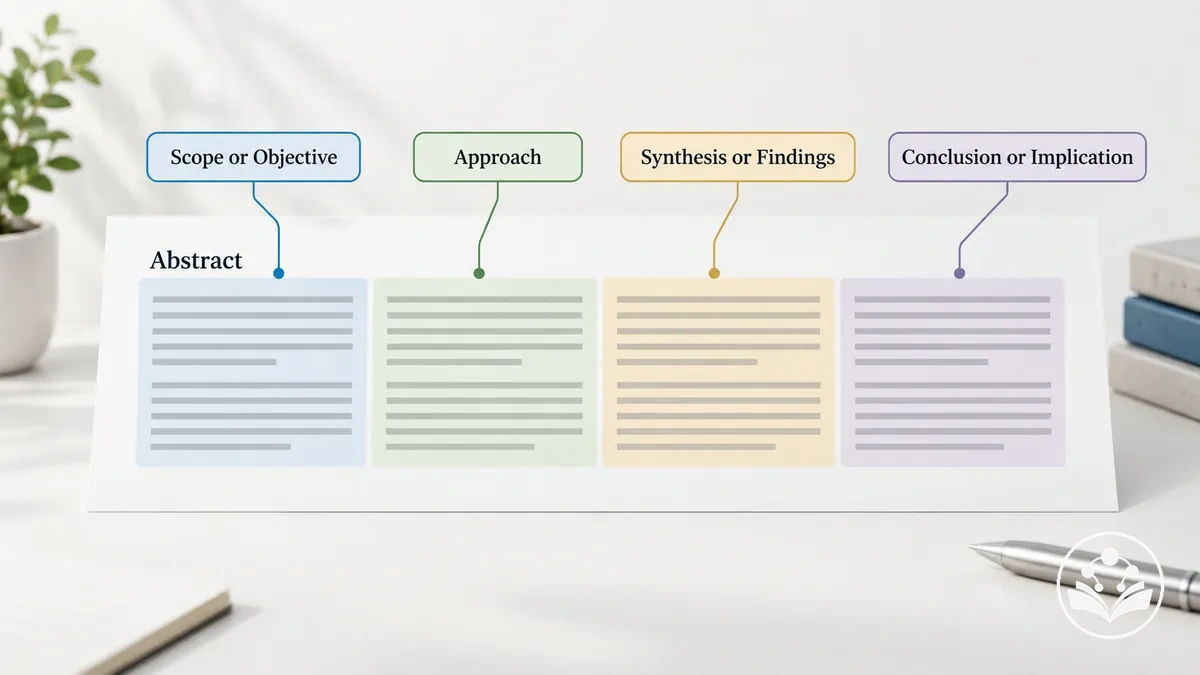
The abstract should reflect information actually present in the manuscript and preserve a clear informational sequence from objective through concluding implication.
A structured abstract may label these functions as Background or Objective, Methods or Approach, Results or Synthesis, and Conclusions, while a single-paragraph abstract can express the same functions continuously.
The exact abstract format and headings depend on journal requirements and review type rather than a fixed universal structure.
Introduction: Establish the Problem, Scope, and Review Purpose
A review article introduction establishes the background and identifies the specific problem or knowledge area that gives the review its rationale.
It explains the significance of that problem without attempting the synthesis that belongs in the main review body.

The introduction narrows the scope by defining which part of the broader topic is included and what remains outside the review's focus.
This boundary connects the problem to the rationale for reviewing the selected literature without implying unsupported knowledge gaps.
The introduction then states the review purpose as an objective or guiding question that directs the later synthesis.
Methods or Review Approach: Explain How the Evidence Base Was Built
The methods or review approach documents how the evidence base was identified, selected, and handled, making the review process transparent to readers.
Its reporting categories describe how evidence entered and was treated within the review rather than prescribing one mandatory workflow.

- Information sources: identifies the databases, collections, or other sources used to locate relevant evidence.
- Search approach: describes how potentially relevant literature was sought at the level of detail appropriate to the review type.
- Eligibility: reports the criteria or logic used to determine which evidence could be included or excluded.
- Selection: describes how records or studies were assessed against the stated eligibility logic.
- Synthesis approach: identifies how the included evidence was organized, analysed, or combined for the review.
Reporting depth varies with the review type and applicable journal requirements rather than following one format for every review article.
Systematic and similarly structured reviews generally document methods more explicitly to support reproducibility, while some narrative reviews describe their review approach more flexibly.
In either case, the methods component should provide enough reporting detail to clarify how the evidence base was built and handled.
Results or Main Review Body: Organize the Evidence Synthesis
- Choose the structural homeDepending on the review type, synthesis may appear as a distinct Results section or as an integrated main review body. Structured reviews may separate results explicitly, while other reviews may use thematic, conceptual, chronological, or similarly defensible sections.
- Group evidence around the review questionThe central body should organise related evidence into coherent groups rather than become a source-by-source catalogue. Authors can synthesise evidence for the manuscript by connecting grouped findings around the review question.
- Make patterns visibleThe grouping should expose agreement, disagreement, or mixed evidence and the implications that the later discussion can interpret.
Tables and figures can support this organization by displaying evidence groups, patterns, or relationships that are already developed in the written argument.
Authors can use tables and figures to make structured evidence easier to inspect without allowing presentation choices to replace the main review body's synthesis logic.
The structural task here is to organize synthesis coherently; the detailed techniques for performing that synthesis belong to the separate synthesis process.
Discussion: Interpret the Synthesis and Its Implications
Detailed guidance on how to write the discussion and conclusion extends beyond this component's structural function.
Conclusion: State the Main Takeaways and Remaining Gaps
References: Document the Evidence Sources
When IMRAD Fits a Review Article Structure
IMRAD—Introduction, Methods, Results, and Discussion—fits a review article when its methods and results or synthesis are meaningfully separable.
A flexible review structure may fit when the synthesis is organised primarily through thematic or conceptual sections.
The comparison therefore concerns structural fit rather than the quality of either review approach.
Relevant criteria include the review approach, explicit methods reporting, separation of results or synthesis, disciplinary convention, and journal requirements.
These dimensions indicate whether IMRAD structure reflects the manuscript's reporting logic or whether a flexible review structure accommodates it more naturally.
Discipline and article type can shape these conventions without making either structure universally applicable.
| Criterion | IMRAD-aligned review | Flexible review structure | Structural implication |
|---|---|---|---|
| Review approach | Fits approaches with clearly differentiated methodological and synthesis stages. | Accommodates approaches organized mainly around thematic, conceptual, or other integrated review-body units. | Choose a structure that reflects how the review approach separates its major reporting functions. |
| Methods reporting | Provides a distinct Methods component when the evidence-building process requires explicit reporting. | May describe the review approach without separating it into a conventional IMRAD Methods component. | The degree of methodological separation influences whether an IMRAD-aligned structure fits. |
| Results or synthesis separation | Fits when findings or evidence synthesis can be presented as a distinct Results or synthesis section. | Fits when synthesis is integrated across thematic or conceptual sections in the main review body. | Structural fit depends on whether synthesis functions as a separable manuscript stage. |
| Disciplinary convention | May align with disciplines and article types that commonly organize scientific writing through IMRAD. | May align with disciplines or article types that use topic-based or integrated review structures. | Disciplinary convention informs fit but does not establish a universal structure for reviews. |
| Journal prescription | Fits when journal requirements specify or support distinct Introduction, Methods, Results, and Discussion sections. | Fits when journal requirements permit thematic, conceptual, or differently labelled review-body sections. | Journal requirements can constrain the available structural options regardless of broader disciplinary convention. |
IMRAD structure may therefore suit reviews whose reporting logic separates method, synthesis, and interpretation into distinct components.
A flexible review structure may suit manuscripts where synthesis develops through integrated thematic or conceptual units instead.
Final fit depends on the review approach, discipline, article type, and journal requirements rather than a universally preferred pattern.
How to Structure the Heading Hierarchy Within the Main Review Body
Develops one narrower evidence distinction or subtopic inside the parent synthesis function.
Remains at a comparable level of granularity with its sibling while staying subordinate to the same parent context.
Manuscript heading levels describe conceptual organization and should not be equated automatically with webpage H1-H6 tags.
APA and other style systems may prescribe heading levels and formatting rules, while the manuscript's conceptual hierarchy determines which ideas warrant major headings or subheadings.
Applicable journal or style requirements can therefore shape presentation without replacing the underlying synthesis hierarchy.
For example, a major heading such as Intervention Effects on Patient Outcomes could contain the subordinate subheadings Short-Term Clinical Outcomes and Long-Term Clinical Outcomes, because both divide the same parent synthesis function at consistent granularity.
Worked review article examples can show how this abstract hierarchy appears within complete manuscripts.
The central rule remains that each heading level should reflect a coherent conceptual hierarchy from parent synthesis function to genuinely subordinate context.
Major Headings Should Represent Distinct Synthesis Functions
Subheadings Should Divide Genuine Subordinate Contexts
A subheading is justified when it expresses a genuinely narrower subordinate context beneath one major synthesis function represented by its parent heading.
It should divide that parent context without restarting the manuscript at a new peer-level topic.
The following criteria test whether a candidate subheading belongs under its parent rather than functioning as a separate context.
- Shared parent function: The subheading develops the same synthesis function established by the parent heading.
- Narrower scope: The subordinate context addresses a defined part of the parent's scope rather than introducing an independent topic.
- Parallel level: Sibling subheadings should maintain comparable granularity and a parallel level of detail within their shared parent.
- Sufficient content: The candidate should contain enough materially distinct evidence or analysis to justify separation from adjacent subordinate contexts.
A valid child context satisfies these criteria semantically, not merely because visual spacing or an isolated detail suggests another heading level.
Source-specific fragments or isolated edge cases do not justify a subheading when they lack sufficient content within the shared parent function.
If a candidate does not remain narrower than the parent heading, it should be evaluated as a peer context rather than a child context.
How Journal Requirements Modify the Default Review Article Structure
Journal requirements can modify the default manuscript structure by requiring, renaming, combining, or reordering specific components.
The target journal’s current author guidelines therefore determine which structural conditions apply before the manuscript structure is finalised.
Only instructions with a direct structural consequence need to change the manuscript's organization.
Relevant criteria include required sections, naming or order changes, length and heading constraints, and required front matter or back matter.
- Abstract format: If the journal requires a particular abstract format, the abstract must follow that prescribed organization rather than the default arrangement.
- Section names and order: Required section names may rename, combine, separate, or reorder components when the author guidelines prescribe those changes.
- Heading levels: Permitted heading levels may limit how deeply the main review body can be subdivided within the journal's required structure.
- Word limits: Overall or section-specific word limits may constrain the depth or separation of manuscript components without establishing a universal section length.
- Front matter and back matter: Required elements may add, remove, or position specific material before or after the main manuscript body.
- Reference conventions: Journal-specific reference conventions may determine how references are presented and whether related reference elements require a particular placement.
Each criterion should be applied only when the target journal specifies the relevant condition, because requirements vary across disciplines and publishers.
The structural implication is the required manuscript change, not unrelated typography, upload procedures, or other administrative submission details.
Before finalizing the manuscript, verify its structure against the target journal's current author guidelines and resolve any journal-specific differences.
A pre-submission quality checklist can then support the broader verification process without turning structural conformance into a new writing method.