
Selecting and Screening Studies for a Review
Select and screen studies by applying predefined eligibility criteria consistently at each stage: first to titles and abstracts, then to full texts for records that remain potentially eligible or uncertain. Exclude only when the available information establishes a criterion failure; otherwise carry the record forward, resolve reviewer disagreements through a predefined process, and document each decision and full-text exclusion reason.

Screening logic
Study screening decision path
Use the same predefined eligibility criteria throughout. The amount of information changes from title and abstract to full text, but the eligibility logic stays consistent.
- Define eligibility before screening. Translate the review question and protocol into explicit inclusion and exclusion conditions.
- Screen titles and abstracts. Exclude only a clear criterion failure; carry potentially eligible or uncertain records forward.
- Assess the full text. Include reports that satisfy the required criteria and record a specific reason when a criterion failure supports exclusion.
- Resolve disagreements explicitly. Compare independent decisions, return to the disputed criterion, seek consensus, and use adjudication when the protocol requires it.
- Document the selection flow. Reconcile stage counts, full-text exclusion reasons, and the final included studies or reports.
Core decision rule: missing or ambiguous information is not the same as confirmed ineligibility.
The review question and review method define the scope that the eligibility criteria must represent.
Those criteria then guide screening decisions about whether each record is eligible, ineligible, or cannot yet be judged from the available information.
A record with insufficient information should therefore proceed to further assessment when a reliable exclusion decision cannot be made.
The exact screening procedure may differ according to the review type, protocol, team structure, or reporting standard, but eligibility criteria remain the basis for deciding which studies enter the included set.
Screening is distinct from finding records through literature searching, evaluating study quality through critical appraisal, and organising evidence after selection.
The next operational requirement is therefore to define the inclusion and exclusion criteria clearly before screening begins.
Table of Contents
Define Inclusion and Exclusion Criteria Before Screening
Define inclusion and exclusion criteria before screening and tie them directly to the review question.
Inclusion criteria specify the conditions a study must meet to be eligible, while exclusion criteria identify conditions that make it ineligible.
Defining these eligibility criteria in advance gives each screening decision an explicit basis rather than allowing the studies encountered after searching to determine the rules.
The appropriate criteria depend on the scope and review method.
A narrowly focused review may require tightly specified participants, interventions, comparators, or study designs, whereas another review approach may intentionally use broader eligibility boundaries.
For that reason, review method selection should inform the eligibility criteria rather than relying on one template for every review.
The criteria should translate the review question and protocol-defined scope into conditions that can qualify, disqualify, or retain a record for further assessment.
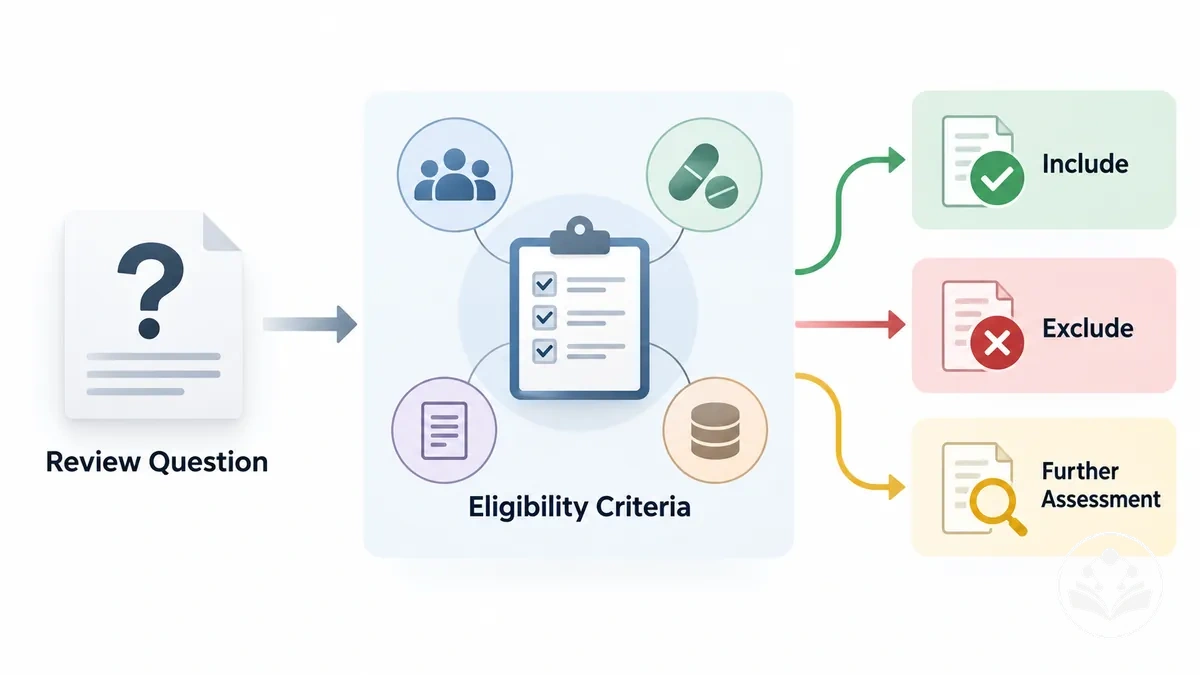
The main criterion groups move from dimensions that define the review question to design, setting, and practical publication limits.
Each criterion should specify the condition that determines whether a record can be included, excluded, or retained for further assessment.
The diagram represents how the review question constrains those eligibility decisions before screening begins.
The bullets then state the decision implication of each criterion class without treating every limit as mandatory for every review.
- Population: define the participant or population characteristics relevant to the review question; records outside those predefined characteristics are excluded when the mismatch is clear.
- Intervention or exposure: specify the intervention, exposure, or concept that qualifies a study; include records that address the defined condition and exclude confirmed mismatches.
- Comparator: where the review question requires a comparator, define which comparison conditions qualify; if no comparator is required by the chosen approach, it should not become an artificial exclusion rule.
- Study design: identify the study designs eligible for the review; a record is excluded when its confirmed design falls outside the predefined scope.
- Setting: define geographic, institutional, community, clinical, or other setting restrictions only when they are relevant to the review question; confirmed settings outside those boundaries are ineligible.
- Publication characteristics: specify any protocol-defined limits on publication type or status; apply them as eligibility conditions rather than as judgments about study quality.
- Time period: define a publication or study-period boundary when the review question or protocol requires one; studies outside that specified period are excluded on that criterion.
- Language: state any language restriction explicitly when the protocol uses one; a language limit is conditional rather than a requirement for every review.
Key distinction: insufficient information is not the same as confirmed ineligibility.
For example, if an abstract does not report the study setting but setting is an eligibility criterion, the record should be retained for further assessment rather than excluded solely because that information is missing.
The breadth and formulation of criteria can also change with review type, as reflected in systematic and scoping review differences.
Once screening begins, the predefined criteria should be applied consistently to comparable records.
Screen Studies in Two Stages
Two-stage screening commonly starts with titles and abstracts, then moves to full texts for records that remain potentially eligible or uncertain.
The first stage uses the limited information in titles and abstracts, while the second stage uses the more complete evidence available in the full report.
Both stages apply the same predefined eligibility criteria at different information depths rather than changing the eligibility logic between stages.
Retrieved records from the literature search provide the input for this staged screening process.
The sequence below shows how potentially eligible or unresolved records move from an initial assessment to a more detailed eligibility decision.
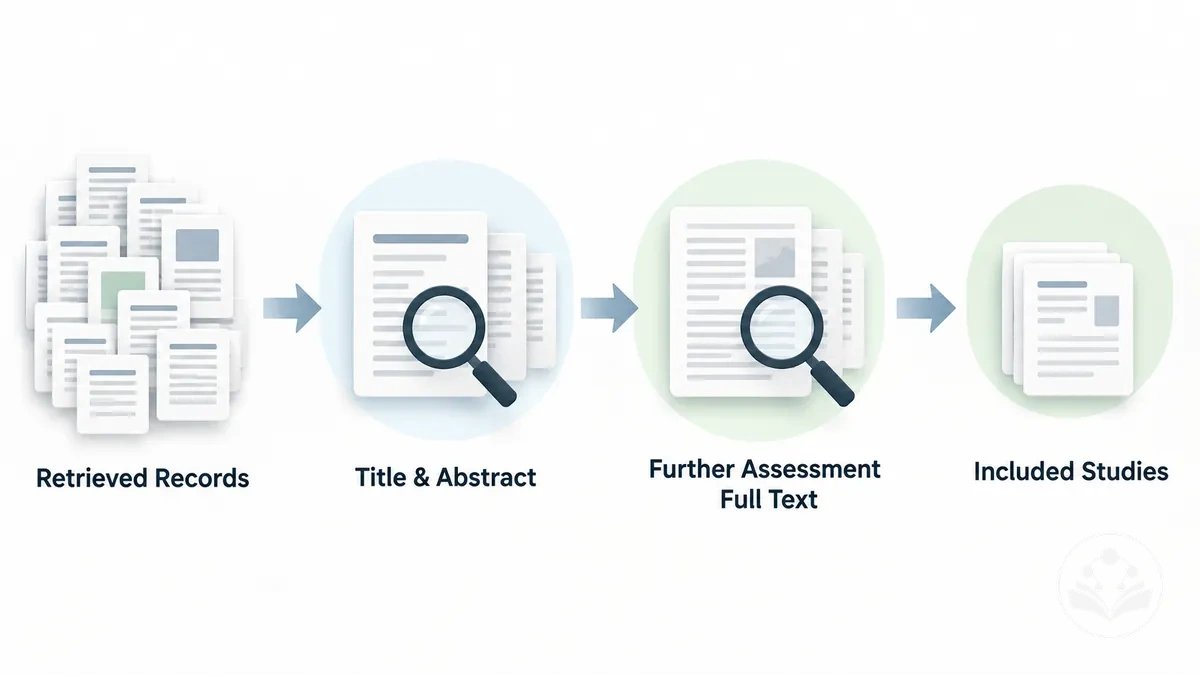
- Title and abstract screening: Screen each retrieved record against the eligibility criteria using the information available in its title and abstract. Exclude records when ineligibility can be established from that information; potentially eligible or unresolved records proceed to further assessment.
- Full-text screening: Assess the complete report against the same eligibility criteria using the greater detail available in the full text. This assessment determines whether the report qualifies for final inclusion or supports an exclusion decision.
Insufficient information during first-stage screening should lead to further assessment when a reliable exclusion decision cannot yet be made.
The exact workflow may vary with the review method or protocol, so this two-stage pattern is common rather than universal to every review article.
The central requirement is a reproducible, documented sequence in which eligibility decisions determine movement from retrieved records to the final included study set.
Screen Titles and Abstracts Against the Eligibility Criteria
Title and abstract screening should exclude a record only when the available information is sufficient to judge it ineligible against a predefined eligibility criterion.
Apply only criteria that can reasonably be evaluated from the title and abstract.
If relevant information is missing or ambiguous, treat the record as uncertain rather than assuming it is ineligible.
First-stage screening separates records according to what the title and abstract actually support.
A clearly stated criterion failure can support exclusion, while incomplete information should not be treated as proof of ineligibility.
The three decision states below distinguish clearly ineligible records from potentially eligible and uncertain records.
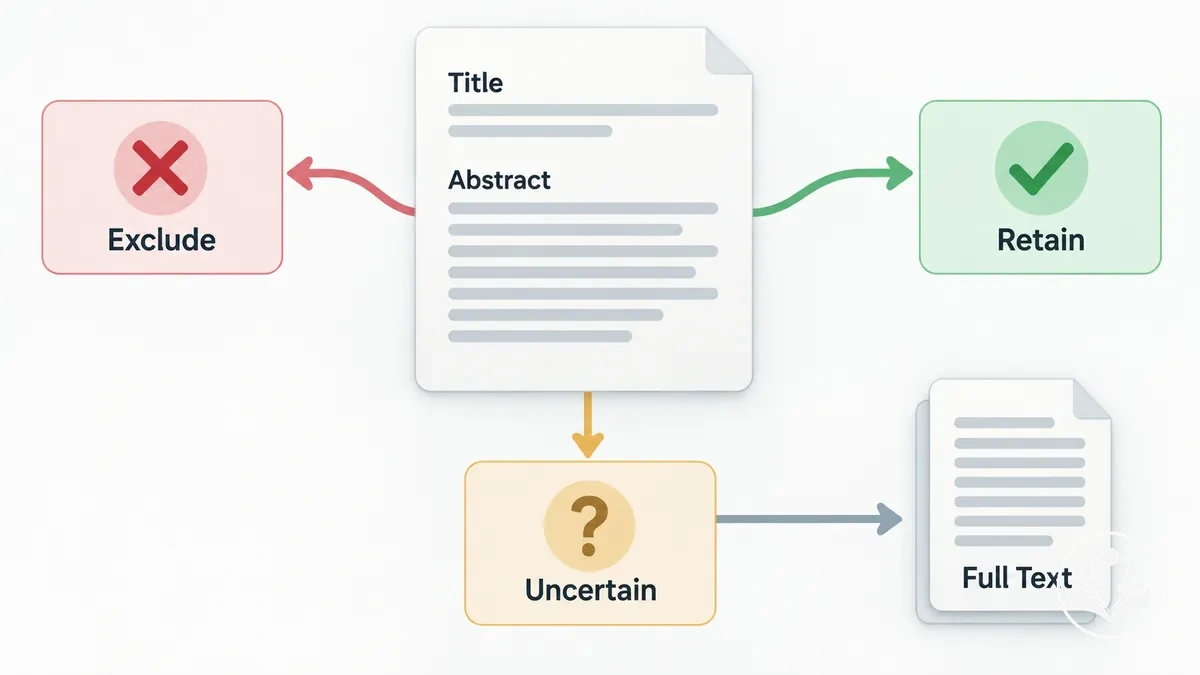
- Clearly ineligible: Exclude the record when the title or abstract clearly shows that it fails an explicit eligibility criterion.
- Potentially eligible: Retain the record when the available information indicates that it may satisfy the eligibility criteria and warrants full-text assessment.
- Uncertain: Carry the record forward when missing or ambiguous information prevents a reliable exclusion decision; the full text provides the additional information needed for further assessment.
For example, if setting is an eligibility criterion but the abstract does not report the study setting, that absence alone does not establish ineligibility.
The record remains uncertain and should proceed to full-text assessment rather than being excluded on an inferred criterion failure.
Assess Full Texts for Final Inclusion
Full-text assessment applies the complete eligibility criteria to each retained record to make the final inclusion decision.
The full text provides details that may have been unavailable during initial screening, allowing previously unresolved attributes to be evaluated.
Full-text assessment should confirm unresolved attributes against the predefined eligibility conditions rather than rely on an overall impression of relevance.
Full-text decision states
- Include
- The full report satisfies the required eligibility criteria.
- Exclude
- The full report establishes a specific criterion failure; document the primary reason for exclusion.
- Unresolved
- The report still lacks enough information to judge a criterion reliably; record the uncertainty and follow the review protocol rather than inventing a failure.
The annotation below shows how full-report evidence connects a criterion check to a documented final decision.
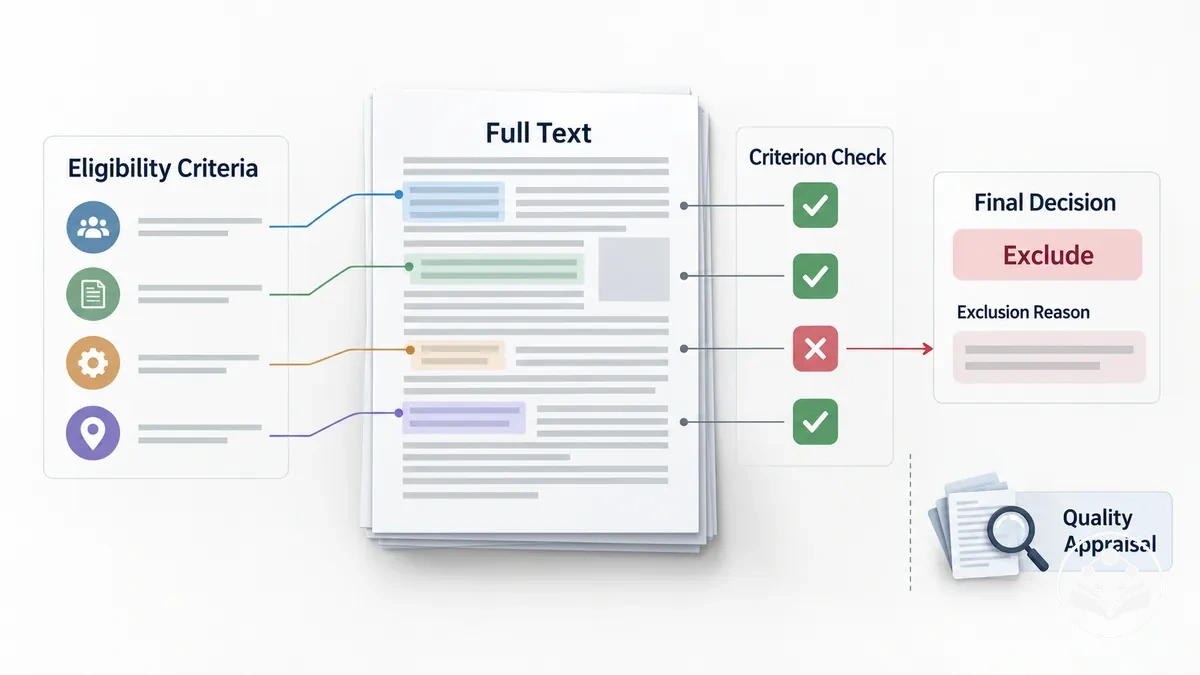
For example, a retained record may appear eligible from its abstract but the full text may show that its study design falls outside the predefined eligibility criteria; the exclusion reason should name that study-design criterion rather than state only that the report is irrelevant.
Full-text screening assesses eligibility rather than serving as critical appraisal, unless quality was explicitly predefined as an eligibility criterion.
The final include or exclude decision should remain traceable to the evidence in the complete report and the criterion applied.
Use Independent Reviewers and Resolve Screening Disagreements
Independent screening by two reviewers is commonly used to reduce the influence of individual selection decisions. For systematic reviews, Cochrane guidance recommends that at least two people independently determine study eligibility, with the disagreement procedure defined in advance.
Reviewer numbers and escalation procedures can vary with the review design and protocol, so the chosen process should be explicit before screening starts.
A screening disagreement should therefore be resolved through an explicit process tied to the eligibility criteria rather than by silently overriding one reviewer.
Screening disagreement resolution begins by preserving the independent reviewers' separate decisions and identifying the criterion or interpretation that produced the conflict.
The resolution sequence moves from criteria-based discussion toward consensus or, when the disagreement remains unresolved, adjudication by a third reviewer.
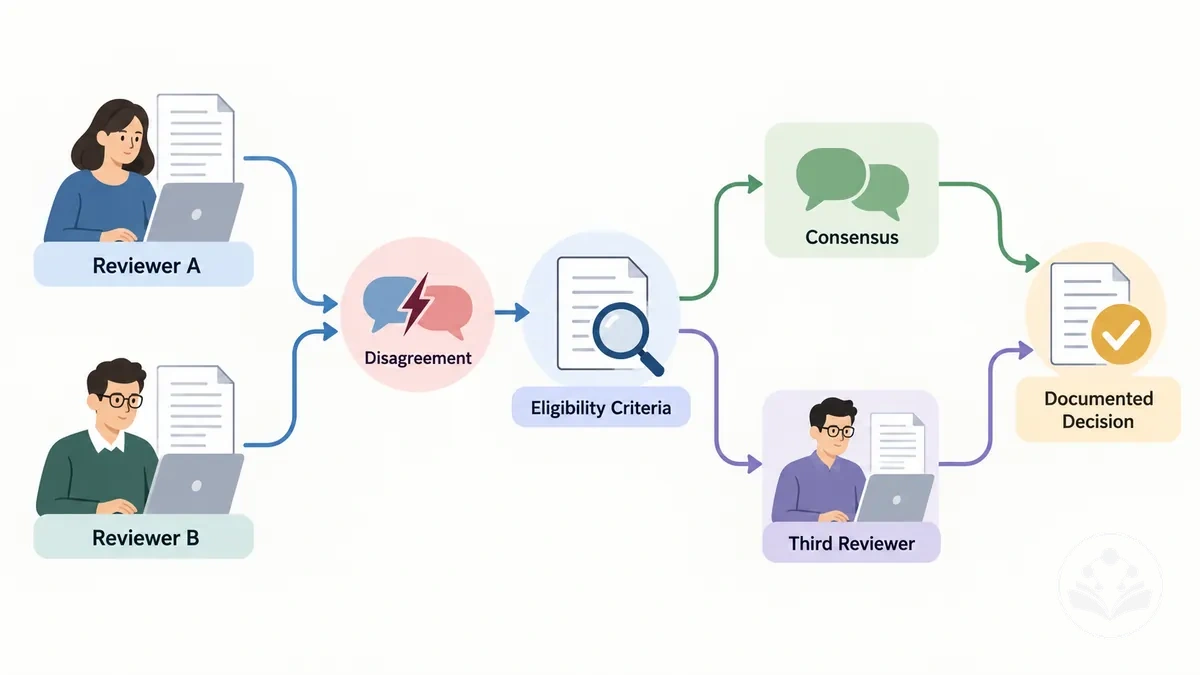
- Assess independently: Each reviewer applies the predefined eligibility criteria without using the other reviewer's decision to determine the initial judgement. Separate assessment preserves two independently reached screening decisions for comparison.
- Identify the conflict: Compare the decisions and identify the specific criterion, missing information, or interpretation responsible for the screening disagreement. This distinguishes a substantive eligibility conflict from a simple oversight.
- Discuss against the criteria: Re-examine the disputed record against the predefined eligibility criteria and the information available for that decision. The purpose is to resolve the identified conflict through consistent criterion application rather than reviewer preference or seniority.
- Reach consensus where possible: When discussion resolves the conflicting interpretation or oversight, record the agreed eligibility decision and its basis. Consensus reflects a shared criteria-based decision rather than one reviewer silently replacing the other's judgement.
- Use third-reviewer adjudication when needed: If the independent reviewers cannot reach consensus, a third reviewer can adjudicate according to the review protocol and eligibility criteria. Document the adjudication and final decision so the resolution remains traceable.
Not every disagreement has the same source.
An oversight occurs when relevant information was missed, while an interpretation difference occurs when reviewers apply the same criterion differently.
Genuine ambiguity remains when the record does not provide enough information for a clear eligibility judgement under the protocol.
Identifying the source of disagreement determines whether clarification, consensus discussion, or third-reviewer adjudication is needed.
For example, one reviewer may include a record while another excludes it because they interpret its study design differently.
Resolution should return to the predefined study-design criterion and the record's reported methods, using consensus when discussion resolves the conflict or third-reviewer adjudication when it does not.
The resulting documented decision should reflect the eligibility criteria and resolution process, not reviewer authority.
Document Study Selection Decisions and Flow
Transparent study selection requires a traceable record of stage counts, selection decisions, full-text exclusion reasons, and final inclusions.
Record these decisions as screening proceeds so each count can be reconciled with the preceding and following stages.
The resulting audit trail should show what entered each stage, what left it, and the documented reason for relevant exclusions.
Keep the counting units distinct
PRISMA-style reporting may count records, reports, and studies at different stages, so use the same unit consistently when reconciling totals.
- Record
- The title or abstract, or both, of a report indexed in a database or website.
- Report
- A document that supplies information about a study.
- Study
- The underlying research investigation; one study can be described by multiple reports.
The reporting sequence should map identification through screening and full-text assessment to final inclusion without unexplained changes in counts.
PRISMA 2020 recommends reporting the selection process from records identified through studies included, ideally with a flow diagram for systematic reviews.
When PRISMA reporting is applicable to the review design, the PRISMA flow diagram visualises movement through identification, screening, eligibility assessment, exclusions, and inclusion; it reports the selection process rather than defining the eligibility criteria.
- Record identification: Carry forward the number of records identified and any documented removals before screening so the starting screening count can be reconciled.
- Record screening: Report the number of records screened and the number excluded during title and abstract screening, keeping terminology consistent with the unit being counted.
- Full-text assessment: Record the reports sought or retrieved for detailed assessment and distinguish reports that could not be retrieved from those assessed for eligibility.
- Full-text exclusions: Record reports excluded after full-text assessment and assign specific exclusion reasons, such as an ineligible study design or population, rather than leaving the reason unexplained.
- Final inclusion: Report the number of included studies and, where the reporting framework distinguishes them, the associated number of included reports.
Counts should reconcile between stages using consistent units and definitions.
For example, if a documented number of reports enters full-text assessment, the subsequent record trail should account for those reports through exclusion with stated reasons, inability to retrieve where applicable, or inclusion.
PRISMA 2020 recommends reporting reports that appear to meet the inclusion criteria but are excluded after full-text assessment together with the primary reasons for exclusion.
Once the included study set and its selection trail are confirmed, the next task is to organise selected evidence without treating that downstream work as part of selection.
Study selection documentation ends with a traceable final inclusion decision and a reconciled record of how the included set was reached.