
Troubleshooting Common Review Article Writing Mistakes
Review article writing mistakes are best fixed by tracing the visible symptom back to the earliest plausible source: the review question or scope, evidence fit, synthesis, or manuscript structure. Because the same symptom can have several causes, treat it as a diagnostic clue rather than proof and verify the upstream condition before rewriting the affected passage.
Diagnose the writing problem before you edit it
Use the visible symptom to choose the first stage worth checking. The result identifies a likely source to investigate, not a guaranteed cause.
- 1Symptom
- 2Likely source
- 3Differentiating check
- 4Corrective direction
Start with a symptom. Then test the suggested stage before changing the prose.
- Likely source to check
- Review-question clarity
- Differentiating check
- Can the passage be tied to one identifiable review question and its inclusion boundary?
- Corrective direction
- Clarify the question before rewriting the passage.
- Likely source to check
- Scope breadth
- Differentiating check
- Are competing subtopics or inconsistent boundaries preventing adequate analytical depth?
- Corrective direction
- Refine a meaningful scope boundary before changing the prose.
- Likely source to check
- Evidence fit
- Differentiating check
- Do the included sources address the concepts, context, population, relationship, or outcome the review question actually requires?
- Corrective direction
- Reassess source relevance instead of compensating with stronger wording.
- Likely source to check
- Evidence synthesis
- Differentiating check
- Does the passage identify a supported pattern, difference, agreement, disagreement, or condition across sources?
- Corrective direction
- Organise source details around the cross-source relationship they support.
- Likely source to check
- Structural coherence
- Differentiating check
- Do section purpose, evidence, claim, implication, and transition appear in a traceable argumentative sequence?
- Corrective direction
- Re-sequence or reframe disconnected material so its contribution becomes explicit.
Limit: one symptom can have more than one plausible cause, so use the result as the first check rather than a final diagnosis.
Table of Contents
How to Diagnose the Source of a Review Article Problem
Review article problem diagnosis starts by locating the earliest plausible source of the visible symptom before choosing a correction.
The same weak passage can suggest an unclear review question, overbroad scope, poor evidence fit, weak synthesis, or structural misalignment, so one symptom may have several likely causes.
A diagnostic clue therefore indicates where to check rather than identifying a cause by itself.

Review question clarity and scope establish what the review is trying to answer and which evidence belongs within its inclusion boundary.
Evidence fit then affects whether the selected material can support that purpose, while synthesis determines whether relationships among sources are interpreted coherently and structural coherence determines whether that reasoning remains visible to the reader.
The differentiating check should establish which of these upstream conditions is present before the symptom is treated as a local writing error.
- Unfocused passage → unclear review question: check whether the passage contributes to one identifiable review question. If its relevance cannot be explained against that question, the interpretation suggests question clarity as a likely cause; the corrective direction is to clarify the question before revising the passage.
- Shallow or scattered coverage → overbroad scope: check whether the review is trying to accommodate competing subtopics or inconsistent inclusion boundaries. If the intended coverage prevents coherent treatment at the required depth, the interpretation suggests scope as a plausible source; the corrective direction is to refine the boundary before changing the prose.
- Claims misaligned with the review purpose → poor evidence fit: check whether the included sources address the concepts, context, or population required by the review question. A mismatch suggests an evidence-fit problem; the corrective direction is to reassess source relevance rather than compensate with stronger wording.
- Source-by-source description without clear relationships → weak synthesis: check whether the passage identifies patterns, differences, agreements, or disagreements across the relevant evidence. If relevant sources remain isolated, the interpretation suggests synthesis as the likely cause; the corrective direction is to strengthen the relationships among findings.
- Relevant reasoning that is difficult to follow → weak structural coherence: check whether claims, evidence, and interpretations appear in an order that supports the review question. If the reasoning is present but its sequence obscures connections between ideas, the interpretation suggests structural coherence as the likely cause; the corrective direction is to reorganise the existing reasoning before rewriting its substance.
Review Scope and Question Mistakes
Weak scope and weak review questions are upstream mistakes because they shape what a review article can cover coherently and what evidence belongs within it.
Scope sets the breadth and boundaries of the review, while the review question clarifies what the inquiry needs the evidence to answer.
When these controls are poorly aligned, the resulting inclusion logic can admit evidence that is relevant to the broad topic but poorly suited to the review’s actual focus.

A workable scope keeps the topic boundaries consistent with the review’s purpose and the depth of coverage that is feasible, whereas answerability depends on whether the review question can be addressed using evidence that fits those boundaries.
Evidence fit therefore requires alignment in both directions: included material should belong within the scope and contribute to answering the review question.
A broad scope is not inherently a mistake, and a narrow question is not inherently better; appropriateness depends on the review purpose, method, and available evidence.
Misalignment can instead appear as inconsistent inclusion or superficial coverage when the intended focus, feasibility, answerability, and evidence base do not support one another.
- Scope — focus: the boundaries should identify which parts of the topic belong within the intended review focus rather than leaving breadth open-ended.
- Scope — feasibility: the breadth should permit the intended evidence to be handled with sufficient depth for the review’s purpose and method.
- Scope — boundary clarity: the inclusion logic should distinguish evidence inside the defined topic boundary from material that is merely related to the wider subject.
- Question — answerability: the review question should specify an inquiry that the evidence admitted by the scope can meaningfully address.
- Question — evidence fit: the included evidence should contribute to answering the review question rather than qualifying only through general topical relevance.
The Scope Is Too Broad to Support a Focused Review
A review scope is too broad when its breadth prevents feasible coverage of the relevant evidence, adequate analytical depth, or coherent synthesis for the review’s purpose.
A broad scope can still be appropriate when the review method, available evidence, and practical constraints allow the intended breadth to be handled coherently.
The comparison graphic shows how scope breadth relates qualitatively to the depth and feasibility that the review can sustain.
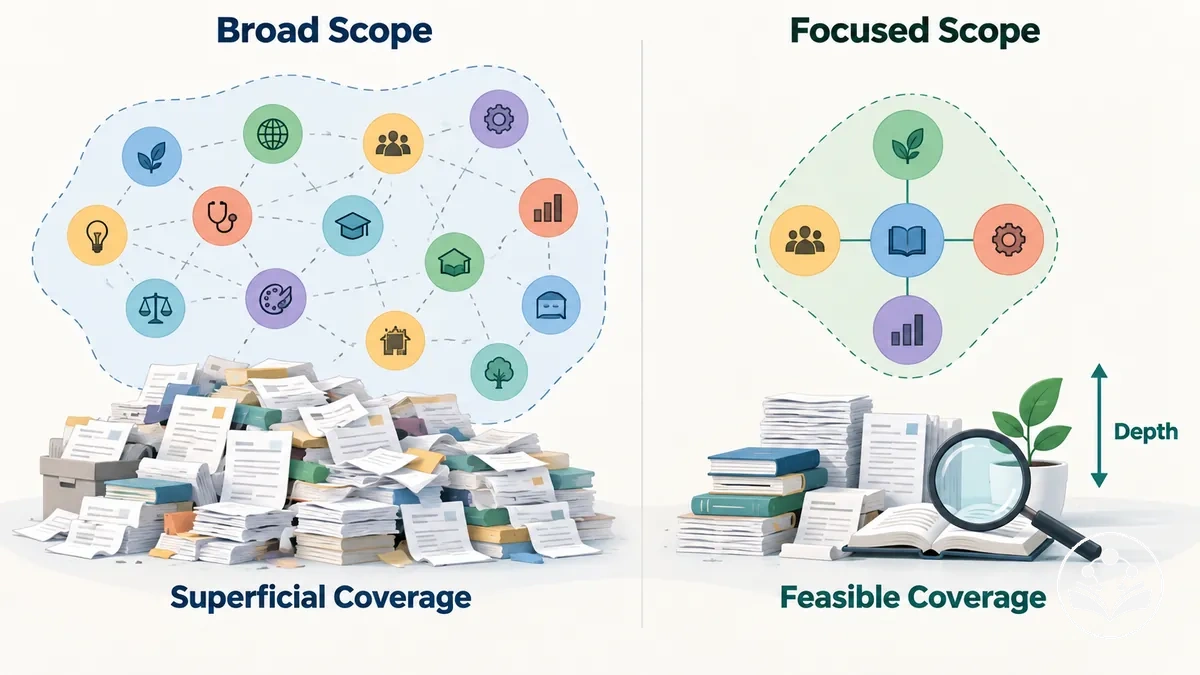
- Excessive subtopics: the scope becomes difficult to cover when loosely connected subtopics compete for attention and prevent the central subject from receiving sufficient depth.
- Unmanageable evidence volume: the available evidence volume exceeds what can feasibly be examined with the depth required by the review’s purpose and method.
- Superficial coverage: the review can mention the relevant areas but cannot analyse them deeply enough to support coherent synthesis.
- Inconsistent boundaries: a boundary based on relevant concepts, populations, contexts, outcomes, or time periods cannot be applied consistently to determine what belongs within the review.
- Unwieldy synthesis: the included evidence addresses such varied aspects of the subject that meaningful relationships among findings become difficult to synthesise coherently.
Breadth should therefore be judged relative to the review’s purpose, method, available evidence, and practical constraints rather than against a fixed scope size or study count.
When the diagnostic cues indicate overbreadth, the corrective principle is to narrow a meaningful boundary that improves feasibility and depth while retaining the evidence needed for the review’s purpose.
Detailed procedures to fix topic and scope problems belong beyond this diagnostic subsection.
The Review Question Does Not Clearly Define What Evidence Belongs
A review question is too weak for evidence selection when it lacks enough conceptual boundary to judge what evidence belongs in the inquiry.
Ambiguity in key concepts, context, relationships, or outcomes can leave evidence eligibility unclear and make relevance difficult to apply consistently.
The annotated example shows how question wording can make these boundaries clearer without prescribing one question framework.
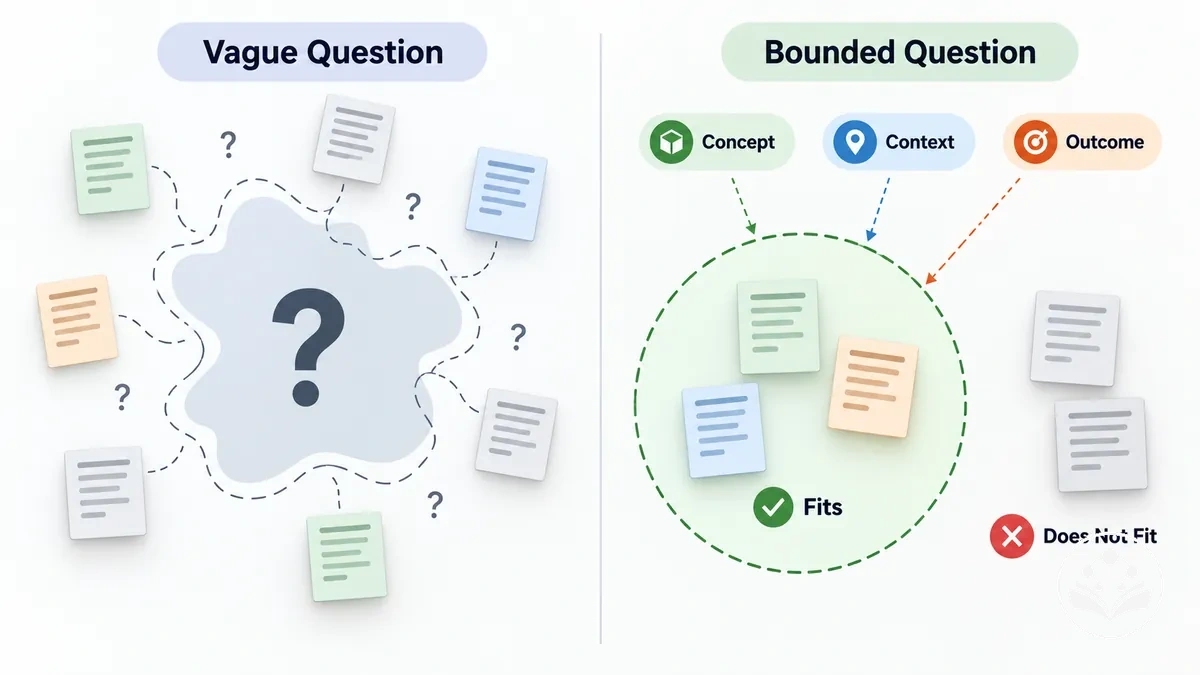
A review question can create an inclusion boundary through attributes such as the concept being examined, the population or context, the relationship of interest, the outcome, or the timeframe when those attributes are relevant to the review type and purpose.
These dimensions are examples of boundary-setting attributes rather than mandatory fields for every review.
When the applicable attributes remain undefined or conflict with the included evidence, source relevance becomes harder to judge and inclusion may become inconsistent.
- Key concepts: the review question should define the concepts that evidence must address closely enough to distinguish relevant material from merely related material.
- Population or context: where these attributes matter to the inquiry, the question boundary should clarify which populations, settings, or contexts make evidence eligible for inclusion.
- Relationship: when the review examines an association, comparison, intervention, experience, or other relationship, the question should make that relationship sufficiently explicit to guide relevance decisions.
- Outcome: when a particular outcome is central to the inquiry, stating it helps distinguish evidence that addresses the intended result from evidence concerned with other outcomes.
- Timeframe: when time is conceptually important to the review, the question can use a relevant period or temporal condition to clarify evidence eligibility without treating a timeframe as mandatory for every review.
Evidence Relevance and Selection Mistakes
Review evidence selection fails when selected sources do not fit the review question or when the evidence base is unsuitable for the claims being made.
Source relevance concerns whether evidence helps answer the review question, whereas evidence suitability also depends on qualities such as credibility, appropriate currency, coverage, and consistent inclusion logic.
A source can therefore be credible and topically related yet still provide weak claim support when it does not address the inquiry closely enough.

Source relevance should be evaluated separately from quality because methodological credibility does not by itself establish question fit.
Currency matters when newer evidence could materially change the claim, but older evidence may remain appropriate when it is foundational or otherwise necessary to the inquiry.
Coverage concerns whether the evidence base represents the important evidence needed for the claims rather than merely accumulating similar sources, while consistent inclusion logic helps prevent comparable sources from being treated differently without a relevant reason.
Evidence suitability therefore requires contextual judgment based on the review question, field, and burden of the claim.
- Question fit: evidence is relevant when its subject, population or context, relationships, or outcomes contribute directly to answering the review question rather than sharing only broad topical similarity.
- Quality and credibility: a source should provide evidence appropriate to the claim being supported; credibility can strengthen claim support, but it does not make an otherwise irrelevant source relevant.
- Currency: recency should be judged according to the field and claim, because current evidence may be necessary for changing knowledge while older foundational evidence can remain relevant.
- Coverage: the evidence base should cover the important evidence required by the review question and claims; narrow or repetitive coverage may leave relevant perspectives or findings insufficiently represented.
- Inclusion logic: comparable sources should be evaluated using consistent relevance and suitability conditions so that inclusion or exclusion reflects the review question rather than shifting criteria.
- Claim support: the selected evidence should collectively be suitable for the strength and scope of the claims made; weak, mismatched, dated where currency matters, or incomplete coverage may require narrower conclusions.
Sources Are Related to the Topic but Not Relevant to the Review Question
Topic overlap is not the same as review-question relevance. A source can discuss the same subject yet still fail to provide evidence that answers the defined inquiry.
Topic overlap
The source discusses the broader subject, but its purpose, population or context, concepts, findings, or relevant claim may not match the evidence the review question needs.
Use: it may still be useful as background, but topic similarity alone does not establish claim support.
Question relevance
The source addresses the applicable attributes of the inquiry closely enough that its findings contribute to answering the review question within the defined boundaries.
Use: its findings can support a claim when the alignment is appropriate to that specific claim.
A partial match can therefore justify background use without making a finding direct evidence for a claim. Keeping the distinction explicit supports a defensible synthesis in which claims are based on evidence that actually addresses the review question.
Evidence Quality, Currency, or Coverage Is Too Weak
An evidence base is too weak when its methodological credibility, source appropriateness, currency, or coverage does not adequately support the review’s claims. Evidence adequacy is claim-relative: the evidence should support both the strength and the scope of the conclusion being drawn.
These dimensions are not interchangeable and there is no single universal standard that replaces contextual judgment. Confidence in the interpretation should reflect how they collectively support the review’s claim burden.
Descriptive Writing and Weak Evidence Synthesis
Descriptive writing reports individual source findings; synthesis explains meaningful relationships across sources. Evidence synthesis integrates findings so the review can identify patterns and interpret what the evidence collectively supports.
The analytical step missing from overly descriptive writing is the connection between isolated findings and a defensible cross-source interpretation.
Agreement
When relevant findings align, synthesis can state the shared interpretation they support without claiming more certainty than the evidence allows.
Disagreement
Mixed findings should remain visible as disagreement rather than being compressed into apparent consensus.
Recurring pattern
A repeated theme can support a cross-source pattern when it recurs across relevant findings under comparable conditions.
Method or context difference
A methodological or contextual difference may help explain divergent findings only when that difference corresponds with the observed variation.
The analytical function of synthesis is to turn separate findings into a structured account of relationships while keeping claims proportional to the evidence and preserving uncertainty where results remain inconsistent or sparse.
Studies Are Summarised One by One Instead of Synthesised Across Sources
Study-by-study reporting becomes a synthesis mistake when each source summary remains isolated instead of being connected through a shared analytical relationship.
Synthesis groups source details so they support a cross-source claim rather than functioning only as separate accounts of individual studies.
The following hypothetical contrast shows how the same source details can change function when they are organised around a relationship.
Studies can be grouped by a shared theme, finding, method, condition, or disagreement when that grouping reflects the evidence rather than a fixed formula.
The relevant source details should remain visible when they explain the comparison or qualify the cross-source claim, but they become subordinate to that larger analytical relationship.
This local distinction helps writers avoid summary-only review writing while preserving study-specific information that contributes to synthesis.
The Review Describes Findings Without Developing Patterns or Relationships
A review remains overly descriptive when it reports findings accurately but does not connect them into a pattern or relationship that can be interpreted for the review question.
Descriptive writing becomes analytical when relationships across findings are identified and their meaning is explained without extending the interpretation beyond what the included evidence supports.
Agreement may suggest that findings converge on a shared interpretation, whereas contradiction requires the inconsistency and its implications to remain visible rather than being presented as consensus.
A recurring theme can reveal a cross-source pattern when it is supported across relevant findings, while a methodological difference may help explain why results differ when that difference corresponds with the observed variation.
When a finding varies by condition or context, the interpretation should state that dependency rather than generalise the pattern; where the evidence remains inconsistent or sparse, uncertainty should be preserved, and a fuller method can help writers improve evidence synthesis.
Review Article Structure and Argument Mistakes
Review article structure becomes a problem when manuscript section order, section purpose, or evidence-to-claim alignment no longer supports a coherent answer to the review question.
Each manuscript section should serve an identifiable function in the overall argument rather than exist only because a conventional heading is expected.
Structural mistakes can therefore disrupt coherence when evidence appears in a section that does not support the claim or argumentative function being advanced there.
Section function should create a logical progression in which evidence supports the relevant claim and each claim contributes to the developing argument.
Transitions should make the relationship between sections explicit enough for the argumentative flow to remain traceable, while proportional emphasis should reflect the importance of each section to the review question rather than follow a fixed allocation.
Because appropriate section order and emphasis can vary by review type and journal conventions, these criteria test argumentative function rather than compliance with one universal manuscript structure.
- Section purpose: each manuscript section should have an identifiable function that contributes to answering the review question or developing the overall argument.
- Logical progression: claims and sections should connect in an order that allows the argument to develop coherently rather than leaving important reasoning disconnected.
- Evidence-to-claim alignment: the evidence presented within a section should support the claim advanced there, with the claim limited to what that evidence can justify.
- Transitions: transitions should clarify how the function or claim of one section connects with the next part of the argument.
- Proportional emphasis: space and analytical attention should correspond to a section's contribution to the review question and argument, subject to the review type and relevant journal conventions.
When diagnosis begins to require a detailed account of section architecture rather than these coherence criteria, writers can check manuscript structure separately.
Sections Do Not Advance the Review Question or Build a Coherent Argument
A manuscript section is structurally weak when its content is relevant in isolation but does not clearly contribute to answering the review question or advancing the argument.
Verification should therefore test the section purpose, the evidence supporting its claim, the resulting implication, and its logical connection to the surrounding argument.
- Section purpose: check whether the manuscript section has an identifiable function that contributes to the review question or advances the argument.
- Evidence support: check whether the evidence presented in the section supports the specific claim being advanced rather than merely relating to the same topic.
- Claim: check whether the claim expresses what the evidence supports and remains proportionate to its scope and limitations.
- Implication: check whether the implication explains how the supported claim contributes to the developing argument rather than leaving the evidence analytically disconnected.
- Connection: check whether the transition preserves a logical connection between this section and an adjacent section so that argumentative coherence remains traceable.
The local chain is section purpose → evidence → claim → implication: the section function establishes why the material belongs, the evidence supports the claim, and the implication identifies its argumentative contribution.
A transition then connects that contribution to the adjacent section, although the way this connection is expressed can vary with the review's structure.
If one link in this chain is unclear, the corrective check is to remove, combine, or reframe unsupported or disconnected material so the section's contribution becomes explicit; broader pre-submission verification belongs in the review article quality checklist.