
The Review Article Writing Process
Review article writing turns a bounded body of literature into a coherent synthesis and critical interpretation, not a source-by-source summary. A strong process starts with a clear review question and scope, uses transparent evidence search and selection, compares studies on relevant attributes, and limits conclusions to what the synthesized evidence can support.
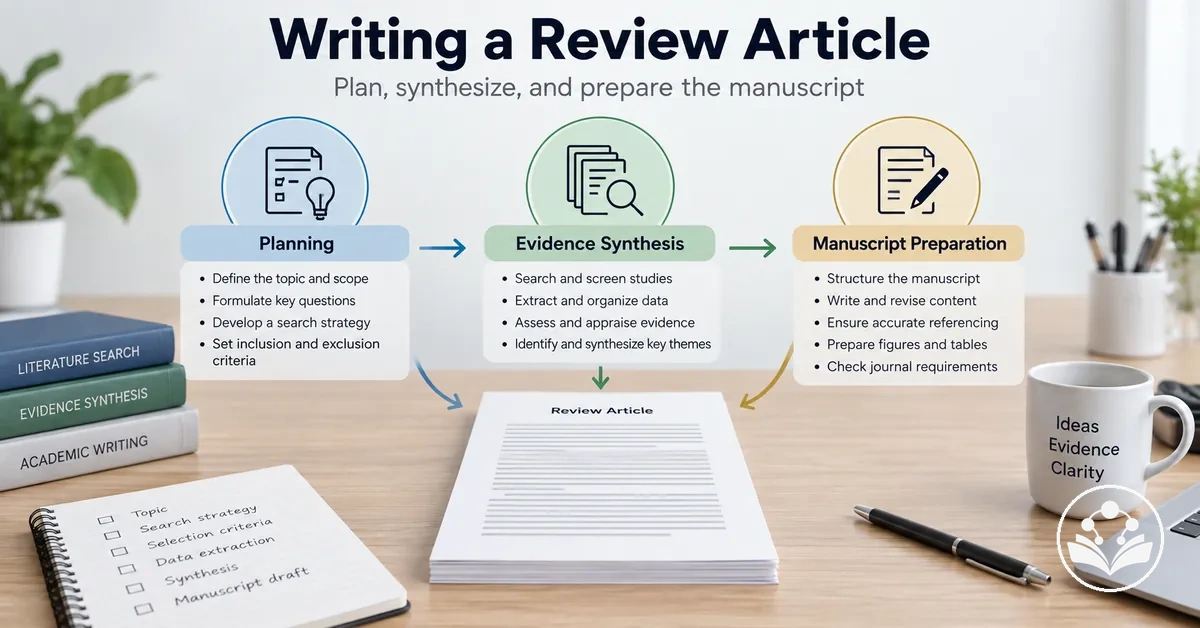
At a glance
From review question to coherent manuscript
Use these stages as a decision sequence: each stage produces the information needed for the next, while the exact method and reporting detail depend on the review type, discipline, and target journal.
- Plan the reviewOutput: a bounded purpose, answerable question, scope, and suitable review approach.
- Build the evidence baseOutput: traceable sources organized with comparable attributes and justified inclusion decisions.
- Synthesize across studiesOutput: patterns, differences, limitations, and interpretations qualified by evidence conditions.
- Shape the manuscriptOutput: an argument-led structure in which evidence supports claims where they are interpreted.
- Check review qualityOutput: a focused, transparent, balanced review whose conclusions stay proportionate to the evidence.
The sequence is logical rather than mechanically fixed: purpose and question constrain evidence decisions, organized evidence enables synthesis, and the synthesis determines the manuscript's argument, emphasis, and conclusion.
Table of Contents
Plan the Review Around a Clear Purpose and Question
A review plan begins with a clear purpose and review question because these constrain the scope, evidence needs, suitable review approach, and eventual manuscript argument.
Defining what the review is intended to explain or establish also clarifies which literature is relevant and what evidence is needed to answer the question.
Conceptual fit concerns whether the purpose, review question, scope, and review approach address the same knowledge need, while practical feasibility concerns whether the available evidence, manageable scope, and outlet constraints can support that plan.
Factors such as available time, resources, expertise, topic, and expected evidence coverage can affect feasibility and methodological fit.
These planning constraints influence how broadly evidence can be gathered and how confidently the resulting synthesis can support the manuscript argument.
The main planning conditions connect early decisions with their later consequences:
- Purpose: A specific review objective defines the knowledge need and guides which evidence is relevant rather than allowing the literature encountered later to redefine the purpose.
- Review question: An answerable question establishes the concepts and relationships the evidence must address, constraining subsequent evidence gathering and synthesis.
- Scope: Boundaries should capture literature relevant to the purpose while remaining feasible under the topic, available evidence, and project constraints; there is no single scope threshold that applies across review types.
- Evidence needs: The question guides what evidence is relevant, while the evidence that can reasonably be gathered affects whether the intended coverage and interpretation are feasible.
- Review approach: Methodological fit requires the approach to serve the purpose and review question, with the appropriate choice depending on the knowledge need and characteristics of the evidence base.
- Outlet constraints: The requirements of the intended journal or other outlet can affect the feasible form and emphasis of the manuscript, so they form part of the review plan rather than a guarantee of publication.
The planning dependencies can also be viewed as a connected system: purpose and the review question act as controlling inputs, while the scope boundary, evidence needs, and review approach are downstream decisions shaped by them.

Before detailed evidence gathering begins, the review plan should be checked for answerability, methodological fit, practical feasibility, and alignment with the intended outlet.
These checks establish whether the planned scope and evidence needs can support a coherent manuscript argument under the conditions of the review.
Define a Workable Topic and Scope
A workable review topic has an explicit conceptual boundary and practical scope: it is broad enough to address a meaningful body of literature but bounded enough to investigate coherently.
The scope defines what the review includes and excludes, while population or context, time range, and other limits should be applied only when they are relevant to the review question.
Scope affects literature coverage, comparability, and synthesis depth because changing a boundary changes which evidence can contribute to the review.
An overbroad scope may encompass substantially different concepts, populations, contexts, or periods, making meaningful comparison and synthesis more difficult; a workable scope preserves the evidence needed to answer the question while establishing boundaries that permit coherent analysis.
Evidence availability also affects feasibility: boundaries that leave too little relevant literature may limit what can be synthesized, while boundaries that encompass diverse evidence require sufficient analytical depth to avoid superficial synthesis.
The following criteria connect each scope boundary to its implication for literature coverage, comparability, and synthesis:
- Conceptual boundary: Specify which concepts or relationships belong to the topic and which fall outside it so the reviewed literature addresses a coherent knowledge need.
- Population or context: Define a population, setting, geography, or other context when it materially affects which evidence is relevant or comparable; omit such a restriction when it does not serve the review question.
- Time range: Use a time boundary when the review question, development of the field, or intended coverage justifies it rather than assuming that one date range is appropriate across reviews.
- Evidence availability: Check whether the proposed boundaries leave relevant literature capable of supporting synthesis; sparse evidence may require reconsidering the boundary rather than drawing conclusions from inadequate coverage.
- Feasibility: Evaluate whether the resulting literature can be examined with sufficient depth under the review's practical constraints, because greater breadth can increase the diversity of evidence that must be compared and synthesized.
The broad-to-focused relationship can be visualized as a topic moving from a large subject area toward a defined conceptual and contextual field, clarifying how narrowing changes the literature considered without implying a universal scope limit.

For example, a topic such as digital learning is too broad to establish a coherent basis for comparison, whereas focusing on a defined digital-learning approach within a specified educational context creates clearer conceptual and contextual boundaries.
Once that local boundary is clear, the deeper process used to choose and scope a review topic can refine it according to the review question, evidence availability, and feasibility.
Formulate a Clear Review Question
A clear review question specifies the knowledge need precisely enough to guide evidence decisions without predetermining the conclusion.
It should identify what the review seeks to understand and make the relevant key concepts or relationships explicit enough to support inclusion, comparison, and synthesis.
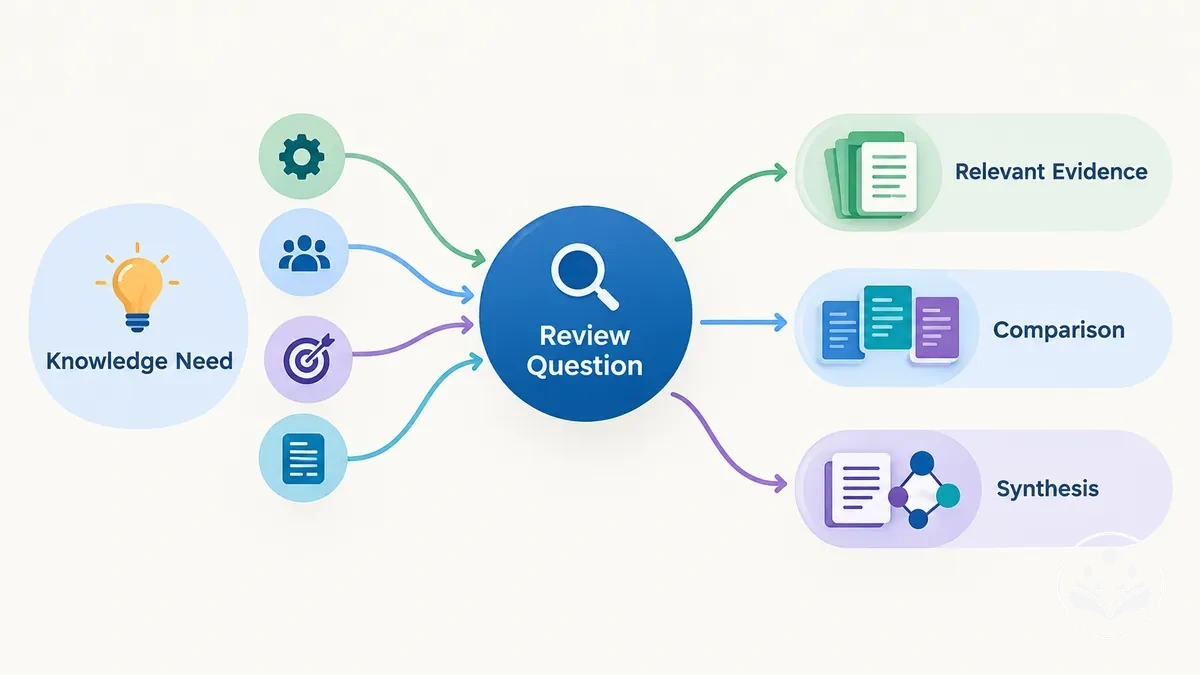
Semantic clarity concerns whether the review question states the relationship being examined, while operational usefulness concerns whether that question can guide inclusion, comparison, and synthesis decisions.
Clarity and answerability determine whether evidence can be assessed against a consistent knowledge need, while scope alignment constrains the question to the boundaries of the review.
Compatibility with the intended review approach provides method fit, although the appropriate question structure can differ by review approach and discipline.
The following criteria connect each question attribute with its practical implication for evidence and synthesis decisions:
- Clarity: The review question should state the knowledge need and relevant relationship unambiguously so evidence can be assessed against a consistent meaning.
- Answerability: The question should ask something the available literature can reasonably address, allowing the evidence to support an interpretable synthesis rather than leaving the central knowledge need unresolved.
- Scope alignment: The question should remain within the review's defined boundaries so inclusion decisions do not expand into populations, contexts, concepts, or evidence outside the intended scope.
- Key concepts: The concepts or relationships that matter to the question should be explicit enough to guide which evidence is relevant and what can meaningfully be compared across the literature.
- Review approach: The question should align with what the intended review approach can examine and synthesize, with the appropriate formulation depending on the purpose, discipline, and evidence needs rather than one question framework for every review.
For example, “digital learning in universities” states a topic but not the relationship or knowledge need to be examined, whereas asking how a defined digital-learning approach relates to a specified educational outcome within the established scope gives inclusion, comparison, and synthesis a clearer direction.
Deeper guidance on how to formulate a review question can refine that wording while keeping the question aligned with the scope, evidence needs, and review approach.
Choose a Review Approach That Fits the Question
The review approach should fit the question, purpose, evidence landscape, and required level of methodological transparency.
Question fit is therefore conditional: an approach is suitable when its search expectations, selection logic, and synthesis burden support the kind of knowledge the review is intended to produce.

Broad interpretive, systematic, and mapping-oriented approaches differ in how they identify, select, and synthesize evidence.
A focused question requiring predefined and reproducible evidence selection may suit a systematic approach, whereas a purpose centred on contextual interpretation may allow broader and more flexible evidence handling.
A mapping-oriented approach may suit a question concerned with the extent, characteristics, or distribution of an evidence landscape rather than a narrowly specified effect.
The comparison applies the same decision dimensions to each approach so their suitability can be assessed without ranking them.
| Review approach | Question fit | Search expectations | Selection logic | Synthesis burden | Methodological transparency |
|---|---|---|---|---|---|
| Broad interpretive | May fit purposes requiring contextual interpretation, conceptual integration, or critical understanding of a body of literature. | Searching may be broader or more iterative when the chosen method permits evidence identification to develop with the interpretation. | Selection remains justified in relation to the review purpose, even when it does not use the predefined eligibility process associated with a systematic approach. | Synthesis emphasizes interpretation and integration across potentially diverse sources. | The basis for evidence selection and interpretation should be explicit enough for readers to understand how the synthesis was developed. |
| Systematic | May fit a specific question when the intended synthesis can be addressed through predefined eligibility criteria and a structured review process. | Searching emphasizes systematic identification of evidence relevant to the specified question. | Predefined eligibility criteria provide an explicit basis for selecting evidence. | Synthesis requires structured handling of the included evidence in relation to the question and chosen method. | Explicit methods make evidence identification, selection, and synthesis processes transparent and, where the method permits, reproducible. |
| Mapping-oriented | May fit broader questions about the extent, characteristics, concepts, or distribution of available evidence. | Searching seeks sufficient breadth to characterize the relevant evidence landscape. | Selection follows criteria aligned with what is being mapped, such as concepts, contexts, or evidence characteristics. | Synthesis commonly emphasizes charting, categorizing, and describing the evidence landscape rather than resolving a narrowly specified effect question. | Explicit search, selection, and evidence-charting methods clarify how the resulting representation of the literature was produced. |
Terminology and methodological expectations vary by discipline, journal, question, and specific review method, so these categories provide a method-selection comparison rather than interchangeable templates.
When finer distinctions are needed, the types of review articles provide deeper method-level context for assessing fit.
Check the Target Journal's Scope and Requirements
Target journal requirements should be verified before extensive drafting because the journal's aims and scope, accepted review formats, and author instructions can constrain article eligibility and the manuscript plan.
Requirements such as structure, a word limit, a reference limit, reporting requirements, or an invited review policy are journal-specific rather than fixed across journals.
Verification should begin with scope and article type, then move to the current author instructions and any policies that affect how the review must be prepared.
The checklist pairs each requirement with the planning decision it can affect.
The image organizes the main journal constraints that should be checked before the manuscript plan is fixed.
- Aims and scope: Verify that the review's subject and intended contribution fall within the journal's stated scope; a mismatch can make the planned manuscript unsuitable for that outlet regardless of how it is structured.
- Accepted review formats: Confirm that the journal permits the intended type of review because accepted article categories can determine whether the planned review is eligible and may affect its expected structure.
- Author instructions: Check the current preparation and submission guidelines for the intended article type so the manuscript plan reflects journal-specific structural and formatting requirements.
- Word limit and reference limit: Determine whether the journal specifies either limit for the relevant review format; when present, these constraints affect the feasible depth, section allocation, and amount of literature that can be discussed or cited.
- Reporting requirements: Verify whether the journal requires or requests a particular reporting guideline, checklist, declaration, or related documentation for the intended review approach, and incorporate applicable requirements into the manuscript plan.
- Proposal and invited review policy: Check whether the journal accepts unsolicited reviews, requires a proposal before a full manuscript, or uses an invited review policy, because that condition can determine whether extensive drafting should proceed before editorial contact.

Journal policies can change and differ by article type, so the current official instructions for the intended journal should remain the controlling source when the review is planned.
This verification establishes which journal-specific constraints need to shape the manuscript before extensive drafting begins.
Build and Organize the Evidence Base
A usable evidence base contains relevant literature that is traceable and organized consistently enough to support later cross-study interpretation.
Its value depends on how well the reviewed evidence addresses the review question and preserves the information needed for comparison, not on source count alone.
- Discover relevant literatureIdentify the potential literature that can address the review question. Coverage determines which parts of the evidence landscape can inform the review.
- Select consistentlyApply the review's stated inclusion logic so each retained source has a traceable reason for inclusion and can be interpreted within the same review boundary.
- Extract comparable attributesRecord the context, method, key finding, limitation, and relevance needed for later cross-study analysis rather than relying on unstructured reading notes.
- Organize for traceabilityKeep extracted attributes linked to identifiable sources. Documentation depth can vary by methodology, but the evidence base still needs enough structure to show what was included and what can be compared.
Boundary: evidence preparation makes sources traceable and comparable; synthesis is the later analytical task of interpreting relationships, differences, patterns, and limitations across them.
Search for Relevant Literature
The literature search should translate the review question into search concepts and databases or sources capable of retrieving relevant literature.
The review question determines which concepts need representation in the search terms and which source coverage is relevant to the review.
Search choices affect both relevance and recall: terminology influences which records match the query, while database or source selection affects disciplinary and publication coverage.
Limits such as date, language, publication type, or context should be used only when justified by the review question or methodology because inappropriate restrictions can exclude relevant literature and introduce bias.
- Derive the search concepts. Identify the main concepts and relationships in the review question, then express each concept through suitable search terms, including relevant synonyms or alternative terminology where needed to improve recall.
- Select appropriate databases or sources. Choose sources whose disciplinary and publication coverage matches the review question rather than assuming one database is sufficient for every review; broader or multidisciplinary questions may require coverage from more than one relevant source.
- Combine the search terms. Combine terms so the search represents the intended relationships between concepts, then inspect whether the retrieved literature remains relevant without narrowing the search so far that important terminology or evidence is lost.
- Apply justified limits. Record any date, language, publication-type, population, or contextual limits and the reason for using them so their effect on coverage can be assessed rather than treated as an arbitrary restriction.
- Inspect retrieval quality. Review the results for relevance, unexpected terminology, disciplinary gaps, and known key literature that should reasonably be retrieved; missed important sources can indicate that search terms, source coverage, or limits need adjustment.
- Document and verify the search when required. Record enough information to support the transparency expected by the chosen review methodology, and use a more exhaustive or reproducible search when that methodology requires it. Before treating the search as adequate, verify that important literature is not being systematically missed; deeper guidance on how to search the literature can support that method-specific execution.
Select and Organize the Evidence
Selected evidence should be retained through a consistent inclusion decision and converted into an evidence record that preserves the attributes needed for cross-study comparison.
The exact inclusion rules can vary with the review question and review approach, but comparable records make it possible to see why each source was retained and how it contributes to the evidence set.
Each evidence record should capture the source or study, its context, method, key finding, limitation, and relevance to the review question.
Recording these attributes consistently supports comparability by showing which studies can be grouped on a shared basis, which differ in important conditions, and which should be flagged as exceptions rather than treated as directly equivalent.
The table organizes those attributes so structured extraction remains distinct from unstructured reading notes.
| Study or source | Context | Method | Key finding | Limitation | Relevance to the review question |
|---|---|---|---|---|---|
| Illustrative study | Specified population, setting, or other condition relevant to the review | Method used to generate the reported evidence | Main result or observation relevant to the review | Condition or constraint that affects interpretation or comparison | Directly addresses a defined concept or relationship in the review question |
Structured extraction makes the evidence set ready for comparison because the same core attributes can be inspected across retained sources instead of being scattered through narrative notes.
Sources can then be compared, grouped, or flagged as exceptions according to their recorded characteristics without assuming that one selection rule applies across all review types.
Synthesize Evidence Into a Critical Interpretation
Evidence synthesis integrates findings across sources to produce a higher-level critical interpretation of patterns, differences, limitations, and implications.
A source-by-source summary reports studies separately, whereas cross-study synthesis examines what the evidence collectively suggests and where its interpretation requires qualification.
- Comparable findings under similar conditions
- Convergence may support a recurring pattern, but the strength of that interpretation remains bounded by methodological quality and stated limitations.
- Divergent findings
- Compare methods, contexts, populations or samples where relevant, and limitations before treating the difference as substantive disagreement; study conditions may explain part of the divergence.
- Heterogeneous, incomplete, or uneven evidence
- Preserve uncertainty. Do not treat vote counting as proof, give every study equal weight by default, or convert an observed association into an unsupported causal claim.
A defensible synthesis states what the evidence supports, under which conditions, and with what limitations; deeper procedural guidance on how to synthesize studies can support that transition from organized evidence to qualified interpretation.
Compare Findings, Methods, and Themes Across Studies
Cross-study comparison reveals relationships among findings, methods, and themes that remain hidden when sources are described one at a time.
The comparison should use dimensions that answer the review question so apparent agreement or conflicting findings are interpreted on a genuinely comparable basis.
Comparability depends on examining shared attributes such as the finding, method, context, population or sample where relevant, and limitations alongside the theme being investigated.
Findings that appear similar may have different interpretive implications when they come from different methods or contexts, while apparently conflicting findings may reflect differences in study conditions rather than a direct contradiction.
Evidence strength should also be considered through stated methodological features and limitations rather than giving every study equal weight by default.
The comparison therefore distinguishes observable differences from explanations that remain conditional on the available evidence.
| Theme | Finding | Method | Context | Limitation | Interpretive implication |
|---|---|---|---|---|---|
| Shared outcome or relationship | Findings align in direction | Methods are sufficiently similar for comparison | Contexts or populations are broadly comparable | Important limitations are similar or explicitly bounded | The agreement may support a recurring pattern within those comparable conditions |
| Shared outcome or relationship | Conflicting findings | Methods differ in design, measurement, or analytical approach | Contexts or populations differ in relevant conditions | Limitations reduce direct comparability | The divergence may reflect methodological or contextual differences rather than showing that one result is necessarily wrong |
The interpretive implication comes from the combination of findings, methods, context, and limitations rather than from the direction of a result alone.
Like-for-like comparison can therefore distinguish meaningful agreement from differences that may reflect study conditions without converting association into causation.
Identify Agreements, Controversies, and Research Gaps
An evidence pattern can indicate agreement, controversy, or a research gap, and each state has a different implication for interpretation.
Agreement reflects convergence under sufficiently comparable conditions, controversy reflects unresolved or condition-dependent divergence, and a research gap reflects missing evidence or a meaningful limitation that constrains what can be concluded.
- Agreement: Repeated convergence across studies under reasonably comparable conditions indicates support for a finding or relationship. Its implication is that the review can describe the pattern with greater confidence within those conditions without treating agreement as universal proof.
- Controversy: Persistent divergence across relevant studies indicates unresolved disagreement when the pattern cannot be adequately explained by known differences in method, context, population, or other study conditions. Its implication is a qualified conclusion that acknowledges uncertainty rather than treating controversy as evidence of failure.
- Research gap: Missing evidence or a substantive limitation that prevents the review from answering an important part of its question indicates a potential gap. Its implication is that the available evidence constrains what can be concluded, but a low paper count alone does not establish a research gap.
These evidence states should be inferred from patterns across the reviewed literature rather than from a single source.
Repeated support under comparable conditions suggests agreement, while divergence may remain unresolved when contextual or methodological differences cannot fully account for the pattern.
Missing evidence should also be distinguished from inconsistent evidence: studies may exist but disagree, which indicates divergence rather than absence.
Methodological weakness is different again because evidence may be present while still providing an uncertain basis for interpretation.
Separating missing evidence from inconsistency, methodological weakness, and material outside the review scope keeps each implication proportionate to what the evidence base actually supports.
Conclusions should therefore remain bounded by the observed pattern and its limitations rather than automatically turning uncertainty into a claim about future research priorities.
Shape the Synthesis Into a Coherent Manuscript
Synthesized evidence should be transformed into a coherent manuscript argument in which each part advances the review's purpose.
The manuscript should develop claims from the synthesis through a purposeful narrative order rather than treating the text as a sequence of source summaries.
The central manuscript argument organizes which claims matter, while thematic or conceptual progression determines how those claims build on one another.
- Central argumentDetermines which claims materially advance the review's purpose.
- Evidence placementSupports each claim at the point where it is interpreted so the reader can see how the synthesis justifies the argument.
- Thematic or conceptual progressionOrders claims so they build on one another instead of becoming a sequence of source summaries.
- TransitionsMake the relationship between adjacent themes, concepts, or claims explicit.
- Proportional emphasisGives more space to evidence and interpretation that materially advance the review and less to peripheral material.
Conventional section labels can help organize the manuscript, but section names do not create coherence by themselves; coherence comes from how claims, evidence, synthesis, and narrative order work together.
Organize the Manuscript Around the Review Logic
Manuscript components should serve the review logic while also satisfying the conventions of the chosen review type and journal.
Each section function should advance the review question or synthesis rather than treating conventional headings as a substitute for interpretive structure.
The major components differ in function and in the evidence or reasoning they must carry.
The introduction defines the problem, purpose, and scope; body sections develop the synthesis through evidence and interpretation; and the discussion or conclusion interprets significance and limitations in relation to the review purpose.
Their exact arrangement can vary with review type and journal conventions, but each component should carry material that performs its assigned function.
| Manuscript component | Section function | Evidence or reasoning carried |
|---|---|---|
| Introduction | Defines the problem, purpose, and scope of the review | Context and reasoning needed to establish the review question and its boundaries |
| Body sections | Develop the synthesis through a purposeful thematic or conceptual progression | Relevant evidence and interpretation needed to support the developing review logic |
| Discussion or conclusion | Interprets the significance of the synthesis and concludes the review argument | Reasoning about significance and limitations supported by the reviewed evidence |
Exact section names, order, and reporting conventions can differ by review type and journal, so component function should guide the manuscript within those constraints rather than imposing a rigid set of headings.
Deeper guidance on how to structure a review article manuscript can translate these functions into an appropriate section architecture for the intended review and outlet.
Develop the Discussion and Conclusion From the Synthesis
The discussion and conclusion should interpret the synthesized evidence and limit each concluding claim to what that evidence supports.
Interpretation should reflect evidence strength, consistency, context, and limitations so claim strength remains proportionate to the synthesis rather than extending beyond it.
Implications should follow from the supported interpretation, while limitations and uncertainty should qualify how confidently those implications can be stated.
Generalizability should be limited to contexts and conditions supported by the evidence rather than assumed beyond them.
Remaining gaps may identify unresolved questions, but they should not turn speculative future directions into established findings.
The conclusion should therefore state the supported significance of the synthesis without introducing new evidence or repeating the results verbatim.
- State the major finding: Identify the central pattern supported by the synthesized evidence without restating every result.
- Interpret the implication: Explain what the finding suggests in relation to the review purpose, considering its consistency and context.
- Acknowledge limitations or uncertainty: Identify conditions that limit interpretation, claim strength, or generalizability.
- Give a proportionate conclusion: Conclude with a claim whose certainty matches the strength and limitations of the underlying evidence.
For example, when evidence is consistent only within a defined context, “the synthesis supports an association under the reviewed conditions” is better calibrated than claiming that the evidence proves the relationship universally.
Each concluding claim should be checked against the synthesized evidence so its wording does not exceed the support available.
What Makes a Review Article Effective
An effective review article combines clear focus, appropriate evidence coverage, critical synthesis, balance, objectivity, transparency, coherence, readability, and a meaningful contribution to understanding the literature.
Review quality is multidimensional, so no single attribute such as source count, novelty, or stylistic polish is sufficient on its own.
The criteria work together because weaknesses in one dimension can limit the value of strengths in another.
Clear scope supports relevant evidence coverage, while transparent evidence handling helps readers understand the basis of the synthesis.
Critical synthesis should interpret patterns, differences, and uncertainty rather than merely describe sources, and balance requires conclusions to reflect both supporting and conflicting evidence where relevant.
The relative weight of these qualities can vary by discipline, review type, and journal expectations.
- Focus and scope clarity: A clearly bounded purpose keeps the review relevant and establishes which literature and relationships belong within its analysis.
- Relevance and timeliness: The reviewed literature should address the question and, where recency matters to the topic, represent evidence current enough for the intended purpose.
- Evidence coverage: Coverage should be sufficient for the review's stated scope and approach, reducing the risk that important parts of the relevant evidence base are omitted from the interpretation.
- Critical synthesis: The review should integrate findings, differences, methods, contexts, and limitations so it explains what the evidence collectively supports rather than presenting disconnected descriptions.
- Balance and objectivity: Interpretation should represent relevant agreement, conflicting evidence, and uncertainty proportionately instead of selecting evidence mainly because it supports a preferred conclusion.
- Transparency: Readers should be able to understand how the literature was identified, selected, organized, and interpreted to the degree required by the review approach.
- Coherence and readability: Claims, evidence, and transitions should form an understandable progression so the review's reasoning remains clear without relying on stylistic polish alone.
- Contribution: The review should add value by clarifying the state of knowledge, relationships within the literature, important limitations, or unresolved uncertainty rather than relying on novelty claims alone.
Exact expectations for these criteria can differ according to discipline, review type, and journal conventions, and satisfying them does not guarantee publication.
Their combined value lies in supporting balanced critical interpretation: a strong synthesis explains what the evidence supports and where its limits remain, while descriptive summary alone provides less interpretive contribution; related common review article writing mistakes show how failures in these dimensions can weaken a review.