
How to Choose and Scope a Review Article Topic
A workable review article topic serves a clear review purpose, has enough connected literature for meaningful synthesis, fits the available time and resources, and is bounded by an explicit scope. Narrow a broad topic by constraining only the dimensions that improve focus—such as concept, population, context, time period, or methodological focus—and stop when further restriction would reduce evidence sufficiency or analytical value.

Review-topic scoping decision map
Use these checks together to decide whether to keep, narrow, widen, or reconsider a proposed review topic. There is no universal source count or ideal topic size; the workable boundary depends on purpose, evidence, intended depth, and practical constraints.
-
Purpose fit
Keep the topic only if its focal aspect serves the review purpose and the intended synthesis can be stated clearly. If not, revise the analytical focus before adding more boundaries.
-
Evidence coverage
Enough relevant, connected literature must remain for meaningful synthesis. Too little evidence points toward widening or reconsidering a boundary; a large, heterogeneous body can signal that further narrowing is needed.
-
Distinct synthesis need
Check whether existing reviews already cover substantially the same purpose and scope. A changed evidence base, different defensible boundaries, or an unresolved synthesis need can justify revisiting the subject.
-
Practical fit
Match breadth and depth to the available time, workload, literature access, and resources. When capacity cannot support the proposed breadth at the intended depth, tighten the scope rather than spreading the review too thinly.
-
Explicit boundaries
State what is included and deliberately excluded across only the dimensions that materially control coverage, such as concept, population or cases, context, time period, or methodological focus.
Decision rule: proceed when the topic is purpose-aligned, sufficiently evidenced, manageable, and explicitly bounded. Narrow when breadth harms coherence or manageability; widen or reconsider when the evidence becomes too sparse; re-check the scope after any material change.
Treat narrowing as an iterative check: change a boundary only when it improves focus or feasibility, then reassess the evidence base before narrowing again.
Table of Contents
Criteria for Choosing a Feasible Review Article Topic
A feasible review article topic satisfies several interacting conditions rather than one pass-or-fail test.
The principal checks are relevance to the review purpose, literature sufficiency for synthesis, the potential for a useful contribution, and practical manageability within the available time and resources.
These criteria should be considered together because strength in one area does not remove a serious constraint in another.
The University of Hong Kong Libraries identifies relevance and significance, availability of relevant studies, existing evidence, time constraints, resources, and manageable scope among its considerations for systematic-review topic selection.
There is no universal literature count, time limit, or weighting that makes a topic feasible across projects; what is sufficient depends on the review purpose, intended coverage, and practical scope.
The criteria below organise the parallel conditions to inspect and the implication each has for whether a proposed review article topic remains workable.

- Review-purpose relevance: the topic should address an issue that fits the stated review purpose. A weak connection between the topic and that purpose reduces its relevance even when the subject is interesting.
- Literature sufficiency: the available literature should provide enough relevant evidence to support the intended coverage and synthesis. If the literature cannot support that review scope, the topic requires reconsideration or adjustment.
- Useful contribution: the existing evidence should leave a reason for another synthesis, such as a perspective, evidence development, or area of coverage that remains useful to examine. If existing reviews already address substantially the same purpose and scope, the case for developing the proposed topic is weaker.
- Practical manageability: the expected workload should fit the time, resources, access, and expertise available for the review. A topic can be relevant and supported by literature yet remain impractical when its scope demands more work or resources than the project permits.
For example, a topic with a clear review purpose, sufficient literature, a useful synthesis need, and a workload that fits the available resources is promising to develop further.
By contrast, a similarly interesting topic may be impractical when its evidence base or workload does not fit the intended scope, so feasibility must be judged from the combined conditions rather than interest alone.
Relevance to the Purpose of the Review
A review article topic has topic relevance when its focus serves the intended review purpose and supports a meaningful synthesis.
Purpose fit therefore depends on whether the topic can produce the kind of understanding and intended contribution the review is meant to provide.
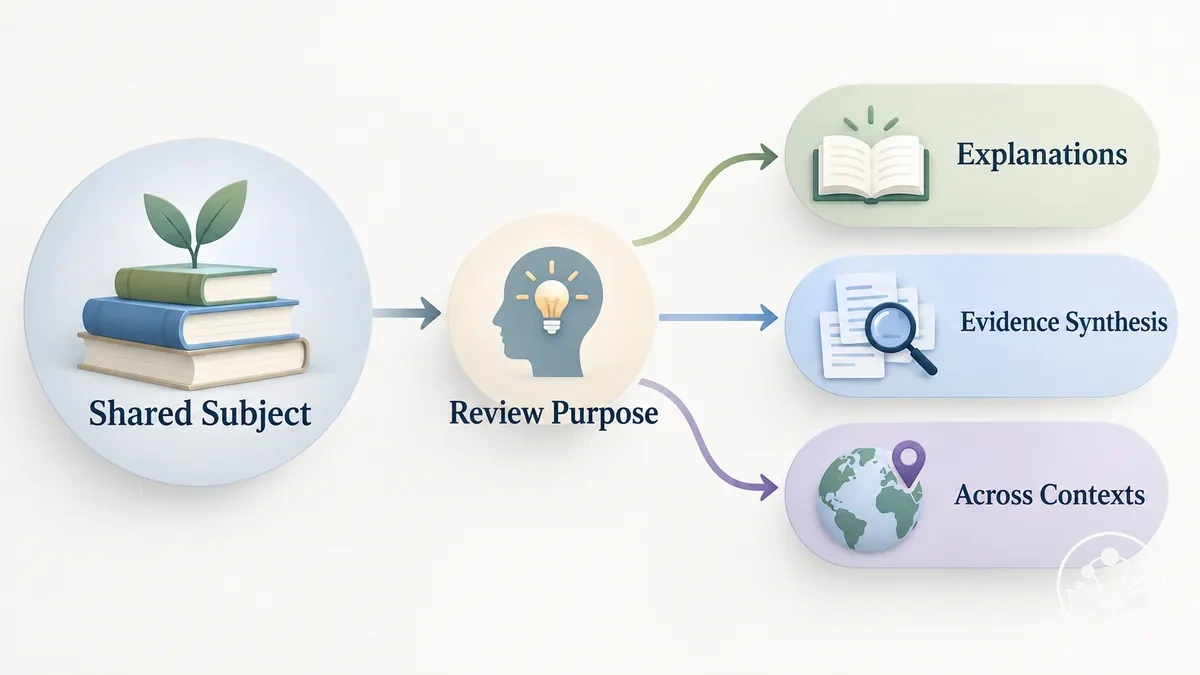
The same subject can require a different scope when the review purpose changes; for example, a review intended to synthesise explanations of a phenomenon would use a different focus from one intended to examine how findings about that phenomenon differ across contexts.
The intended contribution should align with the purpose so that the topic boundaries support the relevant synthesis rather than simply cover an interesting subject.
Purpose guides the scoping decision but does not by itself determine the detailed method, which is considered separately when you choose the review approach.
Availability of Enough Literature to Support the Review
Enough relevant literature must be available to support meaningful synthesis while remaining manageable within the proposed scope.
No universal study count establishes literature sufficiency: too little connected evidence can make the topic difficult to sustain, while an uncontrolled volume of heterogeneous evidence can indicate that further narrowing is needed.
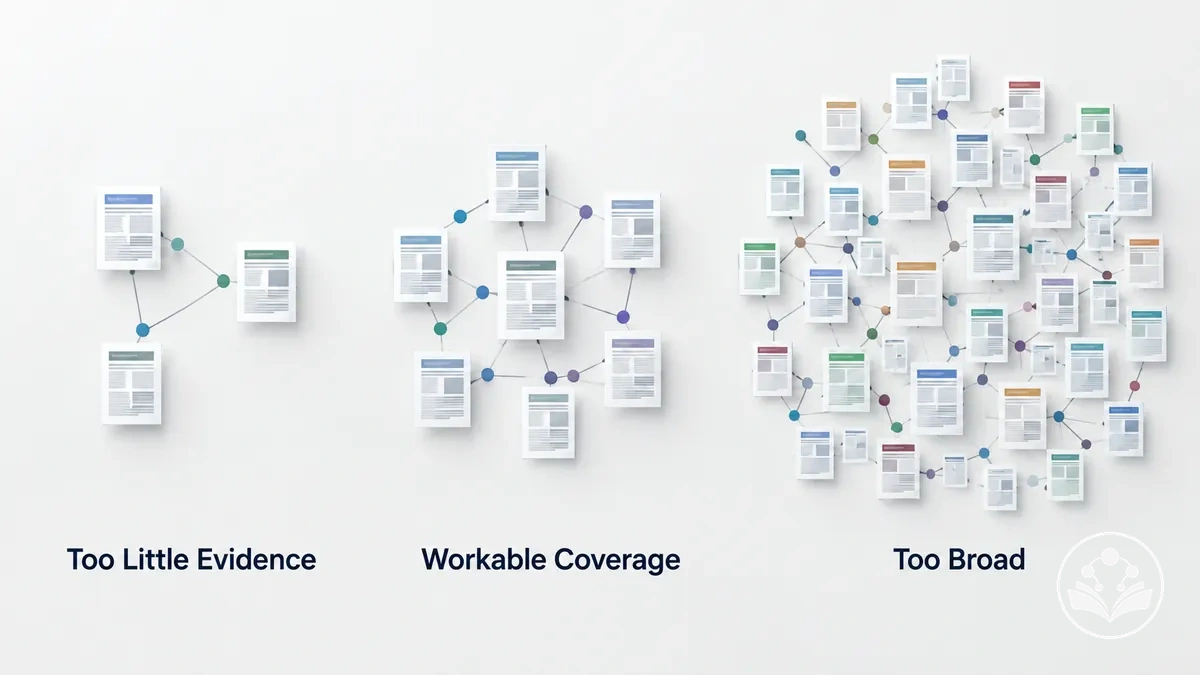
A limited preliminary scan can test whether the evidence base appears reviewable without attempting a complete search.
The check should consider whether available sources provide relevant coverage of the proposed focus, whether recency matters for the review purpose, and whether the literature is sufficiently connected to support synthesis.
Source volume alone does not establish feasibility, so use these dimensions as parallel checks rather than as a required sequence:
- Relevance: the available literature should address the subject and boundaries that the proposed review intends to synthesise.
- Coverage: the source base should provide enough usable evidence across the intended scope; sparse coverage suggests the focus may be unsustainable, while excessive breadth may warrant further narrowing.
- Recency: where current developments are material to the review purpose, the preliminary scan should show evidence recent enough to support that intended coverage.
- Coherence: the evidence should be sufficiently connected to the proposed focus to support a meaningful synthesis rather than merely produce a large set of loosely related sources.
The preliminary scan is a feasibility check, not an exhaustive search or confirmation that all relevant evidence has been retrieved.
Once the topic has sufficient and manageable evidence coverage, the formal process can be developed separately when you plan the literature search.
Whether Existing Reviews Leave a Clear Need for the Topic
Existing reviews weaken the case for another review when they already cover substantially the same purpose and scope adequately, especially when their coverage remains current for the proposed topic.
A different title does not establish a distinct contribution; changed evidence, different boundaries, or an unresolved synthesis need may provide a defensible reason to revisit the topic.

Assess substantive review coverage rather than title similarity by examining how existing reviews overlap with the proposed purpose and scope, how recent that coverage is, and whether the evidence base or intended synthesis has materially changed.
For example, repeating the same purpose and boundaries soon after an adequate review would largely duplicate its contribution, whereas revisiting the subject may be justified when important new evidence changes the available synthesis or when earlier reviews leave a materially different scope unresolved.
These checks help establish whether a defensible synthesis need remains, but they do not by themselves constitute a full research-gap analysis.
- Overlap: if existing reviews already cover substantially the same purpose, population, concepts, and scope, another review may add little distinct contribution.
- Recency: older review coverage may warrant reassessment when developments in the field have materially changed the relevant evidence base, while recent adequate coverage may reduce the need for duplication.
- Changed evidence: new evidence can support an updated synthesis when it materially affects what can be concluded or compared, but its mere existence does not automatically justify another review.
- Scope or synthesis need: a proposed topic may remain defensible when its boundaries, perspective, or unresolved synthesis need differs materially from what existing reviews already cover.
Fit With Available Time and Practical Constraints
A review topic is practical when its expected review depth and breadth fit the available time, workload, access to literature, and other resources.
Practical constraints change the workable scope rather than the topic's intrinsic academic value, so a tighter focus may be necessary when available capacity cannot support a broader treatment at the intended depth.

Each constraint can therefore be paired with a scope adjustment that improves manageability without assuming a universal deadline or ideal topic size:
- Time: less available time generally favours a tighter scope that can be examined at the expected review depth rather than superficial coverage of a broad field.
- Workload: when the breadth or complexity of the proposed topic creates more work than the project can realistically accommodate, narrowing the focus can bring the review scope closer to the available capacity.
- Access: when relevant literature or necessary resources are not practically accessible, the scope may need adjustment toward evidence that can be obtained and evaluated responsibly.
- Review depth: a project requiring deeper analysis may need narrower boundaries than one designed for a more limited treatment of the same general topic.
For example, the same broad topic may be feasible for a long-form project with greater time and resources but require a narrower focus for a shorter assignment with less available capacity.
Feasibility therefore depends on the project's actual constraints and intended depth, not on a universal rule for topic breadth.
When a Review Topic Is Too Broad or Too Narrow
Review topic breadth is too broad or too narrow when its scope prevents a coherent, manageable, evidence-supported synthesis; a workable scope provides enough focus and literature for meaningful analysis without scattering the review across excessive conceptual territory.
No single source count or topic label establishes these states because the appropriate boundary depends on the review purpose, discipline, expected depth, and available evidence.
Diagnosis should compare the same dimensions across each state: literature volume, conceptual spread, manageability, and synthesis potential.
A broad topic tends to encompass heterogeneous literature across many subareas, while an overly narrow topic may leave limited evidence or too little analytical range for useful synthesis.
For example, a general subject such as social media and mental health may be too broad for a focused review, while restricting it simultaneously to one narrowly defined behaviour, population, setting, and short period may produce too little relevant evidence; an intermediate focus can retain a coherent subject while preserving sufficient literature for synthesis.
The comparison below organises these diagnostic signals rather than setting universal thresholds.
| Diagnostic dimension | Too broad | Workable | Too narrow |
|---|---|---|---|
| Literature breadth | Evidence extends across many heterogeneous subareas, suggesting that the proposed scope may require further narrowing. | Literature is sufficiently focused and connected to support the intended review while retaining useful coverage. | Relevant evidence is limited enough that the proposed boundaries may not support the intended synthesis. |
| Conceptual spread | Multiple distinct concepts or subtopics compete for attention, making a coherent review focus difficult to maintain. | Concepts remain sufficiently related to support a coherent scope and a clear analytical focus. | Restrictions leave little conceptual or analytical range beyond a very small part of the subject. |
| Manageability | The breadth creates a review workload or analytical range that may exceed the project's practical capacity. | The scope can be examined at the intended depth within the project's practical constraints. | The scope is manageable, but its restrictions may exclude evidence needed to sustain the intended review. |
| Synthesis potential | Substantial variation across included subareas may make a unified synthesis difficult without clearer boundaries. | The evidence is sufficiently related and substantial to support a meaningful, coherent synthesis. | Too little relevant evidence or analytical variation may remain to support the intended synthesis. |
These signals should guide the next scoping adjustment rather than function as fixed rules for how broad or narrow every review topic must be.
Signs the Topic Is Too Broad
A broad review topic may be too broad when excessive conceptual spread, multiple weakly related or unrelated subtopics, uncontrolled literature volume, or insufficient depth makes a coherent review difficult to sustain.
No single signal proves excessive breadth, and raw search-result counts alone are insufficient because relevance and conceptual coherence matter more than the count itself.
The following cues indicate where excessive breadth may be reducing coherence or manageability:
- Wide conceptual spread: the topic fragments into several distinct concepts or lines of inquiry, suggesting that its boundaries encompass more conceptual territory than can be treated as one coherent focus.
- Weakly related subtopics: the broad topic requires coverage of many unrelated subtopics, making their relationship to a common synthesis increasingly difficult to maintain.
- Uncontrolled literature volume: relevant literature extends across heterogeneous bodies of evidence rather than a connected evidence base, indicating that the scope may be too wide for manageable synthesis.
- Insufficient depth: covering the full scope at the required depth becomes difficult within the project's constraints, suggesting that one or more boundaries need to be constrained to create a manageable scope.
When several of these signals occur together, they support further narrowing of the topic rather than establishing a fixed threshold for excessive breadth.
Signs the Topic Is Too Narrow
A narrow review topic may be over-restricted when too little relevant evidence remains for synthesis, exclusions remove necessary variation, or the remaining analytical range is insufficient for the review purpose.
No universal minimum study count establishes evidence sufficiency, so a small set of relevant studies must be interpreted according to the topic's purpose, scope, and reviewability.
The following cues can indicate that excessive restriction has reduced the evidence or analytical value available to the review:
- Too few relevant studies: the defined scope leaves so little directly relevant evidence that a meaningful synthesis becomes difficult to support, suggesting that the topic may no longer be sufficiently reviewable.
- Restrictive exclusions: exclusions remove evidence needed to represent important variation within the intended subject, indicating that the boundaries may be constraining the review beyond its purpose.
- Limited analytical range: the remaining evidence addresses such a specific set of conditions that meaningful comparison, pattern identification, or synthesis becomes difficult.
- Fragmented evidence sufficiency: relevant studies exist, but they provide too little connected evidence for the intended synthesis, suggesting that the narrow topic may require reconsideration of its boundaries.
A specialist topic can still be appropriately narrow when its purpose justifies the restricted focus and the available evidence remains sufficient for a coherent, reviewable synthesis.
How to Narrow a Broad Topic Into a Workable Review Scope
Narrowing a review topic means reducing one or more meaningful scope dimensions while checking that the remaining topic is still coherent and reviewable.
Select constraints deliberately across the concept, population, context, time period, or methodological focus, then re-check feasibility after each material change rather than narrowing as much as possible.
The sequence is iterative rather than irreversible: each constraint changes both the focus and the evidence that remains relevant.
Testing major constraints one at a time can make their effects easier to identify, although the appropriate order depends on the review purpose.
- Identify the intended focus. State which part of the broad topic the review needs to examine and which relationship or issue should remain central. For a running example, the broad topic “social media and mental health” could first be focused on the relationship between social media use and anxiety, reducing conceptual spread while retaining the central subject.
- Select the relevant scope dimensions. Decide whether the concept, population, context, time period, or methodological focus needs further restriction. In the example, selecting adolescents as the population changes the focus to social media use and anxiety among adolescents; before adding another constraint, check whether the remaining evidence still supports a coherent review.
- Apply a constraint deliberately. Add a restriction only when it serves the intended focus and note what evidence it excludes. Restricting the example to school-based contexts removes studies conducted solely in other settings, so the constraint should be retained only if that context is important to the review purpose.
- Test the remaining evidence and coherence. After a meaningful constraint, check whether the topic remains reviewable: the retained evidence should still address the central concept, selected population or context, and intended analytical focus. If adding a recent time period or a particular methodological focus leaves too little relevant evidence or analytical range for the intended synthesis, that restriction may be too strong.
- Adjust or stop narrowing. Remove, relax, or revise a constraint when it reduces feasibility without adding necessary focus; stop when the topic is focused enough for coherent treatment while the remaining evidence can still support the intended review. The example might therefore retain the adolescent population and school context but omit an unnecessary time-period or methodological restriction if either would exclude evidence needed for synthesis.
The steps can be revisited whenever a constraint removes too much relevant evidence or weakens coherence.
Narrowing is complete for this stage when further restriction would no longer improve the intended focus enough to justify its effect on feasibility and reviewability.
Identify the Aspect of the Topic the Review Needs to Examine
The topic aspect should identify the phenomenon, relationship, population, context, outcome, or controversy that carries the review's main analytical interest.
A defensible focus is the aspect that matters to the review purpose while remaining specific enough to guide sustained examination of the broader subject.
Narrow by Concept, Population, Context, Time Period, or Methodological Focus
Scope dimensions can narrow a broad review topic by limiting one or more boundaries that determine which evidence remains in scope.
Concept, population or cases, context, time period, and methodological focus are parallel options rather than ordered steps, and only the dimensions that materially improve focus without undermining reviewability need to be constrained.
- Concept: narrow the concept by specifying the phenomenon, relationship, outcome, or issue the review will examine. This boundary reduces conceptual breadth and leaves evidence directly connected to the selected topic focus in scope.
- Population or cases: define the population, group, case type, or unit of interest when that distinction is relevant to the review purpose. Doing so limits evidence to the selected population or cases and excludes findings that concern materially different groups.
- Context: restrict the setting, environment, sector, location, or other relevant context when differences between settings would otherwise broaden the review. The resulting scope retains evidence from the chosen context while leaving less relevant settings outside the topic boundary.
- Time period: set a historical range or recency boundary when the timing of the evidence is important to the review purpose. A narrower time period reduces the temporal scope and leaves literature from the selected period in scope without implying that one time window is appropriate for every review.
- Methodological focus: limit the review to a particular methodological perspective or evidence type when that distinction is analytically important. This boundary changes which forms of evidence remain relevant, so it should be used only when the restriction improves the intended focus rather than excluding necessary evidence.
Constrain only the scope dimensions that materially sharpen the topic while leaving enough relevant evidence for a coherent and reviewable synthesis.
Stop Narrowing When the Topic Is Focused but Still Reviewable
Stop narrowing when the review topic is focused enough to have conceptual coherence and manageable breadth, supported by sufficient literature, and still broad enough to support meaningful synthesis.
The stopping point is context-dependent because further restriction can improve focus only until it begins removing evidence or analytical variation needed for the review purpose.
The checks below define a balanced stopping point rather than universal cut-offs.
For example, narrowing a topic to a relevant population may improve coherence, while adding another restriction on context or time period could remove useful evidence without adding meaningful clarity.
- Conceptual coherence: the topic has a stable scope boundary when its central concepts and relationships can be examined together without requiring unrelated lines of inquiry; further narrowing is unnecessary if another restriction would not materially improve that coherence.
- Sufficient literature: enough relevant evidence remains to support the intended review and synthesis. Continue narrowing only when the available literature still covers unnecessary conceptual or contextual breadth; stop when another restriction would remove evidence needed for the analytical purpose.
- Manageable breadth: the scope can be treated at the required depth within the project's practical constraints. A smaller scope is not automatically better once the topic has become manageable.
- Analytical usefulness: the remaining evidence retains enough variation, relationships, or perspectives to support meaningful synthesis rather than only a trivial or overly restricted description.
Once these conditions are satisfied, the scope is sufficiently stable to turn the topic into a review question without continuing to narrow merely for the sake of making it smaller.
How to Define the Final Boundaries of the Review Scope
Final review scope boundaries are explicit decisions about what the review will cover and what it will leave outside its topic-level plan.
A stable final scope states the relevant topic dimensions, inclusion boundaries, deliberate exclusions, and the conditions needed to preserve coherence with the review purpose.
These boundaries should align with the review purpose, the expected evidence base, and practical constraints rather than function as arbitrary limits.
Inclusion defines which aspects of the focused topic belong inside the review, while exclusion and other delimitations identify closely related areas that are intentionally left outside it.
Each boundary therefore affects which evidence remains relevant and how consistently the topic can be treated.
For example, a review focused on social media use and anxiety among adolescents could include adolescents as the population boundary and school settings as the context, while excluding evidence concerned only with unrelated mental-health outcomes.
The following planning sequence formalises decisions already made during narrowing and ends by checking whether the resulting boundaries still describe one coherent review scope:
- Select the relevant topic dimensions. State which dimensions materially define the final scope, such as the central concept, population, context, time period, or methodological focus, without adding restrictions that do not serve the review purpose.
- State the inclusion boundaries. Define the conditions under which an aspect of the topic belongs inside the review, keeping those conditions aligned with the intended focus and expected evidence base.
- State deliberate exclusions and delimitations. Identify related concepts, populations, contexts, periods, or evidence perspectives that remain outside the scope, and make each exclusion consistent with the review purpose rather than incidental.
- Check coherence. Review the inclusion, exclusion, and topic dimensions together to confirm that they describe one recognisable focus, remain practical to examine, and do not remove evidence needed to support the intended analysis.
Set the Scope Across the Relevant Topic Dimensions
Only a scope dimension that materially controls coverage needs an explicit final boundary.
For each relevant concept, population, context, time condition, or methodological focus, state the selected condition and what it means for the in-scope literature; dimensions that do not affect coverage do not need an artificial restriction.
- Concept: set the boundary around the specific phenomenon, relationship, or outcome being examined, leaving literature in scope when it directly addresses that defined concept.
- Population: specify the population or cases covered when this dimension affects the review, so literature concerning that population remains in scope while materially different populations fall outside the boundary.
- Context: define the relevant setting or environment when context controls coverage, limiting the in-scope literature to evidence that addresses that selected condition.
- Time: state a time boundary only when the period is material to the topic, leaving literature within that defined period in scope and literature outside it beyond the final scope condition.
- Methodological focus: specify a methodological boundary only when the type or perspective of evidence materially defines the topic, so the in-scope literature reflects that methodological focus without making it a study-level screening protocol.
Document these final boundary conditions as the scope that has already been chosen rather than using them to begin another round of narrowing.
State What the Review Will Cover
A review scope statement should state positively what the review will cover by naming the subject, relevant population or cases, context, time period, and level of analysis where those boundaries matter.
The statement should combine only the boundaries that define the intended coverage rather than imply that every possible scope dimension must be specified.
“This review examines the relationship between social media use and anxiety among adolescents in school settings during the defined review period, with analysis focused on reported patterns and relationships.”
- Subject
- Social media use and anxiety
- Population
- Adolescents
- Context
- School settings
- Time boundary
- The defined review period
- Level of analysis
- Reported patterns and relationships
Together, these phrases make the review scope operational by expressing the included focus in one positive statement.
Deliberate exclusions can be documented separately without converting the coverage statement into a study-level eligibility protocol.
Use Delimitations to State What the Review Will Deliberately Exclude
Delimitations are deliberate boundaries that specify what the review will not cover.
Each exclusion reflects a chosen scope boundary and should have a clear rationale connected to the intended review coverage rather than simply removing evidence that is inconvenient to address.
Key distinction
Delimitation
An intentional scope choice that defines what the review will not cover and is set as part of the review plan.
Limitation
A constraint on what the review can accomplish that is not simply chosen as a scope boundary.
For example, a review of social media use and anxiety among adolescents in school settings may include school-based contexts while deliberately excluding workplace contexts because they fall outside the defined population and setting; restricted access to relevant literature, by contrast, would be a limitation when it constrains the review without being an intentional scope choice.
How to Prevent Scope Creep During the Review
Scope creep is uncontrolled expansion beyond the agreed review boundaries, such as adding concepts, populations, contexts, time periods, or methods that extend the original focus without a deliberate revision.
A justified change is not scope creep when new information materially affects feasibility or coherence and the boundary is formally reconsidered against the review purpose.
The written scope provides the comparison baseline for every proposed addition because it records the boundaries that currently define the review.
An addition that conflicts with those boundaries can increase workload and weaken coherence by introducing material that no longer serves the same focus.
However, a boundary can be revised when the proposed change is necessary to preserve the review purpose, feasibility, or a coherent evidence base.
For example, an attractive new subtopic should be rejected when including it would shift the review away from its agreed central focus.
Use the following troubleshooting sequence to test each proposed addition against the written scope and determine whether it fits, should be rejected, or requires a controlled revision:
- Identify the proposed addition. State the new concept, population, context, time period, or methodological focus and identify which existing boundary it would affect.
- Test its fit with the written scope. Check whether the addition remains within the agreed focus and supports the same review purpose; if it introduces a materially different focus, treat it as a boundary change rather than an automatic inclusion.
- Assess the consequences. Determine whether including the addition would change coherence, workload, feasibility, or the evidence needed to sustain the intended review.
- Reject or formally revise the boundary. Reject an addition that expands the review without sufficient scope-based justification. If new information makes the change necessary for the review purpose or coherence, revise the affected boundary explicitly so the written scope reflects a controlled revision rather than unrecorded scope drift.
Use the Written Scope to Evaluate Proposed Additions
Every proposed addition should be compared with the written scope before inclusion.
A new source, subtopic, population, context, or time period fits when it remains relevant to the review purpose and within the existing boundaries; novelty or interest alone does not establish relevance.
The decision should consider relevance, boundary fit, coherence, and workload together.
An addition can be included when it supports the existing focus without requiring a scope change, while a mismatch indicates that inclusion would require re-scoping rather than treating the new material as automatically in scope.
- Purpose relevance: if the proposed addition directly supports the existing review purpose, it remains a candidate for inclusion; if it addresses a materially different purpose, inclusion would require reconsidering the scope.
- Boundary fit: if the addition fits the stated concept, population, context, time, or methodological boundary that applies to it, it can remain within the existing scope; if it conflicts with a stated boundary, it requires a scope change before inclusion.
- Coherence effect: if the addition preserves the review's central focus and can be synthesised with the in-scope material, it supports coherence; if it introduces a separate line of inquiry, including it would expand the scope beyond the existing focus.
- Workload effect: if the work created by the addition remains a consequence of covering the agreed scope, workload alone does not make it out of scope; if the extra workload results from adding material beyond the written boundaries, that consequence supports treating it as a scope change rather than routine inclusion.
For example, a newly found source about the already defined population and central relationship may fit the written scope, whereas adding a different population that the current boundary does not cover would require formal re-scoping before inclusion.
Revise the Scope Only When New Information Changes Its Feasibility or Coherence
Revise the scope when new information materially changes the review's feasibility or coherence, not merely because adjacent material is interesting.
Revision test
Revise the affected boundary when…
- the current scope becomes impractical to complete at the intended depth;
- too little relevant evidence remains to support the intended synthesis; or
- the boundary makes the topic conceptually difficult to synthesise coherently.
Then: change only the affected boundary, document why, and reassess how the change alters the literature that remains in scope.
Do not expand the scope when…
the adjacent material is merely interesting and the existing scope remains feasible, coherent, and aligned with the review purpose. Frequent re-scoping without a material reason is scope creep, not controlled revision.
Example: widening an overly narrow population boundary can be justified when it leaves insufficient relevant literature; adding a separate interesting subtopic that does not solve a feasibility or coherence problem is an unjustified expansion.
After any justified boundary revision, re-check the resulting evidence coverage, coherence, and workload so the revised scope remains aligned with the review purpose.