
Pre-Submission Quality Checklist for a Review Article
Before submitting a review article, verify that its purpose and scope match the evidence reviewed, the chosen review approach is reported transparently, the synthesis supports its claims with proportionate certainty, the manuscript is coherent and clear, and the paper fits the target journal’s current requirements. Submission-ready means these applicable checks are satisfied; it does not guarantee editorial acceptance or publication.

Pre-submission readiness tracker
Tick an area after you have checked the manuscript against the criteria described in this article. The tracker organizes the final review; it is not a publication score and does not replace journal-specific instructions.
Main dependency: the exact checks vary by review type, discipline, and target journal. Apply only criteria relevant to the manuscript, then verify the journal’s current instructions immediately before submission.
Narrative, systematic, scoping, and other review approaches can require different levels of methodological detail and reporting, but the final quality check has the same core purpose: confirm that the completed manuscript is internally coherent, appropriately supported, and compliant with the requirements that apply to it.
Table of Contents
Check the Review's Purpose and Scope
The review purpose, review question, and scope should describe the same intended inquiry, with the manuscript's boundaries matching what the review claims it will examine.
Alignment is present when the stated aim defines a clear area of inquiry and the evidence coverage and synthesis remain within that area.
A mismatch occurs when the manuscript materially broadens, narrows, or shifts those boundaries without explaining the change.
Scope variables such as population or concept, setting, time period, and study type apply only when they are relevant to the chosen review approach.
For systematic reviews, the Cochrane Handbook explains that well-formulated review questions guide eligibility criteria, searching, data collection, synthesis, and presentation, illustrating why the stated question should remain connected to the evidence ultimately represented.
The following checks distinguish purpose clarity, scope boundaries, and evidence-to-scope consistency so that scope drift can be identified before it weakens relevance and coherence.
The diagram makes this relationship visible by showing how the stated review purpose should constrain the evidence considered and where out-of-scope material creates a mismatch.
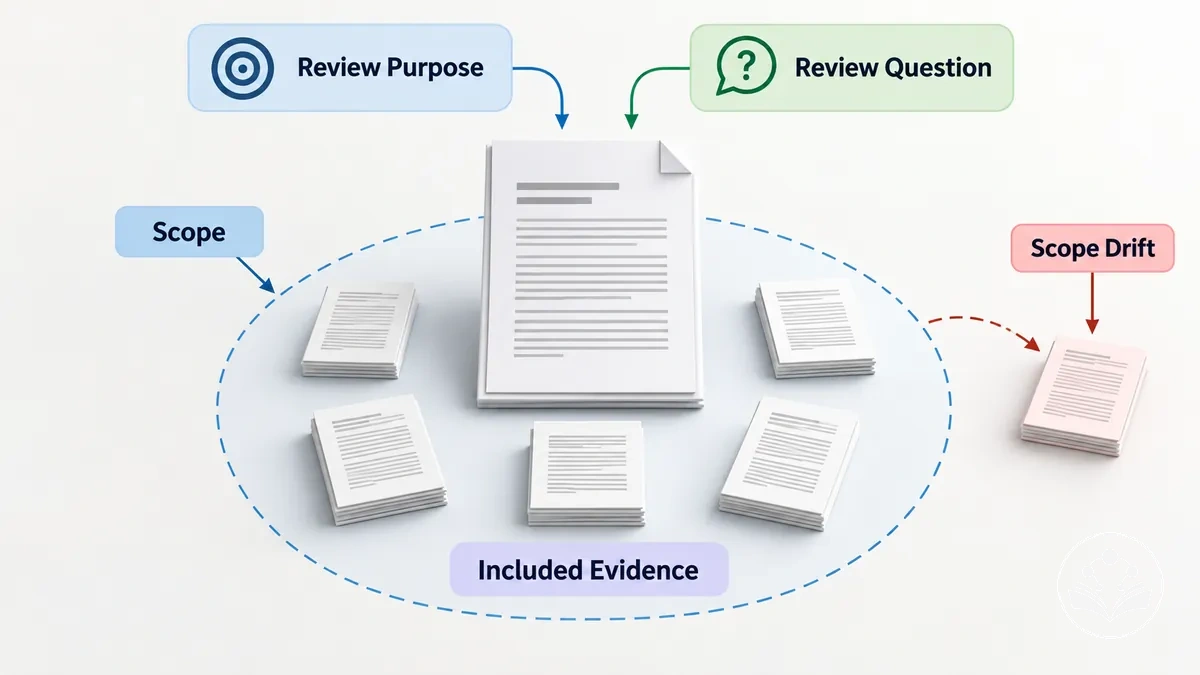
- Purpose clarity: Check whether the review purpose states the inquiry the manuscript actually addresses; a purpose that describes a different problem from the analysis creates a mismatch between the stated aim and the review's contribution.
- Review-question alignment: Check whether the review question expresses the same substantive inquiry as the stated purpose; a question that introduces a different population, concept, intervention, outcome, or other relevant dimension changes the intended scope.
- Scope boundaries: Check whether the manuscript consistently applies the boundaries that are relevant to that review, such as population or concept, setting, period, or study type; unexplained changes make the limits of the review unclear.
- Evidence coverage: Check whether the included evidence remains within the stated scope and adequately represents the inquiry the review claims to examine; material outside those boundaries can indicate scope drift, while omitted in-scope evidence may leave the stated purpose incompletely represented.
- Synthesis consistency: Check whether the synthesis interprets the same evidence domain defined by the purpose and scope; conclusions based on a broader or narrower evidence domain than the stated boundaries reduce alignment between the review's aim, evidence coverage, and final interpretation.
The Review Question and Scope Stay Aligned
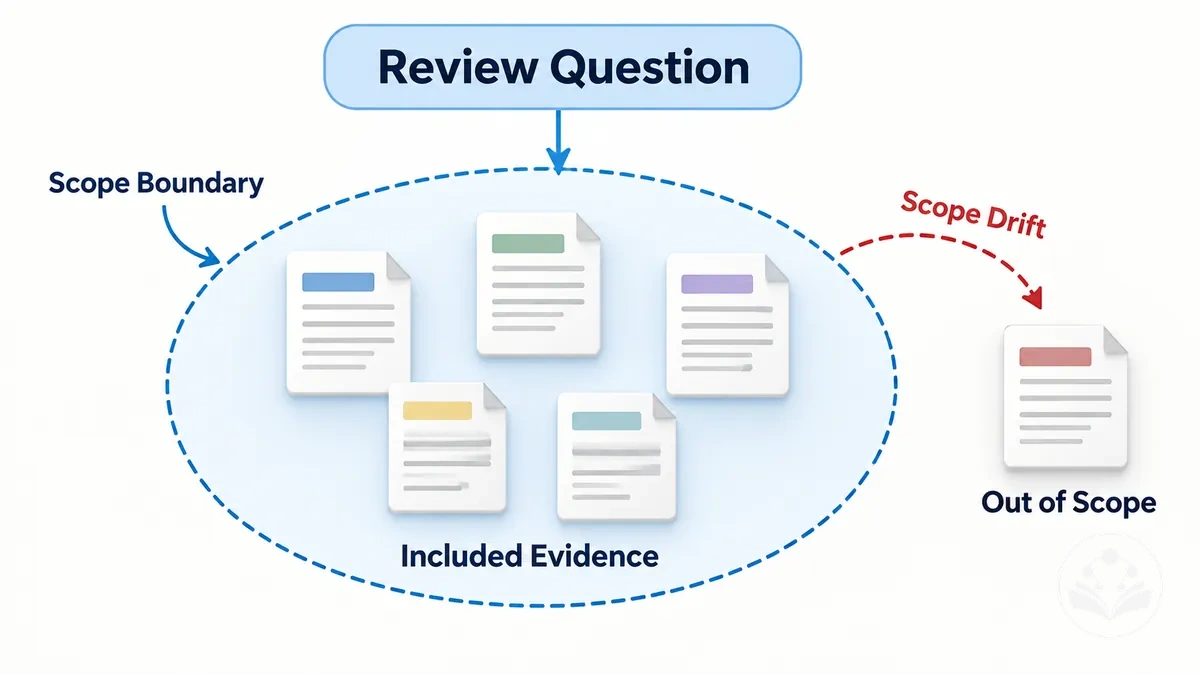
The review question and scope are aligned when the included evidence and synthesis remain within the boundaries implied by the question.
Which boundaries matter depends on the review design: relevant conditions may include a population or concept, setting, time period, study type, or another explicitly stated scope limit.
Comparing those stated boundaries with actual manuscript coverage makes unexplained scope drift visible.
The visual maps the review question to its inclusion boundary and distinguishes evidence that fits the stated scope from material that falls outside it.
An explicitly explained refinement can remain coherent with the review question, whereas unexplained broadening or narrowing changes the observed coverage without a corresponding change to the stated scope.
- Population or concept: When this dimension is part of the review question, check whether the included evidence represents the stated population or concept; unexplained inclusion of materially different subjects broadens the scope.
- Setting: When the question specifies a setting or context, compare that boundary with the settings represented in the included evidence; coverage outside it indicates expansion unless the manuscript explains the change.
- Time period: When a time limit defines the inquiry, check whether the evidence coverage remains within that stated period; silently extending or shortening the period creates a mismatch between the review question and observed coverage.
- Study type: When the review question limits eligible study types, verify that the evidence and synthesis follow that boundary; unexplained inclusion or exclusion of other study types changes the scope being synthesized.
- Other stated conditions: Check any additional boundary explicitly built into the review question against the included evidence and synthesis; a material departure that is not explained indicates scope drift.
The Review Explains Its Significance and Relevance to the Field
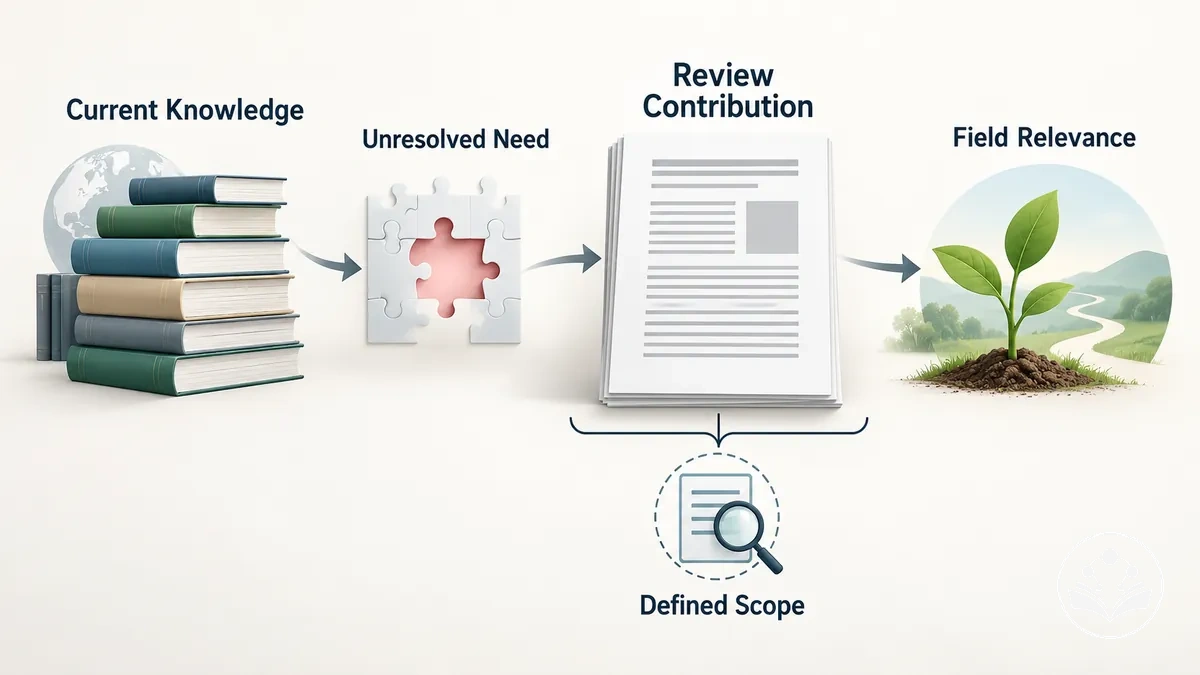
Review significance is demonstrated when the manuscript identifies a specific unresolved need in current knowledge and explains a credible contribution that is relevant to the field within the review's scope.
A rationale supported by the state of the literature is more informative than a generic statement that the topic is important because it connects the claimed significance to an identifiable need and to what the review can actually contribute.
The contribution should remain proportionate to the evidence the review examines and the scope it defines; relevance is supportable when the literature context shows why the unresolved need matters and how the review addresses it.
The image clarifies this relationship by showing an existing body of knowledge, an unresolved area, and a bounded review contribution rather than implying unsupported novelty or impact.
- Unresolved need: Check whether the manuscript identifies a specific limitation, uncertainty, inconsistency, or unanswered issue in current knowledge; without an identifiable need, the significance claim remains generic.
- Contribution: Check whether the review states what its synthesis contributes in relation to that need; a contribution that exceeds what the reviewed evidence can support overstates the manuscript's significance.
- Field relevance: Check whether the manuscript connects its contribution to the literature context and explains why it is relevant to the field; unsupported claims of novelty or importance do not establish evidence-based relevance.
- Scope fit: Check whether the claimed contribution remains within the review's defined scope; claims extending beyond the evidence and boundaries of the review weaken the support for its stated significance.
Check Method Transparency and Evidence Coverage for the Chosen Review Approach
Methodological transparency should be judged relative to the chosen review approach and its reporting expectations, not against one universal procedure.
Narrative, systematic, scoping, and other review types can require different levels and forms of methodology reporting.
The manuscript should therefore report enough method information for readers to understand how the evidence base was identified, bounded, and interpreted for the approach it claims to use.
The visual organizes these reporting relationships around the chosen review approach rather than presenting them as a universal research workflow.
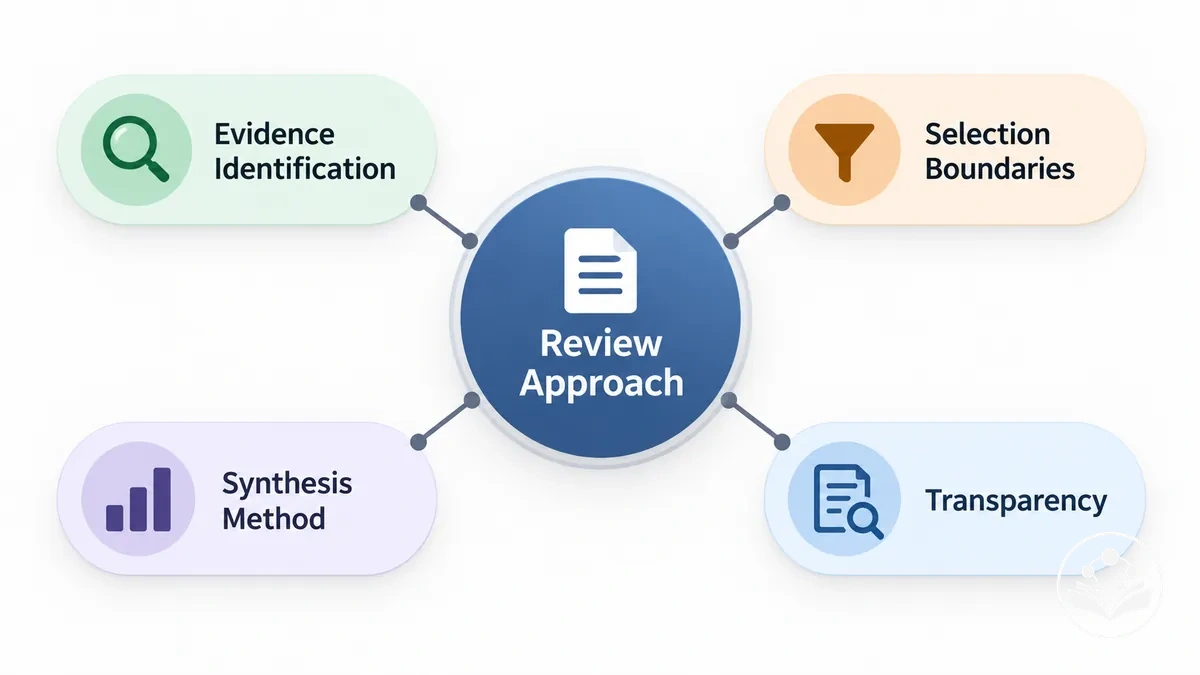
The main checks concern evidence identification, selection logic, evidence coverage, and synthesis method.
Each should be reported at the level needed to interpret how the review moved from its intended evidence base to its synthesis, while any limitations affecting coverage or interpretation should remain visible.
The reporting expectation should therefore follow the declared review type rather than assume that procedures appropriate to one approach apply to all reviews.
- Declared review approach: Check whether the manuscript identifies the review approach it uses and reports methodology consistent with that approach; an unclear or inconsistent declaration makes the remaining method information difficult to interpret.
- Evidence-identification logic: Check whether the manuscript explains how relevant evidence was identified at the level appropriate to the review type; insufficient reporting leaves readers unable to understand where the evidence base came from.
- Selection logic: Check whether the manuscript identifies the boundaries or criteria used to determine which material contributed to the review; unclear selection boundaries make evidence coverage difficult to evaluate.
- Evidence coverage: Check whether the reported methodology allows readers to understand what body of evidence was covered and any stated limitations affecting that coverage; unexplained gaps between the reported method and the represented evidence weaken transparency.
- Synthesis method: Check whether the manuscript explains how the selected evidence was organized, combined, or interpreted in a manner appropriate to the chosen review approach; an unspecified synthesis method obscures how the evidence led to the review's interpretation.
- Method consistency: Check whether the reported evidence identification, selection logic, and synthesis method remain consistent with one another and with the declared review approach; material inconsistencies should be explained rather than left implicit.
The Review Method Is Transparent for Its Chosen Approach
A review method is transparent when the manuscript identifies the review type and reports the methodological decisions needed to understand how evidence was identified, selected, and synthesized, with the depth of reporting matched to that review approach.
The image labels the core method decisions readers should be able to locate in the manuscript and shows their connection to traceability.
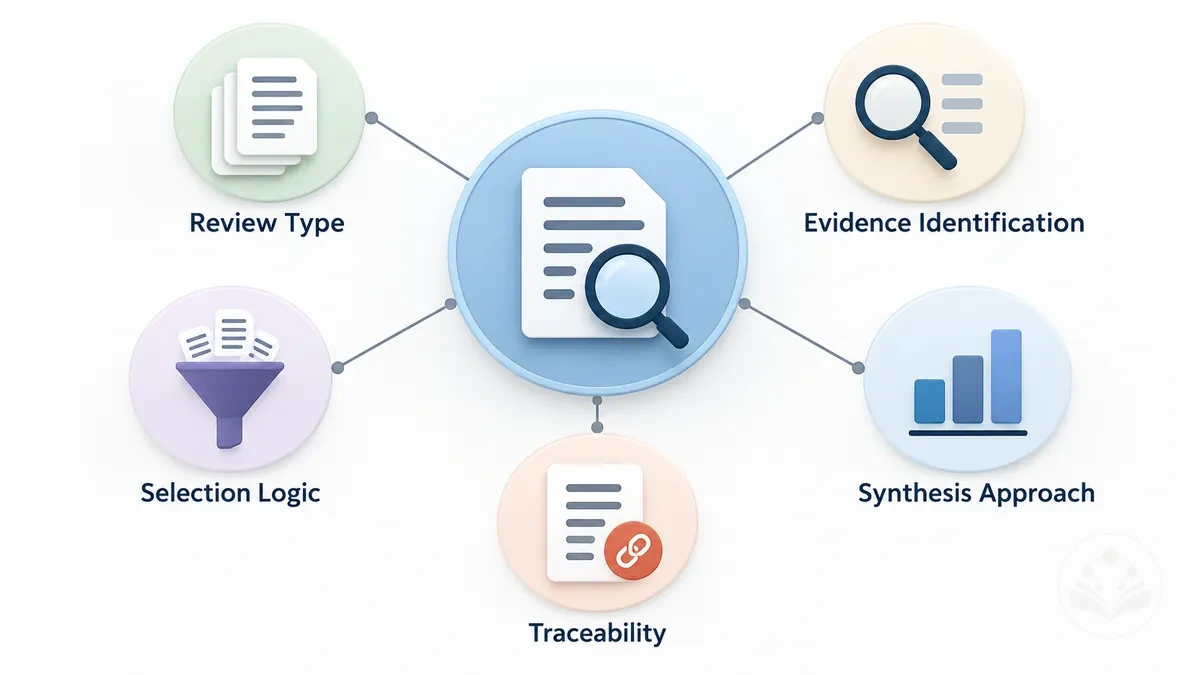
Traceability depends on whether readers can follow the material methodological decisions from the reporting provided; reproducibility is an appropriate expectation only where the review type and its methodology support it.
Missing information about a material decision limits interpretation because readers cannot determine how that part of the evidence base or synthesis was handled.
- Review type: Check whether the reporting names the chosen review type and makes its methodological approach identifiable; without that declaration, readers lack the frame needed to interpret the other reported decisions.
- Evidence-identification method: Check whether the manuscript reports how evidence was identified at the level relevant to the chosen review method; missing identification logic limits traceability of where the reviewed evidence came from.
- Selection logic: Check whether the manuscript documents the conditions used to include or exclude material when selection is part of the approach; absent or unclear selection logic makes the boundaries of the represented evidence harder to interpret.
- Synthesis approach: Check whether the manuscript specifies how the selected evidence was organized, combined, or interpreted; missing synthesis information weakens the trace between the evidence considered and the conclusions drawn from it.
- Material deviations: When the review method departs materially from its stated or planned methodology, check whether the reporting identifies and explains the deviation; an unexplained change can obscure how the final evidence base or synthesis was produced.
The Literature Coverage Matches the Stated Scope and Selection Logic
Literature coverage is adequate when the included evidence matches the review's declared scope and selection logic, not simply when the manuscript contains a large source count.
The appropriate breadth depends on the review type and the boundaries the manuscript states for the evidence it intends to represent.
Coverage should therefore be evaluated against relevant topical, time, setting, or other declared limits and against how the manuscript handles important contrary evidence within those limits.
Unexplained omission of relevant evidence, extension beyond the declared boundaries, or selective emphasis can weaken interpretation when these patterns are inconsistent with the stated selection logic.
The following checks compare each relevant scope condition with the literature actually represented in the manuscript.
- Breadth: Check whether the included evidence provides the breadth required by the declared scope and review type; a high source count alone does not establish adequate literature coverage, while narrower coverage can be appropriate when the stated boundaries justify it.
- Topical fit: Check whether the represented literature addresses the topics, concepts, populations, or other subject boundaries specified by the declared scope; substantial evidence outside those boundaries can indicate overextension when the manuscript does not explain its inclusion.
- Time or setting limits: When the selection logic specifies a time period, setting, or comparable boundary, check whether the included evidence follows that condition; unexplained material outside the limit makes the relationship between the stated selection logic and observed evidence coverage unclear.
- Contrary evidence: When important contrary evidence falls within the declared scope and selection logic, check whether the manuscript represents it rather than selectively emphasizing only evidence consistent with one interpretation; unexplained exclusion can support a concern about selective emphasis, although it is not by itself universal proof of poor review quality.
- Selection consistency: Compare the manuscript's stated inclusion logic with the studies or other evidence actually discussed; unexplained omissions, inclusions beyond the declared scope, or selective emphasis indicate a mismatch between the declared selection logic and the represented literature.
Evaluate Synthesis, Evidence Support, and Argument Strength
Strong evidence synthesis integrates the reviewed evidence into an analytical argument, provides claim support for substantive interpretations, and calibrates argument strength to what the evidence can justify.
The manuscript should connect patterns across studies while accounting for relevant contradictions and limitations rather than presenting disconnected summaries.
Evidence consistency can strengthen an interpretation, whereas mixed, contradictory, or limited evidence should constrain the certainty and breadth of the resulting conclusion.
Synthesis quality, claim support, and argument proportionality are related but distinct checks.
Synthesis evaluates whether studies are integrated around patterns, differences, contradictions, and limitations; claim support evaluates whether substantive claims are traceable to relevant reviewed evidence; proportionality evaluates whether argument strength reflects the consistency, uncertainty, and limitations of that evidence.
Citation volume alone does not establish any of these qualities.
The table separates these dimensions so the evidence pattern, analytical claim, and resulting argument strength can be evaluated together.
| Evaluation dimension | Evidence pattern to check | Implication for the argument |
|---|---|---|
| Synthesis across studies | Check whether the manuscript integrates agreements, differences, contradictions, and limitations across the reviewed evidence instead of listing study findings independently. | Integrated patterns support synthesis; disconnected summaries leave the analytical relationship among studies unclear. |
| Support for substantive claims | Check whether each important claim and interpretation is supported by relevant reviewed evidence and qualified when the evidence is contradictory, limited, or context-dependent. | Relevant evidence supports the claim within its evidential boundaries; unsupported or selectively supported interpretation weakens claim support. |
| Proportionality of the argument | Check whether argument strength reflects the degree of evidence consistency, contradiction, uncertainty, and limitation represented in the synthesis. | Greater evidence consistency can justify a firmer interpretation, while mixed or limited evidence calls for a narrower or more qualified conclusion. |
For example, when several reviewed studies point in the same direction but important contradictions or limitations remain, a supported interpretation can describe the dominant pattern while explicitly qualifying those constraints.
Presenting the same evidence as conclusive would overstate what the synthesis supports; defensible reasoning keeps the analytical claim proportionate to the reviewed evidence.
Claims and Interpretations Are Supported by the Reviewed Evidence
A claim is adequately supported when the reviewed evidence cited for it is relevant to that claim and the wording reflects the strength and limitations of the evidence.
Citation presence alone is not enough; the claim should be traceable to evidence that actually supports the interpretation being made.
- Citation relevance: Check whether each important claim is supported by reviewed evidence that directly addresses the assertion; an unrelated or only loosely connected citation does not provide adequate support.
- Contradiction handling: Check whether material contradictory evidence is represented and incorporated into the interpretation; ignoring relevant contradiction can make the claim appear stronger or more consistent than the evidence supports.
- Causal language: Check whether causal wording matches the designs and findings of the reviewed studies; evidence of association does not by itself justify a causal claim.
- Qualification: Check whether limitations, uncertainty, and conditions are reflected in the wording of the claim; stronger wording requires correspondingly stronger evidential support.
- Generalization limits: Check whether the interpretation stays within the populations, settings, conditions, and evidence boundaries actually reviewed; extending beyond those limits requires support that is not supplied merely by citation presence.
The Synthesis Connects Findings, Contradictions, and Limitations Across Studies
A strong synthesis connects findings across studies by identifying recurring patterns, contradictions, contextual differences, and limitations that affect interpretation rather than presenting each study as an isolated summary.
The synthesis should make those relationships explicit and show how they shape the overall conclusion.
Differences among studies may relate to populations, settings, methods, or other relevant conditions, but the manuscript should only use such factors to explain divergence when the reviewed evidence supports that interpretation.
Genuine synthesis therefore connects an observed pattern or contradiction to the conditions that qualify it and then to its interpretive implication, without forcing agreement where the evidence remains mixed.
- Recurring findings: Check whether the synthesis identifies findings that recur across multiple studies and explains what that pattern indicates for the review's interpretation rather than repeating similar results study by study.
- Contradictions: Check whether meaningful disagreements among studies are made explicit and linked to relevant conditions when the evidence supports such an explanation; unresolved contradiction should qualify interpretation rather than be hidden or treated as automatic failure.
- Contextual differences: Check whether differences in populations, settings, methods, or other study conditions are used to contextualize divergent findings where appropriate; unsupported explanations for those differences should not be presented as established causes.
- Limitations: Check whether limitations that affect comparison or interpretation across studies are incorporated into the synthesis; material limitations should constrain the strength or breadth of the conclusion when they reduce confidence in the observed pattern.
- Interpretive connection: Check whether the synthesis links the combined pattern, contradictions, contextual differences, and limitations to the review's overall interpretation; a sequence of isolated study summaries does not provide the same analytical connection.
Verify Manuscript Structure and Coherence
Manuscript structure is coherent when each major part performs a clear function in relation to the review aim and contributes to one continuous argument.
Structural coherence depends on how sections connect and progress, not on following one universal section order.
The appropriate organization may vary by review type, discipline, and journal conventions, but each part should support the manuscript's overall logic without unnecessary repetition.
The quality check should test whether section order supports logical progression, whether transitions preserve the context needed to follow the argument, whether evidence placement keeps supporting material close to the interpretation it informs, and whether the discussion prepares the conclusion.
The following checklist evaluates these structural relationships rather than prescribing a fixed manuscript template.
- Section function: Check whether each major section has a distinct role that supports the review aim; unclear or duplicated functions can create repetition and weaken coherence.
- Section order: Check whether the major parts follow a logical sequence for the chosen review type; an order that separates dependent ideas or introduces conclusions before their support can disrupt progression.
- Transition continuity: Check whether transitions connect the context and reasoning between sections; abrupt shifts can make related parts read as separate discussions rather than one argument.
- Evidence placement: Check whether evidence appears close to the claim or interpretation it supports; separating evidence from its analytical use can make the relationship harder to follow.
- Conclusion preparation: Check whether the preceding discussion develops the reasoning needed for the conclusion; a conclusion that introduces unsupported ideas or exceeds what earlier sections establish weakens structural coherence.
- Repetition control: Check whether major points are repeated only when they perform a new structural function; unnecessary repetition can obscure progression and make section boundaries less distinct.
This is a finished-manuscript quality check rather than a rewrite workflow: the aim is to identify where structural relationships fail, not to impose one universal organization.
When a structural problem requires broader reconstruction rather than local correction, use the detailed guidance to check manuscript structure without expanding this coherence check into a full section-by-section writing guide.
Sections Progress Logically From the Review Aim to the Conclusions
- Review aimEach major section advances or answers part of the stated inquiry.
- Evidence organizationEvidence is placed where it prepares the synthesis and keeps supporting material close to the interpretation it informs.
- Synthesis and interpretationThe manuscript connects evidence into the analytical move that prepares the final conclusion.
- ConclusionConcluding claims remain within what the preceding synthesis has established.
The exact section order can vary by review type and discipline; the requirement is a traceable reasoning sequence, not one universal template.
Breaks in continuity appear when a transition introduces a new direction without sufficient context, evidence is placed away from the interpretation it supports, or a conclusion introduces a claim that the preceding synthesis did not prepare.
The following checks test whether each section purpose connects logically to the next analytical move and preserves coherence toward the conclusion.
- Review-aim continuity: Check whether each major section clearly advances or answers part of the review aim; material that does not contribute to that purpose can interrupt logical progression.
- Section purpose: Check whether each section performs a clear analytical function and prepares the next move in the reasoning sequence; an unclear function can make the progression difficult to follow.
- Transition logic: Check whether each transition preserves the context needed to understand why the manuscript moves from one section or analytical point to the next; an abrupt shift can create a logical break.
- Evidence organization: Check whether evidence is introduced where it supports the developing analysis and leads naturally into synthesis or interpretation; misplaced evidence can separate support from the reasoning it is meant to advance.
- Synthesis to interpretation: Check whether the interpretation follows from the patterns, contrasts, and limitations established in the synthesis; an interpretive move that is not prepared by that analysis interrupts continuity.
- Interpretation to conclusion: Check whether the conclusion follows from the reasoning established earlier in the manuscript; introducing a conclusion that was not supported or prepared by the preceding synthesis indicates a break in logical progression.
The Discussion and Conclusion Remain Consistent With the Synthesis
The discussion and conclusion should remain proportionate to the synthesis, with each interpretation and concluding claim reflecting what the synthesized evidence can reasonably support.
Major findings may justify a firmer conclusion when they are consistent and well supported, whereas mixed, contradictory, or limited evidence calls for corresponding qualification.
Consistency requires the discussion to interpret the major findings without ignoring material contradictions or limitations that change their meaning.
The conclusion should reflect that same evidence state rather than introduce unsupported new claims or stronger certainty than the synthesis provides.
The following checks test whether each interpretive statement and concluding claim stays within the evidence boundary established by the synthesis.
- Major-findings alignment: Check whether the discussion interprets the major findings actually established in the synthesis; interpretations that depend on findings not developed there exceed the analytical basis of the review.
- Limitations: Check whether material limitations identified in the synthesis remain visible in the discussion and conclusion; omitting them can make the final interpretation appear stronger than the evidence supports.
- Contradictions: Check whether important contradictions or mixed findings are reflected in the interpretation; a conclusion that presents mixed evidence as uniformly consistent overstates the synthesis.
- Conclusion proportionality: Check whether the strength and breadth of the conclusion match the synthesized evidence; limited or context-dependent findings support a narrower or more qualified conclusion than consistently supported findings.
- Unsupported new claims: Check whether the discussion or conclusion introduces a substantive claim that was not supported by the preceding synthesis; new unsupported claims break consistency between the analysis and the manuscript's final interpretation.
For example, when the synthesis shows a recurring pattern alongside meaningful contradictions, a proportionate conclusion can state the pattern while qualifying the disagreement rather than presenting the finding as definitive.
Once this consistency check is complete, use the detailed guidance to review the discussion and conclusion when broader revision of those sections is needed.
Refine Clarity and Editorial Consistency
Editorial clarity should be refined only after the manuscript's substantive logic and evidence relationships are stable, with each revision improving comprehension without changing the intended meaning.
- Locate the frictionStart from the current wording and identify the specific ambiguity, cohesion problem, or unnecessary complexity that obstructs comprehension.
- Revise the local problemChange only what improves clarity while preserving necessary technical distinctions and the strength of the original claim.
- Reread in contextConfirm that the surrounding passage is clearer and that the claim, qualification, and technical precision still mean the same thing.
The main checks concern terminology, sentence clarity, paragraph cohesion, transitions, redundancy, and editorial consistency.
Each variable should be evaluated for its effect on comprehension rather than cosmetic preference.
The following criteria test whether a local revision improves readability while preserving the intended meaning and interpretation.
- Terminology: Check whether the same concept is named consistently unless a distinction is intentional; unnecessary term changes can make one entity appear to be several different concepts.
- Sentence clarity: Check whether each sentence expresses its main relationship without avoidable ambiguity, excessive nesting, or unclear reference; revise the friction while preserving the intended meaning and necessary qualification.
- Paragraph cohesion: Check whether the sentences in each paragraph develop one primary idea and whether supporting details remain connected to it; unrelated or loosely connected material can weaken comprehension.
- Transitions: Check whether each transition makes the logical connection between adjacent ideas clear; revise abrupt or misleading transitions so the reader can follow the intended relationship without adding unsupported certainty.
- Redundancy: Check whether repeated wording, claims, or explanations add a new function; remove repetition that adds no information while retaining repetition needed for qualification, contrast, or contextual continuity.
- Editorial consistency: Check whether capitalization, terminology, tense, abbreviations, and comparable editorial choices remain consistent where the manuscript intends the same meaning; inconsistent treatment can create avoidable interpretation friction.
When the same problems recur across many sections, they may indicate a broader writing failure rather than an isolated edit; in that case, use the guidance on common review article mistakes to identify the wider corrective direction.
Terminology and Key Concepts Remain Consistent
Terminology should remain consistent throughout the manuscript so that each key concept retains the meaning established by its definition, unless a change in wording deliberately marks a real conceptual distinction.
A term should not shift meaning merely for stylistic variation, because terminology drift can change how later findings or interpretations are understood.
Acronyms, category labels, and naming conventions should follow the same underlying meaning each time they are used, while genuinely different concepts should remain distinguishable even when their names are similar.
For example, if a manuscript defines “treatment adherence” as one construct but later uses “compliance” as though it were identical without explaining the relationship, the synthesis may appear inconsistent even when the underlying evidence is not.
- Definition consistency: Check whether each key term continues to refer to the same defined concept throughout the manuscript; a later change in meaning without explanation indicates terminology drift.
- Acronym use: Check whether each acronym refers consistently to the same term or construct after it is introduced; reusing an acronym for a different meaning can create ambiguity in interpretation.
- Synonymous labels: Check whether alternative labels genuinely refer to the same concept before treating them as interchangeable; stylistic synonym variation should not obscure distinctions that matter to the synthesis.
- Category labels: Check whether category names remain stable across sections and whether any changed label reflects an intentional conceptual distinction rather than accidental renaming.
- Naming conventions: Check whether capitalization and comparable naming choices remain consistent where they identify the same concept, while allowing variation when the manuscript or journal context requires a meaningful distinction.
- Conceptual distinction: When terminology changes deliberately, check whether the manuscript explains how the new term differs from the earlier one; an unexplained change can make separate concepts appear identical or one concept appear to change across the review.
Sentences and Paragraphs Are Clear, Concise, and Cohesive
Sentence clarity is present when each sentence states its claim precisely, preserves necessary qualification, and avoids ambiguity that makes the intended meaning harder to interpret.
Paragraph cohesion is present when each paragraph develops one analytical unit and connects that unit clearly to the surrounding discussion.
Complexity should be reduced only where it creates comprehension friction, not simply because a sentence is long or technical.
Reference clarity should make pronouns, modifiers, and other dependent wording easy to connect to the correct subject; paragraph unity should keep evidence and interpretation within the same analytical focus; and each transition should make the relationship between adjacent ideas intelligible.
Revision should therefore improve readability while preserving the evidence strength, technical precision, and intended claim.
- Sentence precision: Check whether each sentence expresses one identifiable claim or relationship without unnecessary ambiguity; revise wording that obscures the claim while retaining any qualification needed for accuracy.
- Reference clarity: Check whether pronouns, modifiers, and references point unambiguously to the intended subject; unclear reference can change or blur the interpretation even when the underlying evidence is sound.
- Paragraph unity: Check whether each paragraph develops one coherent analytical purpose; sentences that serve a different purpose should be moved, revised, or separated when they interrupt cohesion.
- Evidence-to-interpretation connection: Check whether evidence is positioned and worded so its relationship to the interpretation is explicit; separating the two can force the reader to infer a connection the manuscript should state directly.
- Transition quality: Check whether each transition identifies the logical relationship between adjacent sentences or paragraphs, such as continuation, contrast, qualification, or consequence; a weak transition can make a valid reasoning sequence appear disconnected.
Confirm Journal Fit and Final Submission Readiness
Final submission readiness requires both a clear fit with the target journal and compliance with its current submission requirements.
The manuscript should match the journal's aims and scope, accepted article type, and intended audience before formal details are checked.
A manuscript can be internally strong yet still require revision if it falls outside the journal's stated remit or does not satisfy current author instructions.
- Aims and scope: Check whether the manuscript's topic, review purpose, and contribution fit the target journal's stated aims and scope; a substantive mismatch indicates that the manuscript is not ready for submission to that journal.
- Article type: Check whether the journal accepts the type of review being submitted and whether the manuscript matches the relevant article category; an ineligible or misclassified article type requires correction before submission.
- Audience fit: Check whether the manuscript's framing, terminology, and level of detail are appropriate for the journal's intended audience; a clear audience mismatch may require reframing even when the topic itself is within scope.
- Author instructions: Check the target journal's current author instructions for applicable requirements on manuscript organization, formatting, declarations, references, tables, figures, and supplementary material; any unmet requirement creates a revision-needed state.
- Required manuscript details: Verify that all manuscript details required by the target journal are present; any journal-specific required detail that is missing creates a revision-needed state before submission.
- Submission materials: Check whether every required file or supporting document specified by the target journal is prepared in the required form; missing or incorrectly prepared materials mean the submission is not yet complete.
Passing these checks confirms external suitability and submission compliance, but it does not guarantee editorial acceptance, peer-review success, or publication.
Final readiness should therefore be verified against the target journal's current aims and scope, article-type eligibility, author instructions, and submission requirements immediately before the manuscript is sent.
The Manuscript Fits the Target Journal's Aims, Scope, and Article Type
Manuscript-journal fit exists when the review's topic, purpose, intended audience, and article type fall within the target journal's stated aims and scope and editorial remit.
Suitability should therefore be evaluated against the journal's explicit criteria rather than inferred from prestige, indexing, or other unrelated journal characteristics.
Method or format restrictions also affect suitability when the target journal applies them to the relevant article type.
A mismatch may require adaptation or indicate that the manuscript falls outside the journal's remit, and scope mismatch may lead to rejection before external review; however, satisfying these criteria does not guarantee acceptance.
- Topic fit: Check whether the review's subject and purpose fall within the journal's stated aims and scope; a material mismatch indicates that the manuscript may not satisfy the journal's editorial remit.
- Audience fit: Check whether the review addresses the readership the journal identifies or serves; a manuscript aimed at a substantially different audience may require reframing or may be unsuitable for that journal.
- Article type: Check whether the target journal accepts the specific review article type being submitted and whether the manuscript is eligible for that category; ineligibility indicates a mismatch that must be resolved before submission.
- Method or format restrictions: Check whether any journal-stated methodological or format conditions materially affect the manuscript's eligibility or suitability; when such a condition is not met, adaptation may be required before the manuscript fits the stated requirements.
Journal Instructions, Formatting, and Required Manuscript Details Are Satisfied
Formal submission readiness requires checking the manuscript and accompanying details against the target journal's current author instructions.
Formatting, the word limit, and other submission requirements are compliant only when they match the conditions the journal currently specifies; a missing requirement or mismatch creates a revision-needed state.
Journal requirements may cover the title page, abstract, keywords, author information, declarations, reference style, and file requirements, but the exact fields and conditions vary by journal.
Each applicable requirement should therefore be checked against the manuscript or submission materials and classified as compliant, missing, or needing revision.
Recheck the target journal's current author instructions before submission rather than relying on generic formatting conventions.
- Word limit and formatting: Verify the permitted word limit and applicable manuscript formatting in the current author instructions; the manuscript is compliant when it meets the stated conditions, while an unsupported excess or formatting mismatch needs revision.
- Title page: Verify which title-page details the journal specifies and whether each applicable detail is present in the required form; an omitted required field is missing and should be completed before submission.
- Abstract and keywords: Check whether an abstract and keywords are required and whether their format, length, number, or structure matches any conditions explicitly specified by the journal; a requirement that is absent or incorrectly formatted needs correction.
- Author information: Verify that the required author information is supplied and presented according to the journal's instructions; do not assume that every journal requests identical author fields.
- Declarations: Check which declarations or disclosure statements the journal requires for this manuscript and whether each applicable statement is present; a required declaration that is absent creates a missing requirement.
- Reference style: Verify that the manuscript uses the reference style specified by the target journal; a mismatch creates a revision-needed state without extending this check into substantive evaluation of the cited evidence.
- File requirements: Check the current instructions for the files and file conditions required with the submission and confirm that each applicable item has been prepared accordingly; missing or non-compliant files need correction.
- Other journal-specific fields: Verify any additional manuscript or submission details explicitly required for the relevant article type; requirements not stated by the target journal should not be treated as universal obligations.
Citations, References, Tables, and Figures Are Internally Consistent
Citations, references, tables, and figures should be internally traceable and mechanically consistent across the manuscript.
Each in-text citation, reference-list entry, table, and figure should have the expected matching reference, numbering, label, caption, or callout so readers can identify the intended manuscript object without ambiguity.
Internal consistency checks whether an in-text citation corresponds to the correct reference-list entry, whether tables and figures follow consistent numbering, and whether captions, callouts, and labels identify the same objects throughout the manuscript.
Displayed values in a table or figure should also agree with the values described in the surrounding text.
A mismatch can create ambiguity, broken traceability, or a production error even when the underlying evidence itself is sound.
- Citation-reference matching: Check whether every in-text citation has a corresponding entry in the reference list and whether every listed reference that is intended to support the manuscript can be traced to its in-text use; missing or mismatched entries break reference traceability.
- Citation identity: Check whether author names, publication years, identifiers, or other distinguishing citation details correspond between the in-text citation and reference list; inconsistent details can make the intended source unclear.
- Table and figure numbering: Check whether each table and figure has a unique, sequential identifier and whether that identifier is used consistently wherever the object is mentioned; duplicate, missing, or conflicting numbering creates cross-reference errors.
- Captions and labels: Check whether each table or figure caption and its internal labels correspond to the object being presented; inconsistent terminology or labels can make the displayed information ambiguous.
- Callouts: Check whether every table or figure mentioned in the text actually exists and whether each displayed object that requires discussion is called out using the correct identifier; incorrect or missing callouts weaken manuscript navigation.
- Displayed-value agreement: Check whether values, categories, totals, or other information stated in the surrounding text agree with the corresponding table or figure; discrepancies require correction or explanation rather than an assumption that one version is correct.
- Cross-reference consistency: Check whether references to tables, figures, appendices, or other manuscript objects continue to point to the intended item after revisions; renumbering or moving content can leave outdated cross-references that need correction.
This check concerns internal consistency and mechanical traceability, not whether a cited source substantively supports a claim or whether a table or figure accurately represents its original source data.
Journal-specific styling is also a separate requirement; after these internal relationships are consistent, use the detailed guidance to check tables and figures when their design, presentation, or broader use requires separate review.