
How to Organize Literature and Evidence for a Review Article
To organize literature and evidence for a review article, use a stable study identifier across the source record, files, notes, and evidence record; capture review-relevant fields in a consistent structure; and keep every note or extracted value traceable to its supporting source location. The evidence set is ready for synthesis when required records are sufficiently complete, consistently coded, and traceable, with missing values explicitly labelled rather than guessed. Organization prepares the evidence for interpretation; it does not determine what the body of evidence means.

Evidence organization blueprint
Use one connected record system from study selection through synthesis readiness. Each stage keeps the same study identity while adding the information needed for retrieval, comparison, and verification.
-
Define the record systemChoose the unit of record, a stable identifier, core fields, storage locations, naming rules, and an update routine.
-
Create one study recordKeep source details, study characteristics, and review-relevant evidence distinct but connected to the same study.
-
Compare in a literature matrixUse shared fields that answer the review question so methods, samples, findings, and limitations can be inspected side by side.
-
Preserve traceability and retrievalLink notes and extracted data to the study identifier, a source locator, and an evidence-type label; use controlled categories or tags only as provisional retrieval aids.
-
Check synthesis readinessResolve what can be resolved, document what cannot, and confirm that required records are complete enough, consistently structured, and traceable.
Ready-for-synthesis signals
- Completeness
- Required information is recorded where available; absent values are explicitly marked, for example as missing-from-source, not-applicable, or not-yet-extracted when those states fit.
- Consistency
- Equivalent information follows stable labels, formats, and coding rules without erasing justified study-specific differences.
- Traceability
- Each evidence item or note can be connected through the study identifier and a source link or locator to the supporting record.
Boundary: organization supports later synthesis and verification; it does not by itself establish evidence strength, themes, or conclusions.
Consistency means recording comparable information in a repeatable way, while traceability means being able to connect notes and extracted findings back to the correct source record.
These properties make comparison easier because evidence from different studies can be located and examined without reconstructing where each finding came from.
The exact fields, tools, and workflow may differ according to the review question, review type, team context, or working environment, but the records should remain sufficiently consistent for reliable retrieval and comparison.
The practical outcome is an organized set of study records in which sources, research notes, and relevant evidence remain connected and ready for later synthesis.
Before individual studies are recorded in detail, establish a consistent organizing system that defines how those records will be identified, stored, and maintained.
Table of Contents
Set Up a Consistent System for Organizing Selected Studies
Define the organizing system for selected studies before detailed research notes or evidence extraction begins, so every study record follows the same basic rules for identification, storage, retrieval, and updating.
A shared setup supports consistency and makes later comparison easier because records are created within the same workflow rather than assembled differently for each study.
This organization begins once relevant source records from the literature search are available.
The setup sequence establishes how identifiers, records, files, and notes connect before the system is populated with studies retained after study selection.
The accompanying visual shows the architecture of that connection, including the stable study identifier, study record, file location, note location, and update path.

- Define the unit of record. Decide what one record represents within the review, such as one publication or a study linked to multiple reports. The appropriate unit depends on the review type and determines how related source material is grouped.
- Assign a stable study identifier. Give each record an identifier that remains unchanged as notes and evidence are added. Using the same study identifier across records, files, and notes supports traceability and makes retrieval easier.
- Choose the core fields. Define the information that every study record should contain so equivalent information is captured consistently and can later be compared. The exact core fields may differ with the review question and review type, so establish the shared fields without pre-empting detailed evidence extraction.
- Define file and note locations. Specify where source files, study records, and research notes belong and how those locations connect to the study identifier. Defined storage locations reduce unnecessary duplication and make misplaced or disconnected material easier to detect.
- Set a naming convention. Use a consistent naming convention for files and records that preserves the stable study identifier and distinguishes related materials where necessary. The convention can reflect the team's software environment, provided the same rule is applied throughout the chosen workflow.
- Define an update routine. Decide how changes to study records, notes, and stored evidence will be recorded and kept aligned. For collaborative reviews, the routine may also define who updates shared records and how changes are reconciled; for an individual review, a simpler routine may be sufficient. Verify that a study identifier can be followed from its record to its associated files and notes before detailed records are populated.
Stable identifiers and consistent core fields support traceability because related material remains associated with the same study record, while defined storage and naming rules make retrieval more predictable.
These rules can reduce duplicate or disconnected files and create a consistent basis for comparison without requiring one particular software application.
Once the unit of record, identifiers, core fields, storage locations, naming convention, and update routine are defined, the system is ready for repeatable study records.
Create a Consistent Record for Each Study
Each included study needs one study record with the same basic structure so its identifying information, files, notes, and workflow status can be found in predictable places.
Assign a stable study identifier and keep the core record categories consistent across studies.
This structure supports retrieval and auditability without turning the record into a full data extraction protocol.
The repeatable record pattern covers the study identifier, citation metadata, file location, note location, and extraction status when that status is relevant to the review workflow.
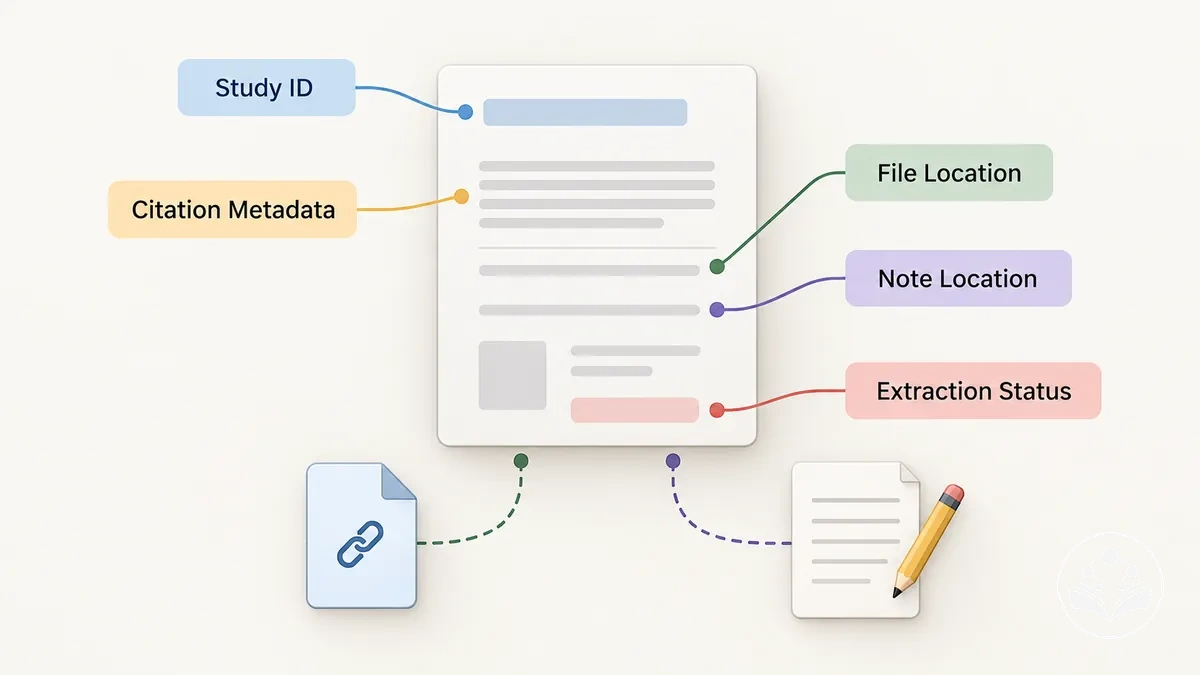
- Assign the study identifier. Give the study record a unique, stable identifier and use it consistently with associated files and notes to support retrieval and deduplication.
- Record citation metadata. Store the citation information needed to identify the source and distinguish it from other study entries, supporting consistent reference checking and auditability.
- Record the file location. Store the source file location or another stable location used within the review workflow so the source can be retrieved from the study record.
- Record the note location. Store the research note location and associate it with the same study identifier where practical, keeping notes connected to the correct source record.
- Update the extraction status when relevant. Label the study record with its current extraction status when the review workflow tracks this stage, so the record indicates whether evidence extraction still requires action.
For example, a hypothetical identifier such as STU-014 can appear in the study record, its source file name, and the corresponding note record.
Reusing the same identifier across those locations makes the related materials easier to retrieve and connect during later updates or comparison.
Separate Source Details, Study Characteristics, and Evidence
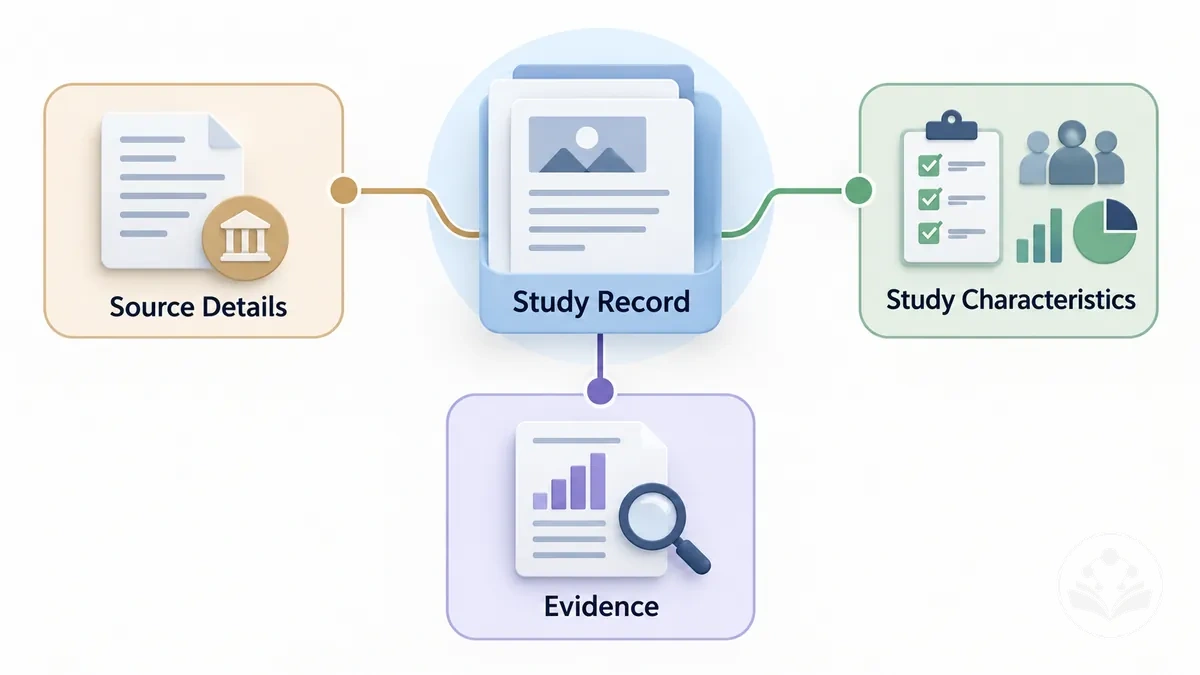
Source details, study characteristics, and evidence are three distinct information classes within a study record.
Source details contain bibliographic details and citation metadata that identify the source and preserve its provenance.
Study characteristics describe the study through attributes such as design, setting, population, or sample, while evidence captures the findings or data relevant to the review question.
Keeping these classes distinct prevents provenance information, study descriptors, and review-relevant evidence from becoming an undifferentiated note.
Source details identify and locate a study; study characteristics describe it; evidence captures what is relevant to the review question.
This separation supports traceability by keeping provenance connected to the source, comparison by keeping descriptive study attributes distinct, and later extraction by separating review-relevant findings from identification data.
The diagram makes the component boundaries visible while showing that all three information classes belong to the same study record.
| Information class | Typical fields | Why it is kept separate |
|---|---|---|
| Source details | Bibliographic details, citation metadata, reference information, provenance | Identifies and locates the source while keeping its origin traceable. |
| Study characteristics | Design, setting, population or sample | Describes the study and supports comparison of study descriptors. |
| Evidence | Findings or data relevant to the review question | Keeps extracted evidence distinct from source identification and descriptive characteristics for later extraction and interpretation. |
Exact study characteristics and evidence fields should be adapted to the discipline, review question, and review design rather than treated as a fixed taxonomy.
The three information classes remain distinct even when the specific fields within each class change.
Build a Literature Matrix to Organize and Compare Evidence
A literature matrix is an organizing and comparison method that places comparable information from multiple studies or sources into a common grid.
Each study remains a separate evidence record while shared evidence fields make relevant attributes and findings visible side by side.
The matrix supports comparison before synthesis rather than completing the synthesis itself.
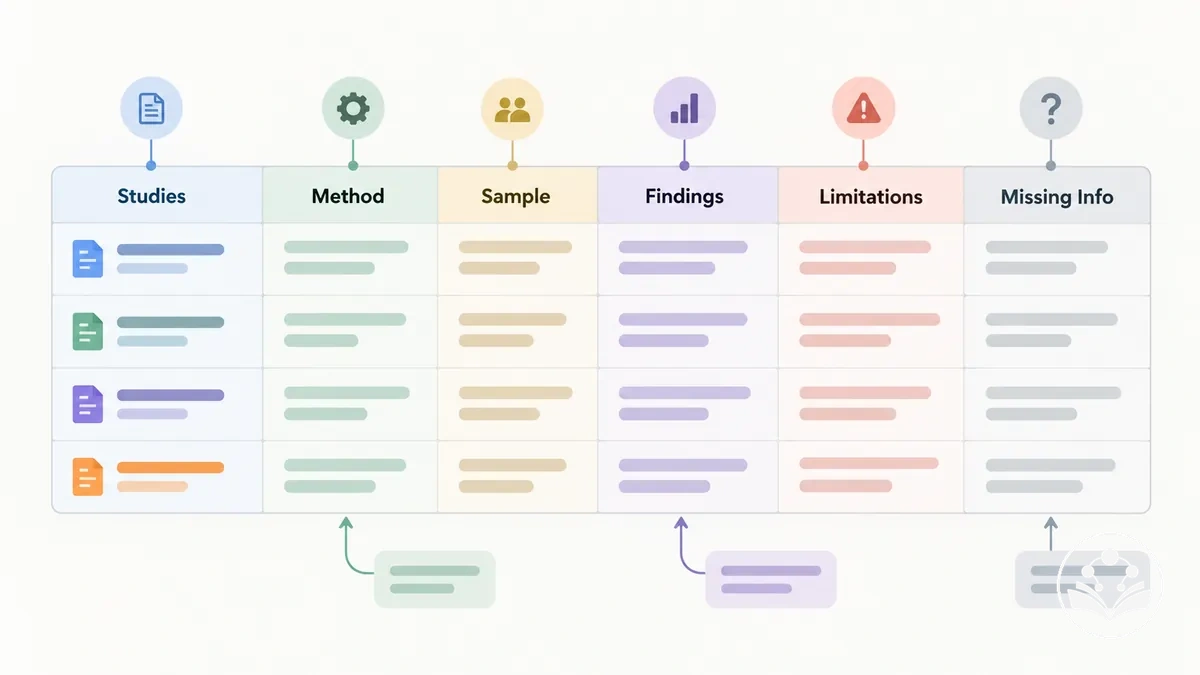
Study rows and shared columns provide a consistent structure for comparison: each row can represent one study, while columns can record fields such as method or design, sample or population, relevant findings, and limitations.
This structure follows the relationship from study to selected evidence field to recorded value or finding, making equivalent information easier to inspect across studies.
The accompanying annotated example demonstrates how several studies align across shared comparison columns without reproducing every entry in the table.
| Study | Method/Design | Sample/Population | Relevant Finding | Limitation/Note |
|---|---|---|---|---|
| Study A | Qualitative interviews | Adult participants | Recurring theme reported | Single setting |
| Study B | Cross-sectional survey | Community sample | Different pattern reported | Evidence field not reported |
| Study C | Mixed-methods study | Defined study population | Related finding reported | Methodological difference noted |
Patterns can become visible when comparable findings recur across rows, while differences in methods, samples, or reported findings can be located without collapsing the studies into one conclusion.
Missing information becomes visible when a shared evidence field has no reported value for a study.
These signals identify material for later interpretation, but they do not by themselves establish themes, resolve contradictions, or determine synthesis conclusions.
Matrix orientation and field selection can vary with the review question, available evidence, and working method; studies may be arranged differently as long as equivalent information remains consistently comparable.
The literature matrix therefore functions as a structured method for organizing and comparing evidence, while deeper interpretation and synthesis remain separate analytical tasks.
Choose Matrix Fields That Match the Review Question
Matrix fields should be included when they materially support the review question or enable meaningful comparability across studies.
Field relevance is review-specific, so a column that is useful for one review may be nonessential for another.
Consistent field selection determines which study descriptors, variables, outcomes, themes, or other evidence can later be compared without assuming that a larger number of fields produces a better matrix.
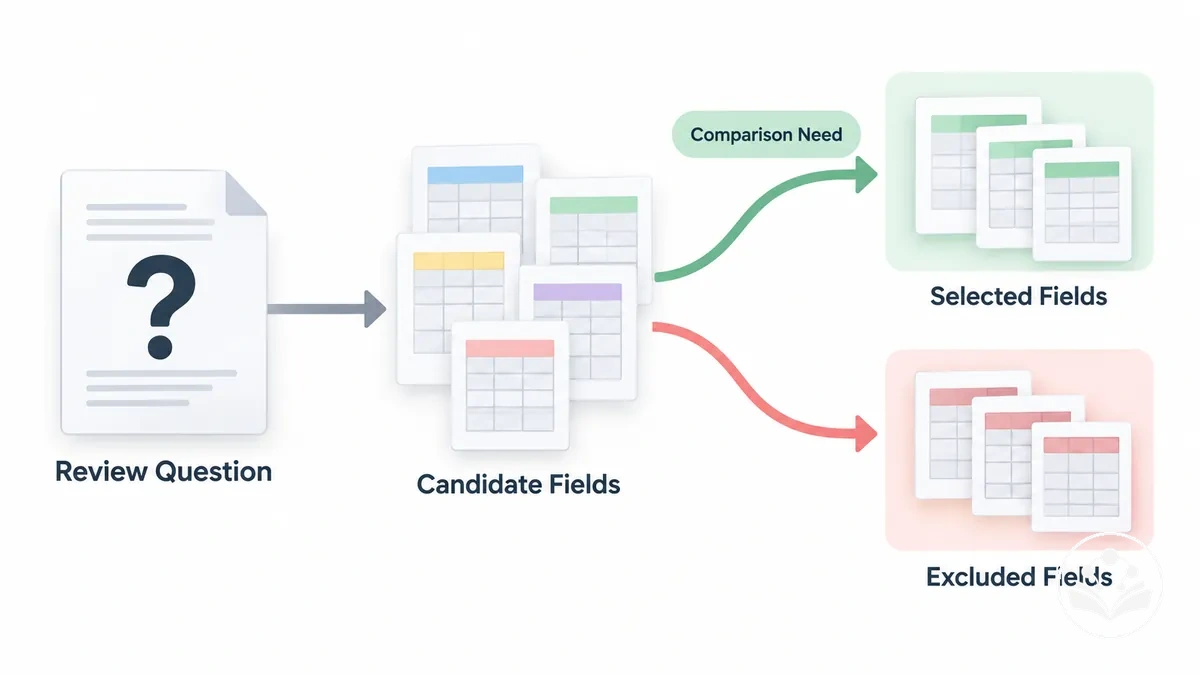
The selection criteria connect each candidate field to an inclusion condition and an analytical implication.
The accompanying diagram shows this relevance-based decision by connecting the review question to candidate fields, selected relevant fields, and excluded nonessential fields.
- Review-question relevance: Include a field when its value directly helps answer the review question or evaluate a defined comparison; otherwise, it can add information without contributing to the intended analysis.
- Consistency and comparability: Include a field when equivalent information can be identified across relevant studies well enough to support a meaningful comparison; inconsistent or missing data can limit how the field is compared.
- Interpretability: Include a field when its values have a sufficiently clear and consistent meaning in the review context; ambiguous categories can make differences between studies difficult to interpret.
- Extraction feasibility: Include a field when the required information can be located and extracted from the available sources with sufficient consistency for the intended use; poorly reported information may produce substantial missing data.
- Essential fields: Use identifiers and study descriptors when they support study identification or a comparison that must remain consistent across records.
- Question-specific fields: Use variables, outcomes, themes, or quality-relevant notes when they directly match the review's aims and intended comparisons.
For example, intervention duration can be a useful matrix field when the review question compares outcomes by exposure length, whereas an author's institutional location may be interesting but nonessential when it has no defined relationship to that comparison.
The decision to include a field should therefore follow relevance, comparability, consistency, interpretability, and extraction feasibility rather than a fixed set of columns.
Record Methods, Samples, Findings, and Limitations Consistently
Comparable study records should use the same descriptive categories for methods, samples, findings, and limitations while preserving what each source actually reports.
Consistent labels can make equivalent information easier to scan, but they should not change the meaning of a study design, population, result, or study constraint.
Units can be standardized where they represent the same quantity, while contextual qualifiers should remain when they are necessary to interpret study-specific information.
The four information classes should be recorded in parallel so readers can locate comparable attributes without treating heterogeneous studies as if they reported identical information.
- Method/Design: Record the reported methods or study design using consistent labels when the terminology can be aligned without changing its meaning; retain the source-specific design description when a broader label would erase a relevant distinction.
- Sample/Population: Record the sample or population information needed for comparison, including reported size, setting, or participant characteristics when relevant; use consistent units and labels where equivalent measures are reported, while preserving contextual qualifiers that affect interpretation.
- Findings: Record findings or reported results that correspond to the review question and distinguish the authors' reported evidence from the reviewer's later interpretation; standardize equivalent units or outcome labels only when doing so preserves the original meaning.
- Limitations: Record limitations reported by the study and retain qualifiers that explain the context in which they apply; keep any reviewer-identified concern distinct so an inferred limitation is not presented as a reported fact.
For example, two heterogeneous studies can retain different study design labels and population descriptions while using the same record categories for Method/Design, Sample/Population, Findings, and Limitations.
This approach supports comparability at the category level without forcing different evidence into identical values or discarding study-specific context.
Use a Structured Evidence Extraction Table When Detailed Study Data Must Be Captured
A structured evidence extraction table is warranted when a review needs systematic data extraction of repeated, review-specific information from included studies beyond the broader comparison supported by a general literature matrix.
Using the same extraction structure across included studies supports consistency and reproducibility by making the information selected for capture explicit.
It can also reduce selective capture by defining relevant fields in advance, but this level of detail is not necessary for every narrative review.
The evidence extraction table should capture fields that serve the review question or allow extracted information to be verified against its source.
A study identifier connects each row to the included study, while population or sample information records the relevant study group.
Intervention or exposure applies only when the review design examines one, and the outcome or measure identifies what was assessed.
The result records the relevant reported evidence, while data location preserves provenance by identifying where that evidence can be checked in the source.
Extraction notes can retain necessary contextual qualifiers or document extraction decisions without turning those notes into a synthesis result.
| Study ID | Population/Sample | Intervention/Exposure | Outcome/Measure | Result | Data location | Extraction note |
|---|---|---|---|---|---|---|
| Study A | Reported study population | Record when applicable to the review design | Review-relevant measure | Reported result relevant to the review question | Source page, table, figure, or section | Relevant qualifier or extraction decision |
| Study B | Reported study population | Not applicable when the review design does not examine an intervention or exposure | Review-relevant measure | Reported result relevant to the review question | Source page, table, figure, or section | Relevant qualifier or extraction decision |
When the extraction process is complex, pilot or check the extraction structure on a small set of included studies before large-scale use to determine whether the fields fit the review question and can be applied consistently.
Adapt fields that create ambiguity, omit necessary context, or do not support verification, while retaining the boundary between organizing extracted data and formally synthesizing the evidence.
Connect Research Notes to Their Supporting Sources
Every research note should remain connected to the source and evidence it describes so its attribution can be verified later without reconstructing the research trail.
The note should identify the study, point to the most stable available source locator, and distinguish whether the recorded material is a quotation, paraphrase, or researcher interpretation.
This linkage supports provenance and auditability without implying that a locator proves the underlying claim is valid.
The note-to-source connection can be created with four repeatable steps that preserve provenance and reduce attribution errors.
- Assign or reuse the study identifier. Link the research note to the same study identifier used for the source record so the note can be traced to the correct study and verified against that source.
- Capture the note. Record the relevant information clearly and keep the source's reported content distinct from later researcher interpretation so the evidential basis remains identifiable.
- Record a source locator. Add the most stable locator available, such as a page, section, figure, table, paragraph, or other source-specific location, so the evidence can be located and checked directly when needed.
- Label the evidential status. Mark the note as a quotation, paraphrase, or researcher interpretation so reported evidence remains distinguishable from the reviewer's own analytical comment during later use.
A traceable illustrative note might read: Study ID STU-021 — paraphrase — p.
14, Table 2, followed by the relevant note; a detached note such as participants improved after the intervention with no study identifier, source locator, or evidence-type label cannot be reliably verified or attributed later.
Before using a research note in analysis or writing, verify that its identifier, locator, and evidential status still connect it to the supporting source.
Keep Notes and Extracted Evidence Traceable to Individual Studies
Traceability is the ability to move from a research note or extracted value back to the exact individual study and, where possible, the specific source location that supports it.
A traceable record preserves this audit path through a stable study identifier and a source locator rather than relying on the note's wording alone.
The connection establishes provenance and supports verification, but it does not by itself establish the validity or evidential strength of the underlying finding.
This traceability supports auditability within the organizing system without turning the record into citation-style guidance.
For example, an illustrative traceable record could use Study ID STU-021 — Table 2 — extracted datum: the study identifier identifies the source record, the table reference provides the source locator, and the evidence-type label identifies the recorded item's status.
Group and Label Evidence for Later Analysis
Group and label evidence with stable, provisional categories so related findings can be retrieved together for later analysis without treating those categories as final synthesis conclusions.
Grouping makes recurring patterns easier to inspect across the organized evidence while preserving the individual studies and findings that support them.
Relevant grouping dimensions can include a theme, concept, population, method, outcome, context, or time period when that dimension materially relates to the review question.
The grouping sequence moves from recurring attributes to provisional labels and then to evidence assignment, with each stage checked for continued usefulness.
- Identify recurring dimensions. Review the organized evidence for recurring themes, concepts, populations, methods, outcomes, contexts, or time periods that could support later analysis. Check that each proposed dimension has a defined relationship to the review question rather than merely appearing repeatedly.
- Define stable labels. Give each useful group a concise label that describes the shared attribute without encoding a final analytical conclusion. Check that the label can be applied consistently and does not create a one-off category for evidence that lacks a meaningful grouping relationship.
- Assign evidence to relevant groups. Place each relevant finding or evidence item under the applicable label so related material can be retrieved together. Check the evidence itself rather than assuming that one study belongs to only one group, because different findings from the same study can support different analytically relevant groups.
- Review label usefulness. Inspect whether the groups remain distinct enough to support retrieval and comparison as more evidence is assigned. Check for labels that overlap unnecessarily, fragment closely related evidence, or no longer represent a useful distinction for the review question, and refine them where needed.
For example, one study could contribute evidence to a population group and an outcome group when separate findings in that study are relevant to both dimensions; the assignments identify retrieval paths rather than declaring final themes.
Preliminary evidence groups are not automatically the final manuscript structure, and grouping for retrieval and later analysis is distinct from choosing thematic versus chronological organization for the written review.
The groups should therefore remain provisional organizational aids until later analysis determines how the evidence should be interpreted and presented.
Use Categories and Tags to Keep Related Evidence Together
Categories and tags create a controlled retrieval layer over organized evidence.
Broad categories represent major groupings, while narrower tags label reusable attributes or subtopics that can apply across multiple studies.
This distinction helps related evidence remain retrievable without turning organizational labels into final analytical themes.
The labeling system should use explicit rules for naming, granularity, consistency, synonym control, and multiple tags so classification labels remain reusable without fragmenting the evidence.
- Naming: Use clear, descriptive labels that reflect the evidence attribute being grouped, and avoid abbreviations that may be ambiguous during later retrieval.
- Granularity: Keep categories broad enough to gather related evidence and tags specific enough to distinguish reusable attributes; excessively narrow tags can fragment evidence into one-off labels.
- Consistency: Apply the same label to the same concept throughout the evidence set so retrieval does not depend on wording variations.
- Synonym control: Choose one preferred label for equivalent terms and apply it consistently; overlapping synonyms can split related evidence across separate retrieval paths.
- Multiple tags: Apply more than one tag when a finding genuinely relates to several reusable attributes, provided each tag has a defined purpose and does not encode an unsupported conclusion.
For example, a broad category such as Population could use narrower reusable tags such as adolescents, older adults, and caregivers when those distinctions matter to the review question.
The useful level of granularity depends on the evidence set and retrieval need, so categories and tags should remain controlled organizational labels rather than a universal taxonomy or a substitute for later thematic analysis.
Coordinate Reference Management, Files, and Evidence Records
A reference manager, source files, research notes, and evidence records serve different functions, but they should operate as connected layers of the same research-record workflow.
The reference manager primarily organizes citation metadata and source relationships, files preserve the documents being consulted, research notes capture source-linked annotations and interpretation, and evidence records carry information selected for comparison against the review question.
Coordination comes from using a stable study identifier or citation key across these layers rather than expecting one repository to perform every function.
The functional division helps keep bibliographic control separate from question-specific evidence while preserving connections among the records.
Reference-management software such as Zotero can, depending on the software version and configuration, support citation metadata, collections, tags, attachments, and annotations.
Source-file storage holds PDFs or other document files, while research notes retain contextual observations and source locators associated with those documents.
An evidence record or matrix carries the study attributes and extracted evidence needed for review-specific comparison.
The study identifier provides the connection point that allows information held in different tools or locations to be associated with the same study.
| Workflow layer | Primary job | Typical contents | Connection key |
|---|---|---|---|
| Reference manager | Organize bibliographic records and source relationships | Citation metadata, collections, tags, attachments, and annotations where supported | Study identifier or citation key associated with the reference record |
| Source files | Store the documents used as evidence sources | PDFs or other source documents, with consistent file naming and storage locations | Study identifier or citation key in the file name or associated record |
| Research notes | Keep contextual notes and interpretation connected to sources | Annotations, paraphrases, interpretation, and source locators | Study identifier or citation key linked to the note |
| Evidence record/matrix | Organize review-specific information for comparison | Relevant study attributes, extracted findings, and question-specific evidence fields | Study identifier or citation key recorded with the matrix row |
For example, a hypothetical study identifier such as STU-021 can be associated with the reference record, included in the PDF file name, attached to the research notes, and entered in the corresponding evidence-record or matrix row.
The shared identifier allows those records to be connected even when they are stored in different tools or locations.
Each layer can therefore retain its primary function while the coordinated identifier preserves the relationship among the reference, files, notes, and extracted evidence.
Check the Organized Evidence Before Moving to Synthesis
Organized evidence should be verified before synthesis so missing records, inconsistent fields, broken source links, or ambiguous labels do not carry unnoticed into later comparison.
Evidence is analysis-ready when the records required by the review are sufficiently complete, consistently structured, and traceable to their supporting sources.
Gaps can remain when the source does not provide the information or the review design permits missing values, but those gaps should be explicitly documented rather than guessed.
The readiness check tests study coverage, completeness, duplicate control, consistency, traceability, provenance, category or tag coherence, and unresolved missing values.
Each check should identify a pass signal and a corrective action when the condition is not met.
The purpose is verification of the organized evidence system, not manuscript-quality scoring or methodological appraisal.
- Study coverage: Check that every study intended for analysis has a corresponding evidence record. The check passes when included studies can be accounted for in the organized evidence; if a record is absent or cannot be reconciled, restore, resolve, or explicitly flag it before proceeding.
- Required-field completeness: Check that fields defined as necessary for the review have been completed where the source provides the required information. The check passes when required information is recorded or a justified absence is explicitly marked; investigate unexplained blanks rather than filling them by inference.
- Duplicate control: Check that duplicate records or multiple reports associated with the same study have not been treated as independent evidence unintentionally. The check passes when record relationships are clear; merge, link, or otherwise reconcile unintended duplicates while preserving distinct source records when they are genuinely required.
- Field consistency: Check that equivalent information is recorded with consistent labels, categories, units, and contextual qualifiers where standardization preserves the source meaning. The check passes when comparable fields can be interpreted consistently; correct inconsistent entries or document study-specific differences that should remain distinct.
- Note-to-source linkage: Check that research notes retain the study identifier and an appropriate source locator where available. The check passes when a note can be traced back to its supporting source; reconnect or flag detached notes before treating them as analysis-ready.
- Evidence provenance: Check that extracted findings or values remain associated with the study and source location from which they were taken. The check passes when the evidence trail supports verification; restore missing provenance or flag the evidence item when its origin cannot be established.
- Category or tag coherence: Check that categories and tags are applied consistently and that overlapping labels do not unnecessarily fragment related evidence. The check passes when equivalent concepts use the intended labels; reconcile ambiguous synonyms or document justified distinctions.
- Unresolved missing values: Check remaining missing values to determine whether they reflect absent reporting, non-applicability, or an unresolved record problem. The check passes when each material gap has an explicit status; resolve what can be resolved and flag justified missingness without guessing a value.
Ambiguous or incomplete records should be resolved where the source permits, documented when a distinction must remain, or explicitly flagged when information cannot be established.
A flagged gap can remain in an analysis-ready dataset when its status is clear and the review design does not require a resolved value for that field.
Once the required records are sufficiently complete, consistent, and traceable, and their unresolved states are explicit, the organized dataset is ready to synthesize the evidence.
Verify Completeness, Consistency, and Source Traceability
Completeness, consistency, and source traceability are separate readiness criteria because they detect different problems in organized evidence.
Completeness checks whether the required records and required fields are present or explicitly assigned an appropriate missing state.
Consistency checks whether equivalent information follows stable labels, formats, and coding rules, while source traceability checks whether evidence and notes retain a verifiable source link to the individual study.
The criteria should be interpreted according to the review design rather than by assuming that every field must contain a substantive value.
A blank may represent missing-from-source, not-applicable, or not-yet-extracted information, and those states have different corrective implications.
Stable labels and coding rules support consistency when equivalent information is recorded the same way, while justified study-specific differences can remain distinct.
Source traceability is acceptable when an evidence item or note can be connected through a study identifier and source link or locator to the supporting record.
These criteria support a readiness judgment without imposing a universal completion threshold.
| Criterion | What to inspect | Acceptable state | Corrective direction |
|---|---|---|---|
| Completeness | Required records, required fields, and the status of missing values | Required information is recorded where available, and absent values are explicitly labelled as missing-from-source, not-applicable, or not-yet-extracted when that distinction applies | Complete unfinished extraction, restore missing required records, or assign the correct missing-state label rather than guessing a value |
| Consistency | Stable labels, formats, units, and coding rules used for equivalent information | Equivalent information follows the same recording rules, while justified source-specific differences remain clearly distinguished | Standardize inconsistent labels or formats where meaning is preserved, or document why a different representation is necessary |
| Source traceability | Links between evidence, research notes, the study identifier, and the supporting source location | Each material item can be traced to the individual study and, where available, to a reliable source locator | Restore the missing source link or locator, reconnect the item to the correct study record, or explicitly flag the item when provenance cannot be established |
For example, if an outcome field is blank because the source never reports that outcome, the correction is to label the value missing-from-source, not to infer a result or treat the record as automatically incomplete.
By contrast, a blank marked not-yet-extracted identifies unfinished work that should be completed before the record is treated as analysis-ready.