Writing the Discussion and Conclusion of a Review Article
In a review article, the discussion interprets the synthesized evidence—explaining the main patterns, differences, limitations, uncertainty, and implications—while the conclusion compresses that interpretation into the shortest defensible answer to the review question and its significance. Keep the conclusion within the same evidence boundary: do not introduce new evidence or a new line of argument.
From synthesis to a defensible conclusion
Use one evidence boundary throughout: the discussion expands the meaning of the synthesis; the conclusion compresses that meaning into a qualified answer and its significance.
1
Start from the synthesis
Identify the dominant pattern, relevant differences, and the conditions represented by the evidence. Do not return to a study-by-study results list.
2
Discussion: interpret and qualify
Explain what the pattern means, examine plausible contextual or methodological differences, account for conflict and limitations, and develop implications without exceeding the evidence.
3
Conclusion: answer and close
State the review answer, retain only the qualification needed for confidence and scope, then state its significance. Add no new evidence, claim, or line of reasoning.
How the evidence changes the wording
Convergent evidence
Supports a firmer claim within comparable represented conditions.
Contextual variation
Calls for a condition-specific interpretation rather than a universal claim.
Unresolved conflict or material limits
Requires a narrower claim with explicit uncertainty.
This task begins after the relevant evidence has already been synthesized; the sections below show how to move from that synthesis to interpretation and closure without extending claims beyond what the evidence can support.
Table of Contents⌄
Distinct Functions of the Discussion and Conclusion
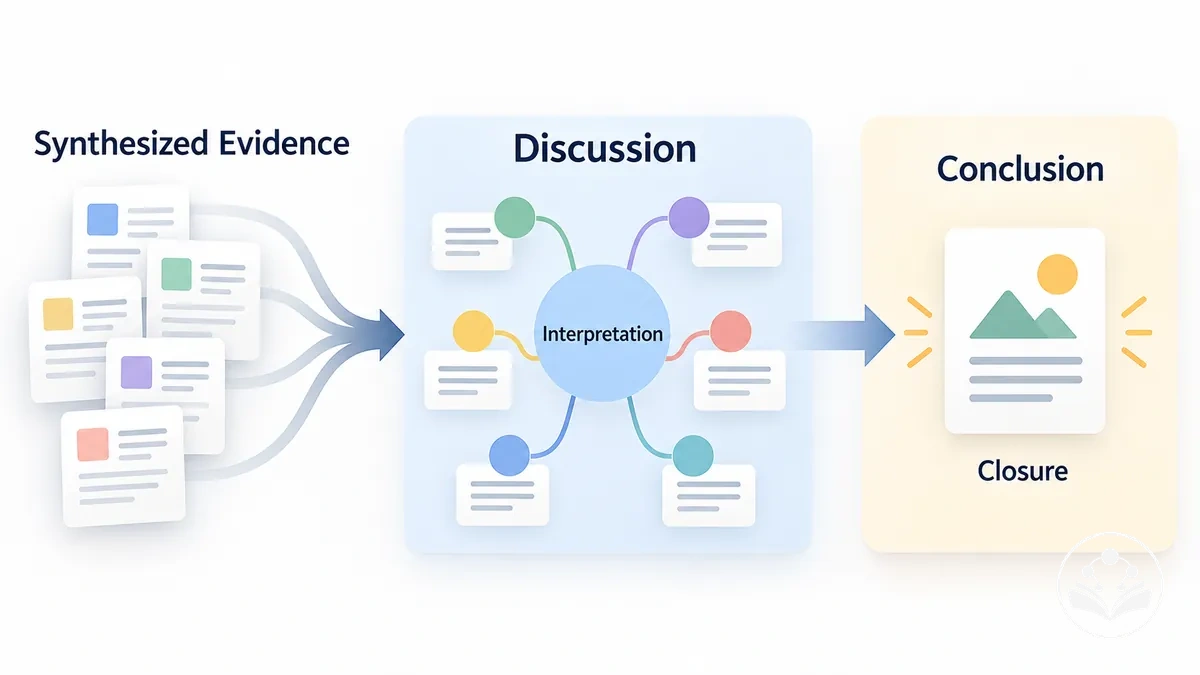
The discussion and conclusion work from the same synthesized evidence but serve different purposes.
The discussion develops interpretation by explaining what the evidence means, qualifying that meaning where uncertainty or limitations affect the claim, and considering its implications.
The conclusion compresses the established synthesis into a concise answer to the review question, its significance, and appropriate closure.
Distinguishing these functions helps prevent interpretation from being duplicated or reopened at the end of the review.
The discussion carries the greater interpretive burden: it uses the synthesized evidence to explain patterns, differences, implications, and the scope of the claims that can reasonably follow.
Its purpose is not simply to repeat evidence but to connect that evidence with meaning while preserving relevant uncertainty.
The following diagram represents the progression from a shared synthesized-evidence input through interpretation in the discussion toward closure in the conclusion.
Dimension
Discussion
Conclusion
Purpose
Explains and qualifies what the synthesized evidence means and why it matters.
States the concise answer to the review question and its significance.
Use of evidence
Works across the synthesis to explain patterns, differences, relationships, and implications.
Compresses the established synthesis into the evidence-supported final answer without starting a new analysis.
Interpretation level
Develops interpretation and explains how the evidence supports or limits that interpretation.
Distils the interpretation already established rather than extending it with new analytical reasoning.
Treatment of uncertainty
Explains relevant limitations, inconsistency, scope, and uncertainty that qualify the interpretation.
Preserves those qualifications so the final answer does not imply greater certainty than the evidence supports.
Closure
Builds toward an evidence-bounded understanding of the findings and their implications.
Provides closure by synthesizing the defensible answer and significance without reopening the discussion.
The conclusion therefore synthesizes rather than duplicates the discussion: it retains the answer, significance, scope, and necessary uncertainty while leaving the detailed interpretation where it was developed.
The exact boundaries of these sections can differ across publication formats, but the conclusion should not independently introduce a new interpretation of the evidence.
Within the wider review article manuscript structure, this boundary keeps the two sections connected without making their informational roles redundant.
As a practical rule, the conclusion compresses the discussion rather than reopening it.
Write the Discussion by Interpreting the Synthesized Evidence
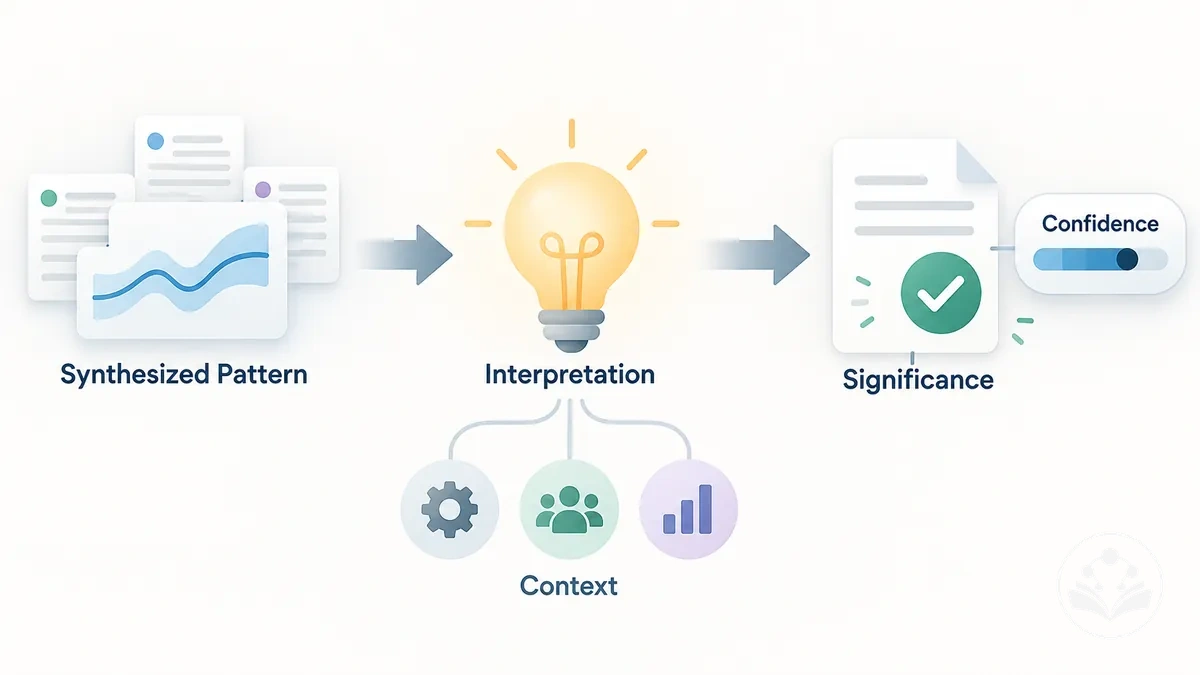
Interpretation explains what the synthesized evidence pattern means and how strongly it can answer the review question.
Begin with the pattern already established by the synthesis, then relate that pattern to its context and significance rather than repeating the underlying findings.
The interpretive task therefore moves from finding to meaning and then to a claim whose confidence remains proportionate to the evidence.
Identify the synthesized pattern. State the relevant consistency, divergence, or relationship across the synthesized evidence and connect it to the review question. Before continuing, verify that the statement describes a synthesis-level pattern rather than listing individual study results.
Explain what the pattern means. Interpret the pattern using relevant context, including differences in methods, populations, measures, or other plausible explanatory factors where these are supported by the reviewed evidence. Before continuing, verify that a plausible explanation is presented as a factor that may account for the pattern rather than as an established cause unless the evidence supports that causal claim.
Qualify its significance. Relate the interpretation to the review question and state its significance while accounting for consistency, limitations, and uncertainty. Before continuing, verify that the resulting confidence does not exceed what the synthesized evidence can support.
Consistency can support greater confidence when relevant evidence converges under sufficiently comparable conditions, whereas divergence requires attention to the context in which findings differ.
Differences in methods, populations, or measures may provide a plausible explanation for variation, but they do not by themselves establish why the variation occurred.
Significance should therefore express what the pattern implies for the review question within the scope of the available evidence.
Limitations and uncertainty should narrow the interpretation when they weaken the basis for a broader claim, so confidence reflects the combined evidence rather than the mere repetition of similar findings.
Descriptive reasoning states what the synthesized evidence shows; interpretive reasoning explains what that pattern may mean for the review question.
For example, a descriptive statement might note that findings are consistent in one context but diverge in another, while an interpretive statement would examine whether differences in populations, methods, or measures plausibly explain that divergence and what it implies for the review question.
The interpretation should end with a qualified significance claim whose confidence matches the consistency, context, limitations, and uncertainty of the synthesized evidence.
Begin With the Main Findings Without Repeating the Results
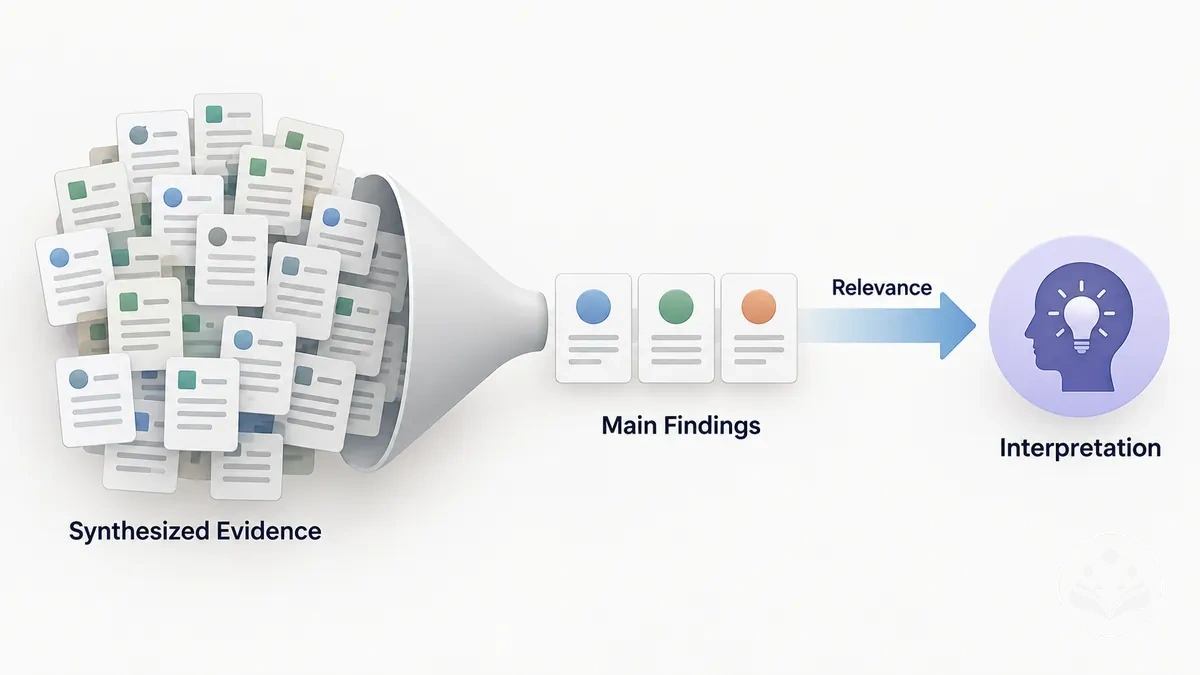
Only the most consequential main findings from the synthesized evidence should open the discussion, with selection guided by their relevance to the review question.
Summarize each selected evidence pattern briefly rather than repeating detailed results, then orient the reader to the interpretation it requires.
This selective opening establishes what matters most before shifting from the finding itself to its meaning.
Restatement: The synthesized evidence shows a consistent pattern in one context and divergence in another.
Interpretive opening: The contrast between consistency in one context and divergence in another makes the conditions associated with that pattern relevant to interpreting what the evidence means for the review question.
Each selected finding should earn its place by directing attention to an interpretive issue, such as why the pattern is relevant to the review question or what its boundaries mean for the discussion.
The prior task is to synthesize studies; the discussion opening should use that synthesis selectively rather than reproduce it.
Briefly naming the main findings supplies the necessary evidence context, while interpretation explains why those findings matter.
Interpret Patterns, Agreements, and Differences Across the Evidence
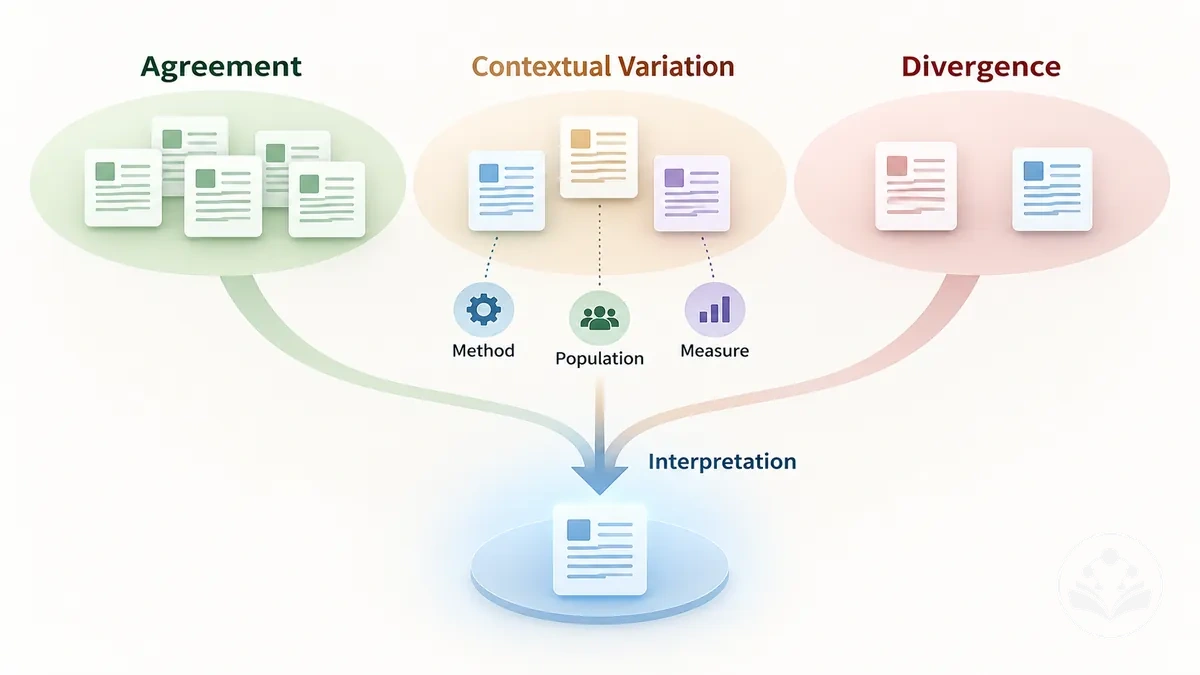
Patterns across the synthesized evidence should be interpreted in context rather than counted as votes: agreement indicates consistency under relevant conditions, while differences may represent contextual variation or unresolved divergence.
The comparison should therefore examine whether the direction of findings remains consistent across methods, populations, measures, and study conditions.
Confidence in the review answer increases when relevant evidence agrees under sufficiently comparable conditions and becomes more qualified when important differences remain unexplained.
Evidence Pattern
Context or Condition
Interpretation
Effect on Confidence
Agreement
Findings show a similar direction across sufficiently comparable methods, populations, measures, or contexts.
The pattern is consistent across the examined conditions.
Supports greater confidence in the synthesis for those conditions.
Contextual difference
Findings differ alongside relevant variation in methods, populations, measures, or context.
The divergence may reflect those study conditions, but the observed difference alone does not establish causality.
Supports a conditional interpretation and limits confidence beyond the contexts represented.
Unresolved divergence
Findings differ and the reviewed conditions do not provide a supported explanation for the variation.
The synthesized evidence does not resolve why the findings diverge.
Reduces confidence in a single, broadly applicable review answer and preserves uncertainty.
Methods, populations, measures, and context can change what is being compared and therefore how a difference should be interpreted.
A pattern that agrees within comparable populations but differs across populations may reflect population-specific conditions rather than a direct contradiction.
Likewise, findings based on different measures may diverge because the measures capture different aspects of the review question.
These explanations should remain plausible interpretations unless the synthesized evidence supports a stronger relationship.
The resulting confidence should therefore be tied to the conditions under which agreement or divergence occurs.
For example, if the synthesized evidence is consistent within one population context but diverges in another, the useful interpretation is conditional: the review answer has greater confidence for the context showing agreement and greater uncertainty where divergence remains.
If the differing evidence also uses distinct methods or measures, those differences may help explain the pattern, but they should not be presented as causes without supporting evidence.
The significance of the pattern lies in how these conditions narrow, qualify, or strengthen confidence in the review question.
Account for Conflicting Evidence and Uncertainty
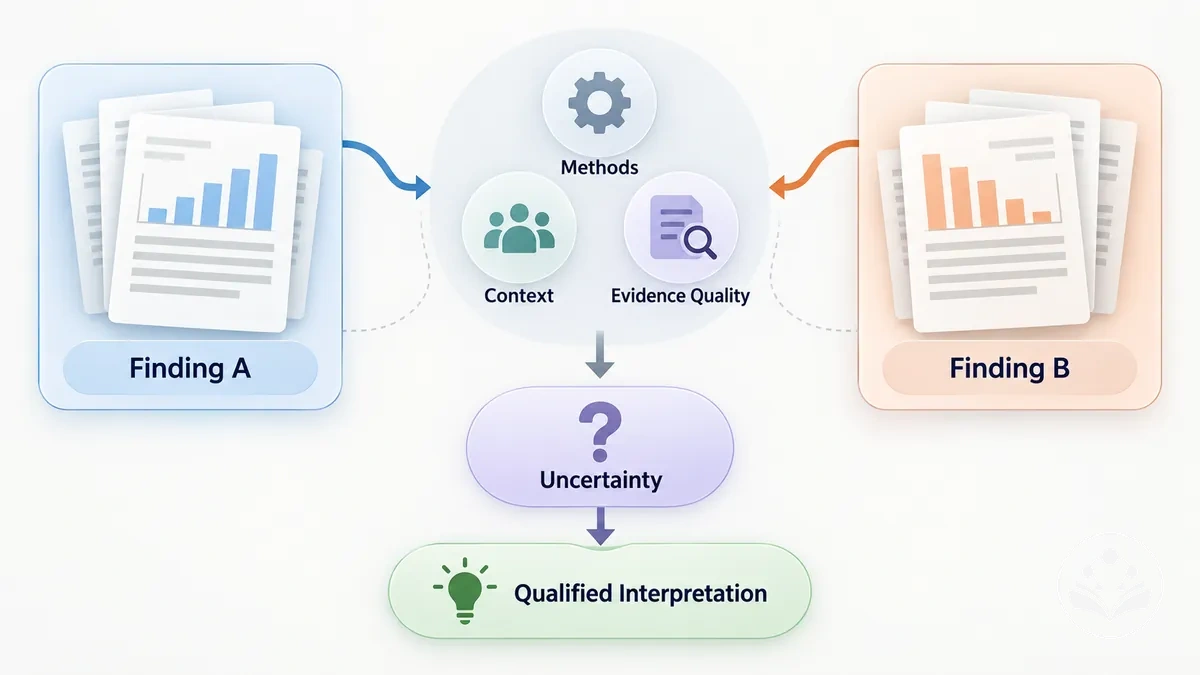
Conflicting evidence increases uncertainty when credible findings differ and the discrepancy cannot be adequately explained by methodological or contextual differences.
Rather than forcing the evidence into one answer, assess whether differences in methods, populations, measures, context, evidence quality, or precision plausibly account for the divergence.
If those checks do not explain the inconsistency, the conflict should remain explicit and confidence in the interpretation should be reduced.
Methodological comparability: Check whether the competing findings were produced with sufficiently comparable designs, procedures, analytical approaches, or study conditions. A methodological difference may provide a plausible explanation for the discrepancy, but it should not be treated as the cause unless the synthesized evidence supports that inference.
Population or setting: Examine whether the findings apply to different populations, settings, or contextual conditions. Divergence that follows these boundaries may support a context-specific interpretation rather than a single conclusion applied across all populations.
Measurement or outcome definition: Determine whether the evidence uses comparable measures and defines the relevant outcome in the same way. Differences in what was measured or how an outcome was operationalized may make apparently conflicting findings less directly comparable.
Evidence quality or precision: Consider the credibility, evidence quality, and precision of the competing findings where these characteristics are known. A newer or larger study should not be treated as the definitive winner on that characteristic alone; the interpretation should reflect the relevant strengths and limitations of the evidence being compared.
Residual unexplained inconsistency: If credible findings still conflict after the relevant methodological and contextual checks, classify the discrepancy as unresolved uncertainty. The appropriate result is lower confidence and a more qualified conclusion, not a forced resolution.
The diagnostic distinction is between explainable conflict and unresolved conflict.
When differences in methods, populations, measures, or context provide a credible basis for conditional variation, the interpretation can be narrowed to the conditions under which each finding applies.
Evidence quality and precision can also affect how much confidence each finding warrants, but they do not create an automatic hierarchy in which one finding wins.
When no supported explanation accounts for the discrepancy, uncertainty remains part of the synthesized evidence and should be carried into the final interpretation.
Unresolved conflicting evidence weakens conclusion strength because the review cannot support one interpretation with the same confidence that consistent or credibly explained evidence would allow.
The conclusion should therefore state the remaining uncertainty and limit its claim to what the conflicting evidence can defensibly support.
State Limitations That Change the Strength or Scope of the Interpretation
A limitation belongs in the discussion when it changes the strength, scope, generalizability, or confidence of an interpretation, not merely because it is an imperfection in the evidence or review process.
The relevant test is whether the constraint affects a specific inference and therefore requires a qualification.
Minor weaknesses that do not materially change the interpretation, its uncertainty, or its applicable population or context do not need equal emphasis.
Population limitation: If the evidence represents a narrow or context-specific population, the affected inference may remain credible for that population while its generalizability to other populations or settings is uncertain; the claim should therefore be restricted to the represented scope.
Measurement limitation: If studies use inconsistent measures or outcome definitions, the inference that findings are directly comparable may be constrained; confidence should be qualified where measurement differences make the apparent pattern less precise or consistent.
Evidence-quality limitation: If evidence quality or precision is limited in ways relevant to the claim, the interpretation may still be plausible but warrant lower confidence; the qualification should identify the inference that cannot be supported as strongly rather than treating the evidence as automatically invalid.
Review-process limitation: If a constraint in the review process may have affected which evidence was identified, included, or assessed, the affected inference should be bounded accordingly; the limitation matters when that constraint creates uncertainty about the completeness or scope of the interpretation.
Each material limitation should therefore be written as a relationship between the constraint, the inference it affects, and the resulting qualification.
A narrow population can limit generalizability, inconsistent measurement can reduce confidence in comparability, and limited evidence quality or precision can weaken the strength of an inference without necessarily eliminating it.
The degree of qualification depends on how directly the limitation bears on the claim, so no universal threshold for acceptable quality, precision, or generalizability should be invented.
The resulting statement should specify the confidence boundary or scope that the evidence can support rather than end with a generic disclaimer.
Develop Implications and Future Research From the Interpretation
Implications and future research should follow directly from the interpreted evidence rather than appear as detached recommendations at the end of the review.
Keep the outputs distinct
Implication
States what the interpreted evidence means or changes within its supported scope. It may be practical, theoretical, or methodological.
Practical: identifies where a pattern is relevant under particular conditions.
Theoretical: shows where an existing explanation may not fully account for the synthesis.
Methodological: shows how measurement or design differences affect confidence in comparison.
When uncertainty is substantial, narrow the implication to the context or inference the evidence can support.
Recommendation
Prescribes what someone should do. A recommendation is not automatic simply because an implication exists; it requires additional justification for the proposed action.
Future research direction
Starts from a specific unresolved issue left by the interpretation. Name what remains unclear, why it matters, and which population, context, measure, method, or relationship needs further examination.
“More research is needed” is not enough unless the missing evidence and the uncertainty it could reduce are specified.
Each output should be traceable to a finding, uncertainty, or limitation already established in the synthesis, and its strength should remain proportionate to the evidence.
For example, if evidence remains inconsistent across differently measured outcomes, the future research direction is to determine whether the divergence persists when comparable measures are used in the population or context relevant to the review question.
Distinguish Evidence-Based Implications From Speculation
An evidence-based implication follows logically from the synthesis within the consistency, relevance, scope, and uncertainty of the reviewed evidence, whereas speculation extends the consequence beyond what that evidence can support.
Implication strength cannot exceed evidence strength: an association does not by itself support a causal claim, and findings from a represented population or context do not automatically generalize beyond it.
The distinction is therefore between a supported implication that stays within the evidence's logical and contextual bounds and a speculative extension that exceeds those bounds.
Evidence consistency: An implication is better supported when the relevant synthesis shows a sufficiently consistent pattern under comparable conditions; substantial unresolved inconsistency requires qualification rather than a stronger consequence.
Relevance to the target context: The finding should be relevant to the population, setting, or conditions to which the implication is applied; transferring it to a materially different context introduces uncertainty that should be stated.
Scope and generalizability: The implication should remain within the populations, settings, measures, and conditions represented by the reviewed evidence unless support for broader generalizability is established; extending beyond that scope is speculation.
Uncertainty: Limitations or unresolved uncertainty that affect the underlying interpretation should also qualify the implication, so its wording reflects the confidence that the synthesis can support.
Logical connection: The proposed consequence must follow from the interpreted finding without adding an unsupported inferential step; in particular, an observed association should not become a causal claim unless the evidence supports causal inference.
Qualification preserves usefulness when an implication is plausible but its transferability or inference strength is uncertain.
For example, if a synthesis identifies an association within a particular population, stating that the finding may have implications within that population stays closer to the supported scope than claiming that the factor causes the outcome across populations.
The former acknowledges relevance while preserving uncertainty; the latter adds both a causal claim and broader generalizability that the reviewed evidence may not support.
The strongest safe wording is therefore the most specific implication that follows from the synthesis without extending its causal meaning, context, or scope.
Link Future Research Directions to Specific Gaps and Unresolved Questions
Each future research direction should correspond to a specific research gap, conflict, limitation, or unresolved question already identified in the reviewed evidence.
The direction should state the evidence need that would address the unresolved issue rather than naming only a broad topic for further study.
A limitation becomes a research direction only when it creates a specific uncertainty that further investigation could plausibly clarify.
This evidence-linked approach keeps future research focused on what remains unresolved in relation to the review question.
Unresolved conflict: When credible findings remain inconsistent under relevant conditions, the research direction should target the source or persistence of that conflict because it limits confidence in the review answer; investigation using sufficiently comparable conditions or measures may clarify whether the divergence remains.
Population or context gap: When the reviewed evidence does not adequately represent a population or context relevant to the review question, the missing evidence constrains the applicable scope; research examining that specific population or context may determine whether the interpreted pattern extends to it.
Measurement uncertainty: When inconsistent measures make findings difficult to compare, the unresolved question concerns whether the apparent variation reflects the phenomenon or differences in measurement; investigation using comparable measures may reduce that uncertainty and clarify the synthesized pattern.
Material limitation: When a limitation leaves a particular inference inadequately supported, the research need should target the missing evidence responsible for that confidence boundary; further investigation may strengthen, narrow, or leave unchanged the interpretation depending on what the new evidence shows.
Translating an unresolved issue into future research therefore requires specifying what remains uncertain, why that uncertainty matters to the review question, and what evidence or investigation could reduce it.
Identifying research gaps from reviewed literature is a prior analytical task; this subsection converts an already-identified gap or unresolved question into a researchable next step.
A generic statement that a topic deserves further study does not identify the missing evidence, whereas a specific direction names the uncertainty and the evidence needed to clarify it.
The resulting research direction should therefore end with a defined evidence need, such as determining whether an unresolved pattern persists under comparable measurement conditions in the population or context relevant to the review question.
Write the Conclusion as a Focused Answer to the Review Question
The conclusion should begin with the shortest defensible final answer to the review question, expressed from the main synthesis already established in the discussion.
State what the reviewed evidence supports overall without reopening detailed comparisons or introducing new evidence.
If the evidence supports only a conditional answer, preserve that qualification from the start.
State the answer to the review question. Synthesize the main synthesis into one concise answer that directly resolves the question within the reviewed evidence. Verify that the statement comes from analysis already established in the discussion and introduces no new evidence or argument.
Qualify the answer. Adjust the conclusion according to evidence strength, scope, relevant limitation, and uncertainty so that its certainty does not exceed what the synthesis supports. Verify that every qualification reflects an established evidence boundary rather than a new interpretation.
State the significance. Explain briefly what the qualified answer means within the scope of the review and why that interpretation matters. Verify that the significance follows from the established synthesis and does not introduce a new recommendation, comparison, or argumentative direction.
The qualification should reflect how consistently the evidence supports the final answer and where limitations or uncertainty narrow its scope.
Strongly convergent evidence may justify a firmer statement within the represented conditions, whereas unresolved inconsistency or restricted populations may require a more conditional conclusion.
Evidence strength should therefore determine the confidence of the wording, while limitations define where the answer can reasonably apply.
The conclusion should retain those boundaries rather than implying broader certainty than the review supports.
The final sentence should state the significance of the qualified answer without restarting the discussion.
Its role is to provide closure by expressing what the established interpretation means within the review question's scope, leaving the reader with a concise and evidence-bounded conclusion.
Summarize the Main Synthesis and Its Significance
The main synthesis should compress the combined evidence into a direct answer to the review question rather than present a study-by-study summary.
Build the conclusion in three parts
1
Answer
Compress the combined evidence into the direct answer to the review question. State the dominant pattern and the conclusion it supports at the appropriate level of confidence.
2
Qualification
If consistency is limited or uncertainty remains, restrict the answer to the populations, contexts, measures, or conditions represented by the evidence. Retain only qualifications that materially change confidence or scope.
3
Significance
Explain why the integrated answer matters within the review question’s scope. The significance must follow from the synthesis itself, without a new finding or a reopened interpretation.
This structure gives the combined evidence clear significance while retaining the conditions under which the conclusion is defensible.
Avoid New Evidence, Claims, or Arguments in the Conclusion
New substantive evidence, an unsupported claim, or a new argument does not belong in the conclusion because it lacks the established reasoning developed earlier in the review.
The conclusion may use new wording when that wording accurately synthesizes evidence, reasoning, and significance already established.
The verification task is therefore to detect new substance, not merely sentences that have been newly phrased.
New evidence: Check for a fact, result, source, or evidence point that was not used in the established reasoning. Introducing it at this stage gives the conclusion material that has not been interpreted in the prior discussion; remove it or relocate the necessary analysis to the discussion before relying on it in the conclusion.
Unsupported claim: Check whether a substantive assertion exceeds what the established synthesis supports. If its meaning requires support that has not already been developed, remove the unsupported claim or qualify it to the confidence and scope supported by the reviewed evidence.
New argument: Check whether a concluding sentence introduces a new line of reasoning rather than compressing an established interpretation. A new argument reopens analysis instead of providing closure; relocate the reasoning to the discussion if it is necessary, or remove it from the conclusion.
Overextended conclusion: Check whether the final answer extends beyond the populations, contexts, conditions, or certainty supported by the synthesis. Such an extension exceeds the evidence boundary; correct it by adding the necessary qualification and restricting the conclusion to the supported scope.
Use four recognition cues during verification: whether the sentence introduces an evidence point not previously analysed, makes an unsupported assertion, adds a new line of reasoning, or extends the conclusion beyond the established scope.
New wording is acceptable when it compresses established reasoning; new substantive evidence or argument is not.
For example, a newly phrased sentence that synthesizes an established evidence pattern and its qualification is legitimate, whereas a previously undeveloped causal explanation is a new claim requiring support.
The consequence of genuinely new content is that the conclusion depends on analysis the review has not yet established.
Apply a correction according to the problem: remove unsupported substance that is unnecessary, qualify a claim that exceeds the evidence, or relocate necessary analysis to the discussion before relying on it in the conclusion.
Preserve legitimate synthesis and significance statements when they accurately restate established reasoning at the appropriate scope and confidence.