
Introduction
Defines the review focus, scope, boundaries and organising direction.
A literature review is organised around three coordinated functions: introduction, body and conclusion. The introduction sets scope and direction, the body groups and synthesises literature through a defensible organising principle such as thematic or chronological organisation, and the conclusion consolidates the resulting patterns or implications; in a thesis or larger paper, these functions may be distributed across surrounding sections rather than appearing as three fixed labels.

Literature review structure at a glance
Read the review as a chain of functions: define the boundary, organise and synthesise the literature, then consolidate what the synthesis shows.
Introduction
Defines the review focus, scope, boundaries and organising direction.
Body
Groups related literature, compares relationships among studies and develops synthesis across connected subsections.
Conclusion
Consolidates the patterns, tensions and implications already developed in the body instead of opening a new line of literature.
Document context changes placement, not the underlying functions. A standalone review usually contains scope, synthesis and closure within its own boundaries; an embedded review may share some of those functions with the surrounding thesis, dissertation or paper.
This is a document structure, not a writing workflow. Exact headings, subsection count and visible boundaries should follow the review purpose, discipline and applicable assignment or institutional requirements.
The three main sections of a literature review are the introduction, body, and conclusion, with each component performing a distinct function.
The introduction establishes the scope, direction, and focus of the review.
The body develops the discussion through the organisation and synthesis of evidence, while the conclusion consolidates the review's overall position and implications.
These functions contribute differently to coherence by connecting the review's focus, development, and closure.
The introduction defines boundaries that give the subsequent discussion direction, while the body groups and relates evidence within that scope.
The conclusion draws together the patterns, relationships, or implications developed through the body rather than opening a separate line of discussion.
Together, the three components connect a defined focus with synthesis and a consolidated overall position.
The relationship among the components can be visualised as a continuous structural system, with each section performing a distinct function while supporting the same review focus.
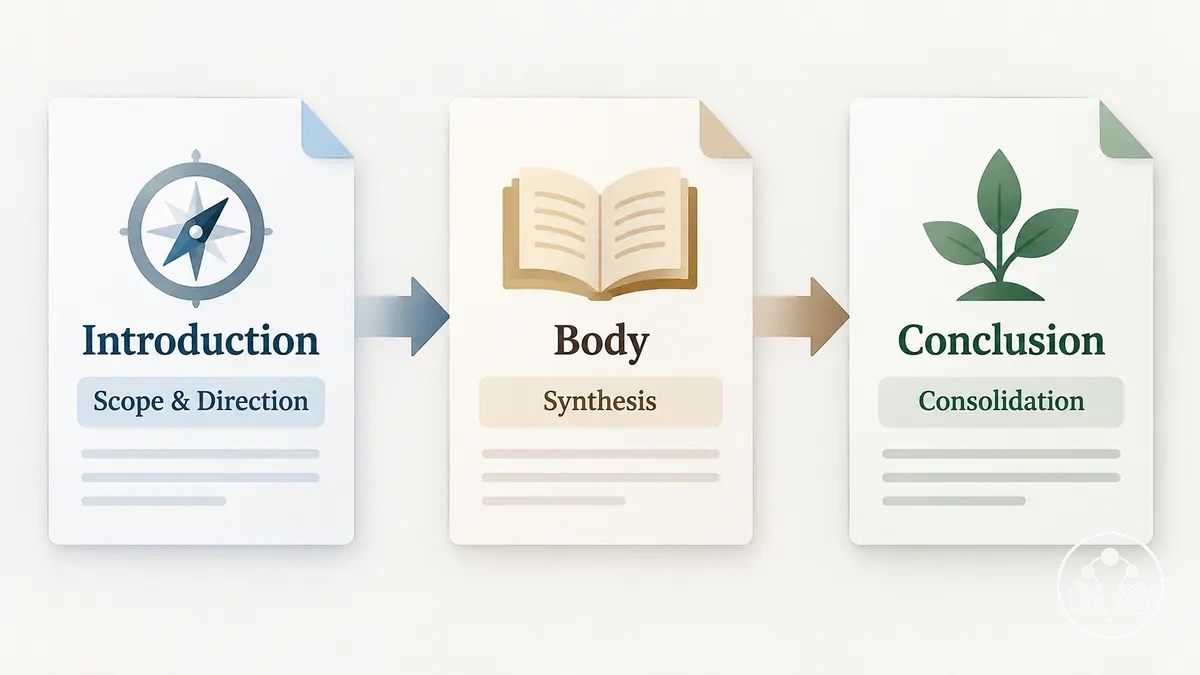
In a larger paper, thesis, or research document, these functions may be absorbed into or redistributed across broader chapters and sections rather than appearing under identical labels.
The functional model remains introduction for direction, body for development and synthesis, and conclusion for consolidation and coherence.
The literature review introduction establishes what literature is being reviewed, defines the scope and focus, and sets the direction for the body.
Its boundaries clarify which aspects of the topic belong within the review and which fall outside its focus.
The introduction also signals the organising logic that will connect the selected literature in the body.
These framing functions constrain the later discussion by giving the body a defined conceptual boundary and organising direction.
Topic framing identifies the review focus, while scope boundaries limit the literature and issues relevant to that focus.
The organising logic indicates how the body will arrange the selected literature into a coherent discussion rather than leaving its sequence unexplained.
The relationship can be visualised as a narrowing movement from a broad topic through a defined scope and review focus into the organising direction of the body.

The exact content order, length, and wording of an introduction can vary with the discipline, assignment, and document requirements.
The structural principle remains that the introduction establishes the focus, boundaries, and direction needed to prepare the body.
The literature review body carries the main analytical and synthetic burden by grouping related literature into coherent subsections.
Each subsection develops a defined aspect of the review focus by connecting evidence rather than treating individual sources as isolated entries.
This architecture supports synthesis by making relationships among studies explicit within the main discussion.
Subsection grouping gives related sources a shared structural focus, allowing their agreements, differences, patterns, or interpretations to be considered together.
These connected groups show how literature forms subsections that contribute to the same overall focus.
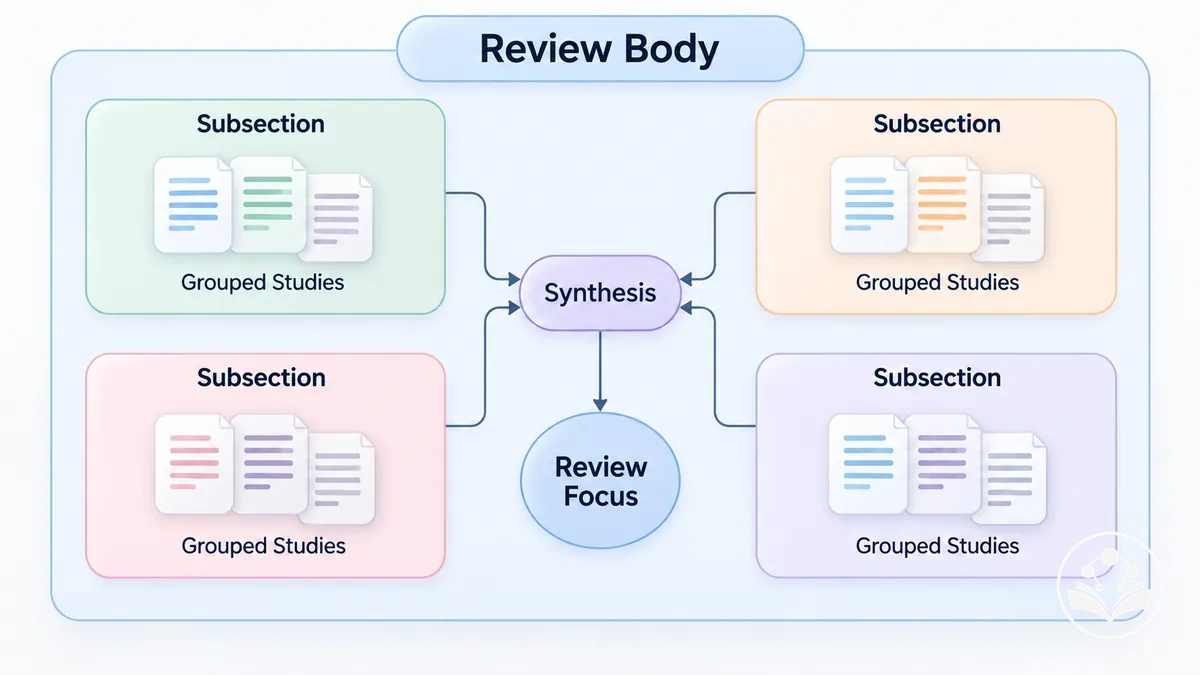 Within each subsection, evidence can be compared and synthesised according to the relationship that justifies its grouping.
The subsection then contributes that synthesis to the review's broader line of reasoning, supporting coherence across body sections.
Synthesis-ready grouping
Sources share a defensible focus, so their agreements, differences, patterns or interpretations can be compared and synthesised together.
Source-by-source listing
Sources appear as isolated entries. Proximity alone does not create the analytical relationship needed for a coherent body subsection.
Body architecture concerns how subsections and grouped literature relate, not paragraph mechanics. The number and arrangement of subsections follow the review's scope and purpose rather than a universal formula.
The literature review conclusion consolidates the synthesis established in the body into an overall position related to the review focus.
It integrates the main patterns, tensions, and implications rather than treating them as separate findings.
Where the literature shows convergence or divergence, the conclusion retains that distinction instead of overstating agreement.
Consolidation brings prior body findings together so their collective significance within the review becomes clear.
The relationship can be visualised as body patterns and tensions converging through synthesis into an overall interpretation connected back to the review focus.
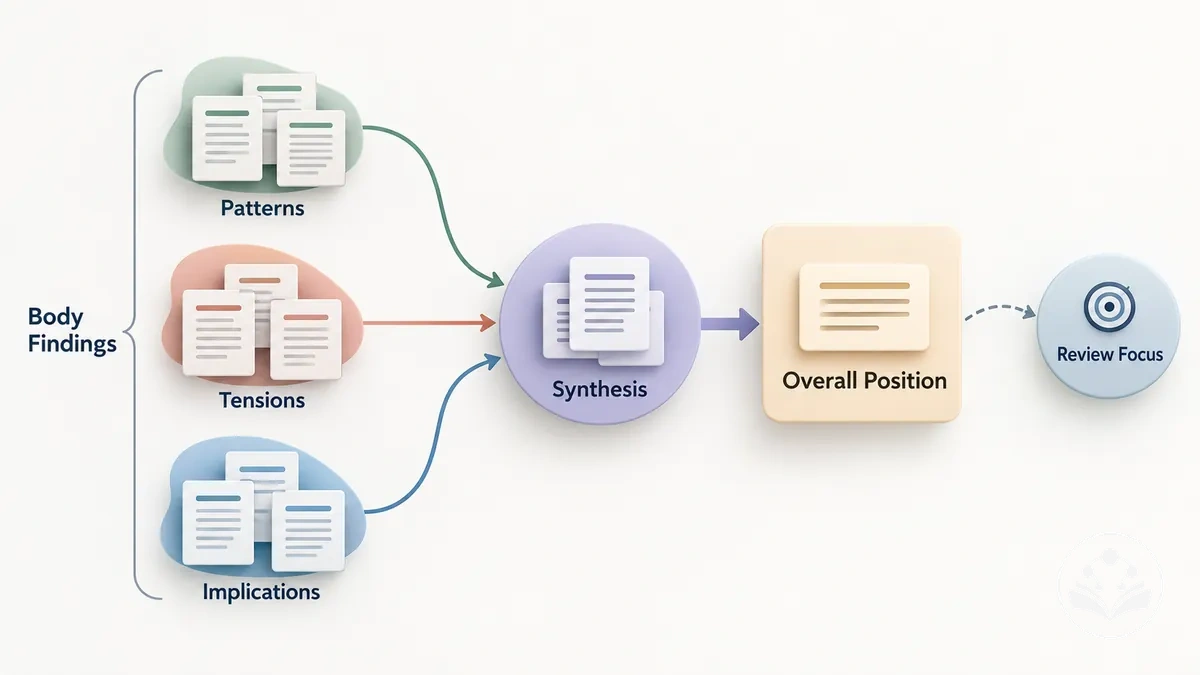
The conclusion consolidates existing body findings; it does not introduce a new body of literature.
In a literature review embedded within a thesis chapter or larger paper, some closing implications may instead be carried into later sections, while the conclusion still provides appropriate closure for the review focus.
Literature review body subsections organise related literature according to a defensible organising principle that gives each grouping a coherent analytical focus.
The organising principle establishes why particular sources belong together and where the subsection boundary lies.
A useful grouping creates a coherent unit for synthesis, whereas a weak grouping merely sorts sources without supporting relationships among them.
The organising basis can reflect a shared theme, time period, method, debate, concept, or another relationship relevant to the review purpose.
A theme groups literature addressing the same recurring issue, while a concept groups sources around a shared analytical idea.
A time period can distinguish developments across a chronology, and a method can group studies using comparable approaches.
These bases are examples rather than mandatory headings, and their suitability depends on the relationships the review needs to synthesise.
Each subsection therefore connects a defined focus with the literature included under that organising principle.
The grouping should make relationships among sources recoverable so that comparison, convergence, disagreement, or development can contribute to synthesis.
This architecture can be visualised as one broad body divided into connected groups, with several sources assigned to each subsection under a shared organising principle.
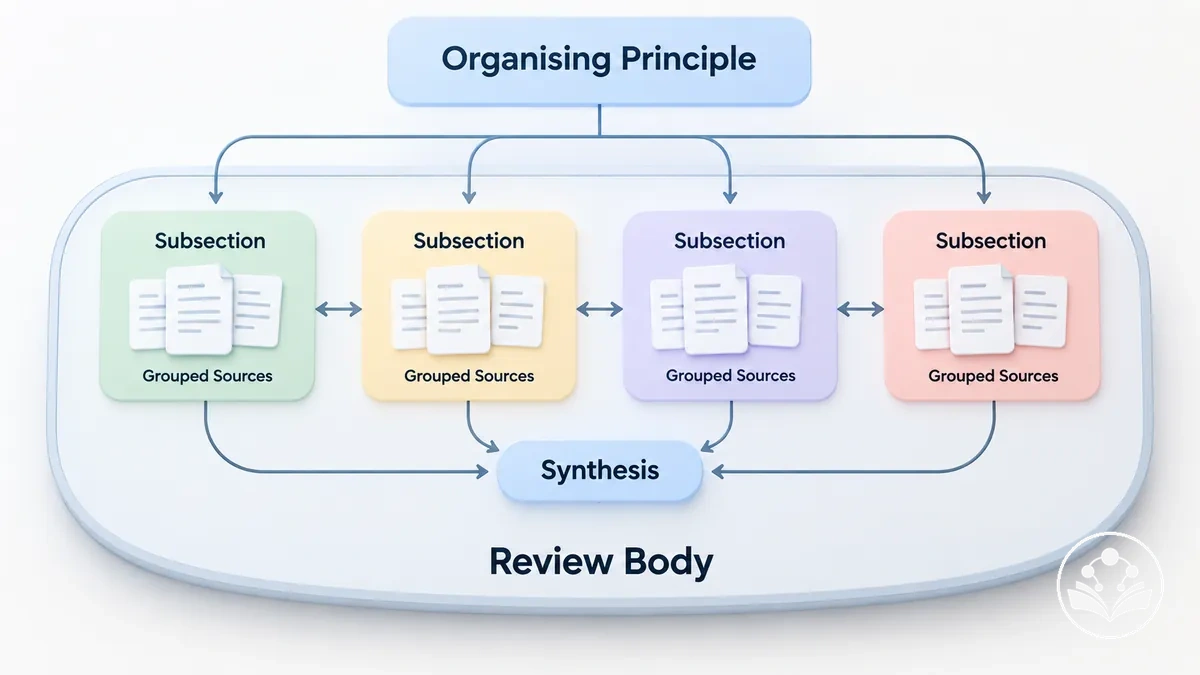
For example, a broad review of changes in a research field could use a small set of connected subsections for foundational concepts, later methodological developments, and current debates.
Each grouping would synthesise multiple relevant studies and contribute a distinct part of the body while maintaining coherence across the review.
A shared focus is the relationship that justifies discussing a set of sources together within one subsection.
The sources may address the same question, concept, pattern, debate, period, method, or another relation that supports a common analytical purpose.
The grouping is defensible when that relationship enables the studies to be examined together through synthesis rather than merely placed beside one another.
For example, several studies examining different interventions could form one synthesis-ready grouping when they address the same underlying debate and can be compared through that relationship.
Listing those studies separately without connecting their findings would create proximity between sources, but not the shared analytical relation needed for a coherent subsection.
Subsectioning is coherent when readers can recover the organising principle that explains why material appears within each subsection.
The grouping rule should make each subsection boundary intelligible and preserve a predictable relationship between the material and its analytical purpose.
Consistency therefore depends on a recoverable organising logic rather than mechanical uniformity across every subsection.
The organising principle can be evaluated by checking whether boundaries, exceptions, and sequence preserve that logic.
These criteria test whether the subsection scheme remains interpretable without requiring every grouping to take an identical form.
A justified exception can preserve coherence when its different grouping basis has an explicit analytical reason.
The sequence should likewise clarify how successive subsections relate within the broader organising logic.
A hybrid structure can therefore remain consistent even when individual subsections use different organising bases, provided their relationship is explicitly justified.
For example, a broader thematic structure may contain a chronological subsection where temporal development is analytically relevant to that theme.
The criterion is recoverable logic across the structure, not mechanical uniformity in every subsection.
Section order creates coherence when each part prepares, develops, or resolves context needed by the section that follows.
The sequence therefore reflects a meaningful dependency rather than an arbitrary arrangement of material.
Its exact form can vary with the review's organising logic, especially within the body.
The opening scope establishes the context that later body sections depend on to remain focused.
Within the body, each transition should connect the function of the preceding section with the development required by the next.
This progression allows contrasts, continuations, or shifts in emphasis to accumulate within the chosen organising logic.
The conclusion then draws on that developed context to provide cumulative synthesis and closure appropriate to the review's purpose.
One illustrative sequence shows how structural dependency can determine subsection order rather than prescribing a universal arrangement.
The sequence models document logic rather than the process used to research or write the review.
Each stage follows because it supplies context or analysis needed for the next stage.
Structural order explains why sections appear in a particular sequence within the document.
The process used to research and write the review may occur in a different order and does not determine the final structural progression.
The first body subsection should follow logically from the scope and organising principle established in the opening.
Its focus should address the most relevant starting point created by those boundaries and the chosen organising logic.
This dependency gives the sequence a clear rationale rather than treating the first subsection as a universal starting point.
The opening establishes direction and relevance, whereas the body performs the substantive synthesis beginning with the focus that logically follows from that frame.
Successive body sections need an explicit conceptual relationship between one subsection's takeaway and the focus of the next subsection.
The connection should explain why the next focus follows, rather than relying on a surface linking phrase.
A meaningful conceptual bridge supports coherence by making the progression of the review's discussion interpretable.
The sequence is coherent only when the reason for the progression is explicit. A linking phrase by itself does not create that relationship.
For example, a subsection identifying broad agreement about an approach could be followed by one that contrasts this agreement with evidence of limitations under particular conditions.
That relationship gives the second subsection a clear analytical reason to follow, whereas switching abruptly to an unrelated theme would leave the sequence conceptually unexplained.
The final body movement should make the cumulative synthesis of preceding subsections relevant to the review purpose before the conclusion.
It should surface the overall pattern or tension that the body collectively indicates and connect that interpretation to the review's focus.
This connection prepares the closing function without requiring the conclusion to introduce a new analytical branch.
Convergence
Findings support a common interpretation, allowing a clearer overall position when the body genuinely supports it.
Divergence
Findings point in different directions, so the closing implication should preserve the disagreement rather than flatten it into consensus.
Unresolved tension
Competing interpretations remain plausible; retain the alternatives and explain their significance for the review purpose.
The conclusion can then consolidate the established pattern, tension, and implication into an appropriate closing position without extending the analysis beyond what the body supports.
Literature review structure can distribute the same core section functions differently when the review sits within a thesis, dissertation, or larger paper.
An embedded literature review can rely on the surrounding document context to provide some scope, methodological context, or later closing material.
A standalone review instead carries those functions within its own boundaries, so visible structure can differ without changing the review's underlying analytical purpose.
The distinction is therefore between where each section function is located, not which document context is superior.
A standalone review contains its scope, synthesis, and closing function within one self-contained review, whereas an embedded review may share those functions with surrounding sections or chapters.
| Document context | Opening/scope function | Body synthesis location | Closing function |
|---|---|---|---|
| Standalone literature review | Established within the review's own opening boundary | Developed within the review's main body | Completed within the review's own closing boundary |
| Dedicated thesis/dissertation chapter | May combine chapter-specific scope with context established elsewhere in the thesis or dissertation | Located primarily within the dedicated literature review chapter | May close the chapter while broader implications are developed elsewhere in the document |
| Integrated literature-review section | May draw its scope from the surrounding section or larger paper | Located within the relevant section rather than a separate review chapter | May be absorbed into a later discussion or conclusion serving the larger document |
Document context therefore determines the location of the literature review, which affects where each retained section function becomes visible.
A dedicated chapter can preserve a clear chapter boundary while drawing contextual support from earlier material, whereas an integrated section can absorb more of its boundaries into the surrounding argument.
In either case, structural redistribution concerns the placement of functions rather than their automatic removal.
Exact chapter boundaries and headings can vary with discipline, institution, and specific requirements, so no universal thesis or dissertation arrangement applies.
The relevant distinction is whether the literature review is standalone or embedded and how its necessary functions are distributed within that document context.
The introduction–body–conclusion model remains useful because it describes structural function rather than mandatory heading labels.
An introduction provides an opening function, the body carries development, and the conclusion provides closure.
In a larger document, these functions can remain identifiable even when their visible labels or boundaries change.
The possible location of each function depends on how the literature review is positioned within the larger document.
The mapping is functional rather than prescriptive, so continuity depends on preserving each function rather than matching fixed labels.
These functions may therefore be carried by dedicated review material or by surrounding sections where their structural purpose remains recoverable.
For example, an embedded review may inherit its scope from an earlier thesis section, develop synthesis within the current section, and pass its closing implication into a later discussion.
The introduction, body, and conclusion logic remains recoverable through those functions and their location, even without three separately labelled sections.
A literature review chapter boundary depends on the role the review performs within the surrounding research structure.
Its document purpose affects where the review begins, what preceding context it can rely on, and what material follows it.
The boundary should therefore reflect the review's structural relationship with the wider thesis architecture rather than a universal rule.
Several criteria determine whether a literature review needs a distinct chapter boundary or a more integrated section boundary.
Some arise from the research design and synthesis burden, while others reflect discipline, supervisor expectations, or institutional requirements.
Together, these conditions determine how much context and synthesis the review must contain before continuity passes to the following argument or method.
The relevant criteria connect each surrounding-document condition to its structural implication for the literature review boundary.
For example, a literature review may form a dedicated chapter when its synthesis burden supports a substantial independent discussion, but it may be integrated when synthesis serves a narrower research stage.
A different thesis architecture may also place contextual material before the review or move methodological discussion immediately after it, changing the appropriate section boundary.
The final boundary decision should align with the research structure, document purpose, disciplinary convention, supervisor expectations, and applicable institutional requirements.