
Review Article Examples: Structure, Synthesis, and Argument in Practice
A strong review article example shows how a defined purpose and scope organise the literature, how evidence from multiple studies is synthesised around a shared point, and how that synthesis supports a qualified argument. Use the example to trace those connected writing functions rather than to copy its wording or format.
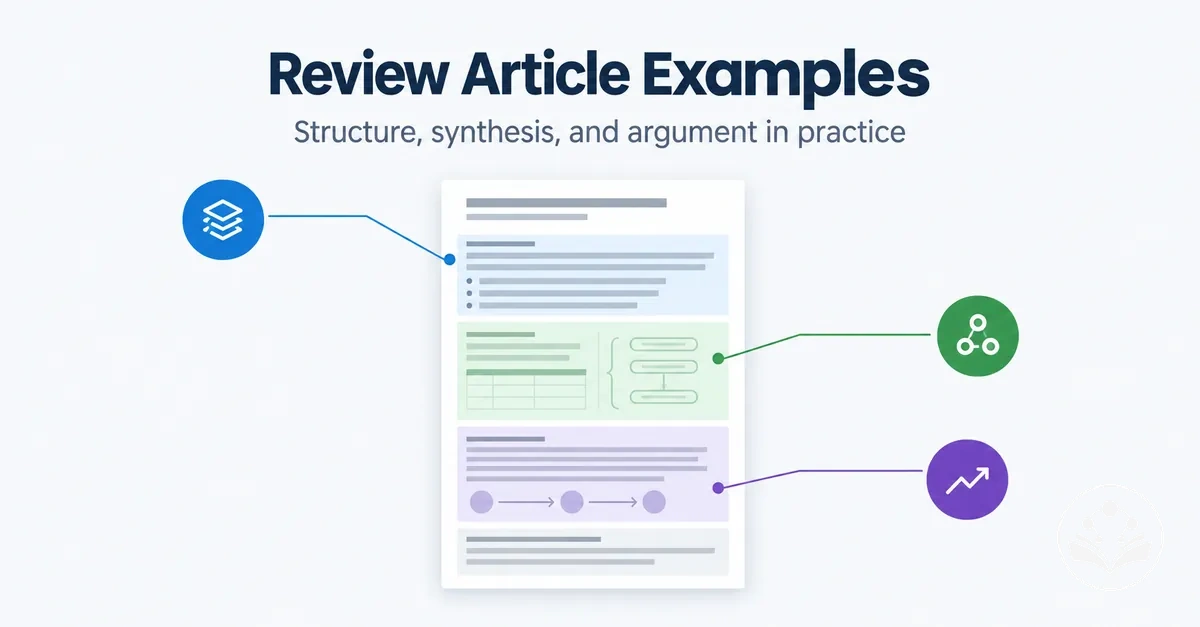
How to read a review article example
Follow the writing chain from the review question to the final implication. The value of the example lies in the hand-offs between these functions.
-
Purpose and scope Define what the review is examining and which literature belongs within that analytical boundary.
-
Evidence organisation Group comparable findings around a theme or claim so the literature serves the review question rather than source order.
-
Synthesis and interpretation State how findings relate through agreement, contrast, or a context-dependent difference, then explain what that pattern means.
-
Qualified argument Draw an implication that remains proportional to the strength, consistency, context, and limitations of the evidence.
Reading rule: ask whether each writing move gives the next move an analytical basis. If the chain breaks, the example may show information without showing a coherent review argument.
The exact structure can vary with the review question, review type, discipline, and journal requirements; the transferable value lies in the writing functions the example makes visible.
Table of Contents
What a Good Review Article Example Demonstrates
A good review article example demonstrates a coherent purpose and scope, functional structure, cross-study synthesis, evidence-supported interpretation, and a traceable argument.
These qualities are visible in what the manuscript does with the literature: sections serve the review question, evidence is connected across studies, and conclusions follow from the interpretation developed from that evidence.
Formatting or journal prestige alone does not demonstrate these writing functions.
The most useful criteria identify observable relationships between purpose, structure, synthesis, evidence, and argument rather than cosmetic features.
The annotated example labels these functions in context, while the criteria list shows what to look for and why each feature matters.
- Purpose and scope: The review question or stated purpose defines which literature belongs within the manuscript's scope. This matters because the reader can judge whether the evidence contributes to the same analytical task rather than accumulating around a loosely related topic.
- Structural coherence: Sections perform identifiable functions and maintain continuity with the review's purpose and developing argument. This matters because organisation should help the reader follow the analytical progression, even though section names and placement may vary by review type or journal requirements.
- Cross-study synthesis: The review article example connects studies through relationships such as agreement, disagreement, recurring patterns, or differences in findings instead of reporting each study as an isolated summary. This matters because synthesis makes the combined evidence, rather than the sequence of individual sources, the object of analysis.
- Treatment of agreement and disagreement: Similar and conflicting findings are stated explicitly and interpreted in relation to the review question. This matters because a useful review distinguishes a consistent pattern from evidence that remains mixed or context-dependent rather than flattening different findings into one conclusion.
- Evidence-supported interpretation: Analytical claims explain what the combined evidence means and remain connected to the studies that support them. For example, reporting that several studies reached different findings identifies disagreement; explaining what that disagreement means for the review question turns the reported evidence into interpretation.
- Qualification and argument alignment: The manuscript qualifies claims when the available evidence is limited, inconsistent, or conditional, and the conclusion does not extend beyond the interpretation established from that evidence. This matters because the line of argument remains traceable from evidence through interpretation to conclusion.
The relative emphasis on these criteria may vary with the review type, review question, discipline, and journal requirements.
A review article example remains useful as a learning model when its conclusions stay aligned with the evidence and interpretation developed within the manuscript.
Annotated Review Article Example: How the Parts Work Together
Consider an annotated review article example examining how a defined academic support practice relates to student engagement across a selected body of literature.
The worked example uses an original scenario so the review focus remains secondary to the writing functions being demonstrated.
Its passages show how framing, evidence, synthesis, interpretation, and argument can operate as connected functions rather than isolated model sentences.
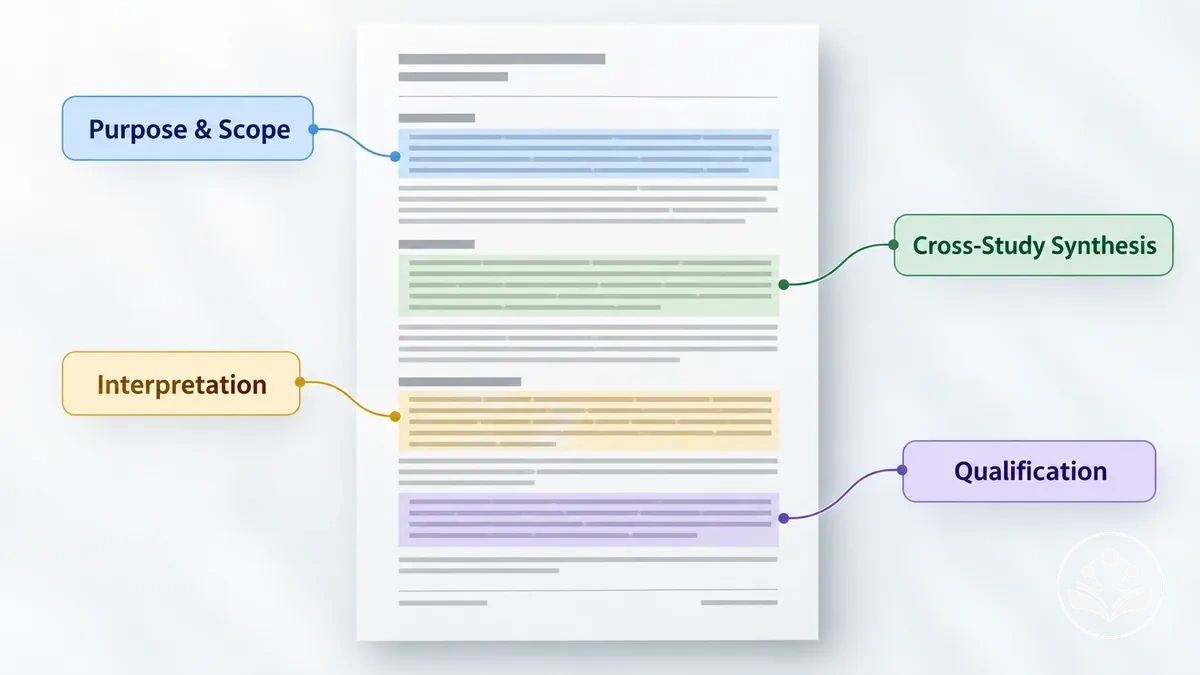
The annotations track a functional progression: the review focus establishes what the literature is being examined for, grouped evidence brings related study findings into synthesis, interpretation explains the pattern formed by that evidence, and a qualified implication contributes to the argument.
The sequence illustrates relationships among writing moves rather than prescribing one fixed arrangement for every review article.
The visual traces this progression across generic manuscript blocks, showing how review focus, grouped evidence, interpretive claim, and qualified implication connect within the same manuscript passage.

- Review focus — frames the analytical scope: “This review examines how structured academic support relates to student engagement, with attention to the conditions under which studies report similar or different patterns.” This writing move defines what the literature will be examined for, giving later evidence a common analytical focus and supporting coherence.
- Grouped evidence — synthesizes relationships among findings: “Across the reviewed studies, several findings associate structured support with greater engagement, while other findings indicate weaker or inconsistent relationships under different study conditions.” This writing move groups evidence by relationship rather than source order, allowing agreement and disagreement to contribute to the synthesis.
- Interpretive claim — explains the pattern: “Taken together, the mixed findings suggest that the relationship between structured support and engagement is conditional rather than uniform across the reviewed evidence.” This writing move interprets what the grouped findings mean instead of merely repeating them, advancing the argument from evidence toward an analytical claim.
- Qualified implication — limits the argument to the evidence: “The reviewed evidence therefore supports treating structured support as a potentially relevant factor in engagement, while differences among study conditions limit a broader conclusion.” This writing move qualifies the implication so the argument remains proportionate to the pattern established by the evidence.
The annotated example moves from a defined review focus to grouped evidence, then from synthesis to interpretation and a qualified implication.
Each writing move gives the next move an analytical basis, creating functional continuity and coherence without implying that real review articles must use the same arrangement.
How the Example Establishes the Role of Each Section
Each part of the annotated review article example has a local section function and also hands information forward to the next part of the argument.
The review problem frames the scope, evidence is organised around a relevant theme or claim, interpretation explains what that evidence means, and the resulting implication closes the reasoning loop.
In real manuscripts, section names, grouping, and order can change with the review type, question, discipline, or journal requirements while comparable functions can still be performed.
Detailed patterns vary beyond the functions shown here and are addressed in review article structure.
The diagram shows the functional handoffs within one continuous argument, while the bullets identify each part's immediate purpose and the information it hands forward.

- Review problem framing: Frames the review problem and defines the scope within which evidence is relevant. It hands forward a focused question or analytical boundary for organising the literature.
- Evidence organisation: Organises relevant evidence around a theme or claim rather than leaving findings disconnected. It hands forward a grouped body of evidence for interpretation.
- Interpretation: Interprets the grouped evidence by explaining what the observed pattern means in relation to the review problem. It hands forward an interpretive claim that supports the developing argument.
- Qualified implication: Connects the interpretation to the argument while keeping the claim within the conditions represented by the example. It completes the local reasoning path by stating the implication supported by the interpreted evidence.
How the Example Connects Findings Across Studies
Study findings become synthesis when the writer states an explicit relationship among studies around a shared point, rather than placing separate source summaries or citations beside one another.
In the annotated example, the useful relation is between what the studies report and whether those findings show agreement, contrast, or a context-dependent difference that changes the interpretation.
Agreement can show that findings are consistent around a shared claim, while contrast can identify evidence that points in different directions.
A difference may also be interpreted in relation to context, method, or limitation when the illustrative evidence defines that attribute; the difference alone does not establish why the findings diverge.
This local example shows the relational move rather than the full method of evidence synthesis, and agreement among study findings does not by itself establish causation.
The diagram makes the cross-study relationship visible by connecting generic study findings through agreement, contrast, or conditional difference to a shared implication.
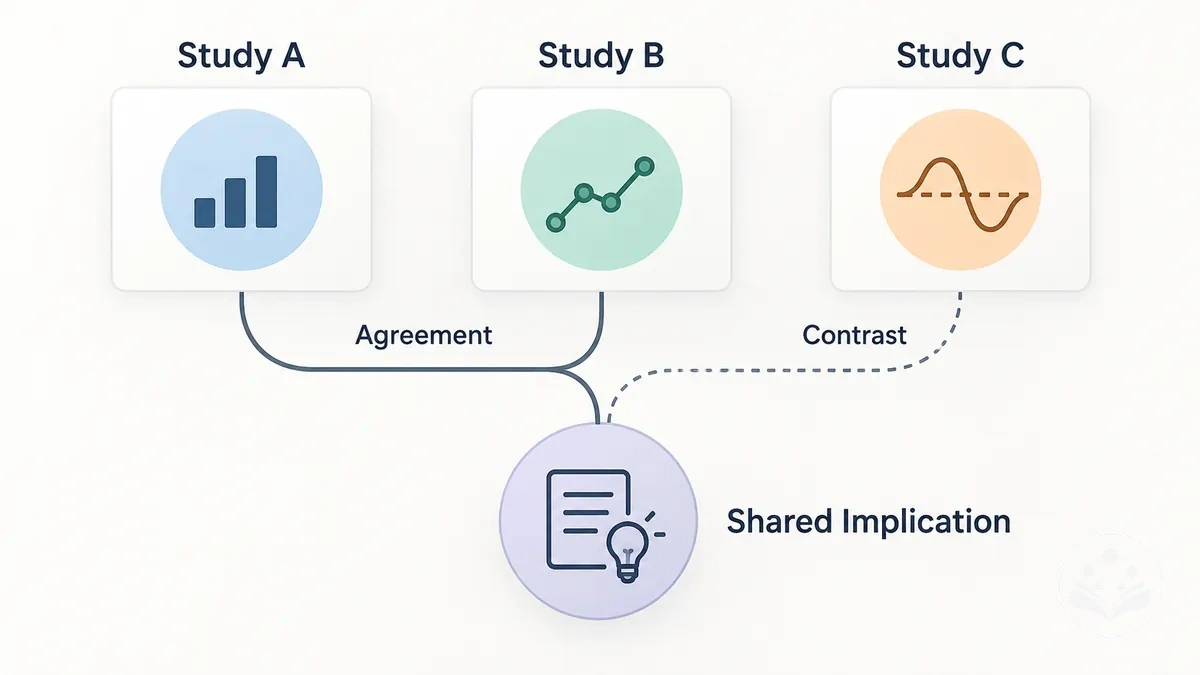
The following illustrative pair uses the same evidence to show how a contrast between findings becomes an explicit implication for the shared point.
The integrated version makes the relationship and its implication explicit: the findings differ around the same shared point, and context marks a condition under which the interpretation may differ.
Synthesis therefore comes from explaining the cross-study relationship and what it means for the claim, not from citation density alone.
How the Example Turns Synthesis Into an Argument
Synthesis becomes a review argument when an observed pattern in the evidence supports an interpretive claim and that claim is qualified by the evidence's limitations.
The pattern is what the synthesized study findings show together; the interpretive claim is the review author's inference about what that pattern means.
Direct study findings remain evidence rather than becoming facts about a broader conclusion simply because several findings align.
The review author can infer an implication from the combined pattern, but mixed findings, differences in context or method, and relevant limitations should constrain the strength of that inference.
Qualification makes this boundary explicit by stating the condition or uncertainty under which the interpretive claim is supported.
The strength of the review argument should therefore remain proportional to the strength and consistency of the evidence supporting it.
The diagram separates the observed evidence pattern from the review author's interpretive inference and shows where qualification limits the resulting implication.

The following original reasoning example separates the observed pattern from the review author's inference before qualifying the implication.
The reasoning chain turns synthesis into an evidence-supported argument by making the inference visible and limiting it to what the pattern can justify.
The qualification is part of the argument because it keeps the implication proportional to the evidence on which it rests.
Synthesis Paragraph Examples: Connecting Studies Around a Shared Point
A synthesis paragraph is organized around a shared point or controlling claim and the relationships among study findings, rather than the order in which sources were read.
Multiple sources contribute to the paragraph when their findings are connected through a meaningful relationship such as agreement, contrast, or a context-dependent difference.
The writer then interprets that relationship in relation to the controlling claim instead of treating citation count as evidence of synthesis.
The paragraph-level evaluation lens considers whether the controlling claim focuses the evidence, whether multiple sources are integrated, whether their relationship is explicit, and whether the writer adds interpretation and qualification where the evidence requires it.
These criteria make the relationship between evidence and the paragraph's analytical function observable.
The central test is whether combining the sources produces new understanding of the shared point that isolated summaries would not provide.
The following criteria connect each paragraph-level feature to an observable cue and its analytical function.
- Shared point and controlling claim: The synthesis paragraph organizes study findings around one analytical focus, giving evidence from different sources a common purpose rather than following source order.
- Integration of multiple sources: Findings from more than one source contribute to the same controlling claim, so the paragraph connects evidence rather than presenting separate summaries.
- Explicit relationship: The paragraph states how the study findings relate, such as agreement, contrast, or a difference associated with context or method. This relationship makes the analytical connection among the sources explicit.
- Interpretation: The writer explains what the relationship among the findings means for the shared point, producing an implication or inference from the combined evidence rather than merely repeating individual findings.
- Qualification where needed: When findings are mixed, context-dependent, methodologically different, or otherwise limited, the paragraph qualifies its interpretation so the controlling claim remains proportionate to the evidence supporting it.
A Source-by-Source Paragraph That Stops at Summary
This source-by-source paragraph is intentionally realistic: it uses plausible academic reporting rather than exaggerated writing errors.
Its limitation is that source order controls the paragraph, while no explicit comparison, integration, or interpretive claim connects the studies around a shared point.
- Study A
- Reports that structured academic support is associated with higher student engagement in its study context.
- Study B
- Finds a similar association between academic support and engagement among its participants.
- Study C
- Reports a weaker relationship under different study conditions.
- Study D
- Notes that engagement outcomes differ across the groups examined in that study.
- Study E
- Suggests that the relationship between academic support and engagement may vary across educational contexts.
The paragraph remains summary-dominant. Its observable cues are:
- One-source-at-a-time sequencing: Each sentence reports a different study, so source order determines the progression rather than a controlling claim.
- Repeated reporting verbs: Reporting verbs such as reports, finds, notes, and suggests keep attention on what each study says without stating how the study findings relate.
- No explicit comparison or integration: The paragraph contains potentially similar and different findings, but it does not connect them as agreement, contrast, or a context-dependent relationship around a shared point.
- No interpretive claim: The paragraph does not explain what the combined evidence means, so it stops before producing an implication from the studies together.
A source summary can still provide necessary local context, and a single-source sentence may be appropriate when it serves that function.
In this example, summary alone fails to establish what the relationships among the studies mean for the shared point.
A Synthesized Paragraph That Connects Evidence Around a Claim
The same study findings create a different analytical result when the synthesized paragraph is organized around a controlling claim rather than source order.
Here, explicit relationships of agreement and difference connect the evidence, while context qualifies the interpretation those relationships support.
Shared pattern
Across the illustrative studies, structured academic support is associated with higher student engagement in several contexts, but the reported relationship is not uniform.
Agreement
Study A and Study B report similar positive associations, creating agreement around the claim that academic support may be relevant to engagement.
Difference and context
Study C reports a weaker relationship under different study conditions, while Study D identifies variation among the groups it examines. Study E also suggests that the relationship may differ across educational contexts.
Qualified interpretation
Taken together, these study findings support the interpretation that academic support is associated with engagement in the illustrative evidence, while the differences qualify any claim that the relationship is uniform across contexts.
Unlike the preceding source-by-source paragraph, this synthesized paragraph groups comparable evidence around one claim and connects the study findings through explicit relationships.
Agreement contributes to the shared interpretation, while differences in context constrain its scope and provide the necessary qualification.
The integration therefore produces information gain: the reader can identify both the combined pattern and the condition limiting its implication, rather than receiving separate source summaries.
Discussion Section Example: Extending Synthesis Into Interpretation
A review-article discussion interprets a synthesized pattern by explaining its meaning, significance, limitations, and implications rather than simply reporting the pattern again.
The discussion connects the established evidence to an interpretive claim while keeping that claim proportional to what the reviewed evidence supports.
Where an exception or limitation changes the pattern's scope, the discussion qualifies the implication instead of presenting it as universal.
The following original discussion passage builds from the illustrative pattern established earlier: structured academic support is associated with higher student engagement in several contexts, while some study findings show a weaker or inconsistent relationship under different conditions.
The example moves from that synthesized pattern to interpretation, accounts for the exception, and then draws a qualified implication.
The restatement identifies what the synthesized evidence reports, whereas the interpretation explains what that pattern means for the review's argument.
Qualification enters where a limitation or exception narrows the significance and implication that can reasonably be drawn from the evidence.
This local example stops at that interpretive function; the broader development of a manuscript's discussion and conclusion writing requires additional decisions beyond this passage.
Evidence Table Example: Organizing Comparisons That Support the Argument
An evidence table is useful when comparable study attributes need to be scanned together to reveal patterns, contrasts, and limitations across the reviewed evidence.
By organizing each study against the same relevant attributes, the table makes relationships that are harder to scan across separate source summaries more visible.
Those relationships can then support synthesis and interpretation within the review argument.
In this illustrative evidence table, each row represents one study, while the columns compare its context or sample, method or design, key finding, relevant limitation, and contribution to the shared review point.
These fields serve this example because they expose differences that affect interpretation; another review question, review type, or evidence base may require different comparable attributes.
| Study or Source | Context or Sample | Method or Design | Key Finding | Relevant Limitation | Contribution to the Shared Review Point |
|---|---|---|---|---|---|
| Study A | Educational context A | Observational design | Structured academic support is associated with higher student engagement. | The association is specific to the represented context and does not establish causation. | Contributes evidence of a positive association between support and engagement. |
| Study B | Educational context B | Observational design | Academic support is associated with higher engagement among the represented participants. | The finding is bounded by the represented participant context. | Adds agreement with Study A around the shared review point. |
| Study C | Different educational conditions | Observational design | The relationship between support and engagement is weaker under the represented conditions. | Different conditions limit direct comparison with Studies A and B. | Introduces a contrast that qualifies a uniform interpretation. |
| Study D | Multiple participant groups | Comparative design | Engagement patterns differ among the represented groups. | The illustrative evidence does not establish why the groups differ. | Shows that the relationship is not represented consistently across groups. |
| Study E | Different educational contexts | Comparative design | The relationship between academic support and engagement differs across the represented contexts. | Contextual variation constrains broader generalization. | Supports a context-dependent interpretation of the shared review point. |
The cross-row comparison reveals agreement in Studies A and B alongside differences in Studies C, D, and E, so the pattern supports a qualified rather than universal interpretation of the relationship between academic support and engagement.
Context or sample and method or design also show where apparently comparable findings require caution, while each limitation constrains how strongly its contribution can support the review argument.
The evidence table organizes these relationships, but the review argument comes from interpreting what the pattern and its limitations imply for the review question.
Broader decisions about presenting evidence through tables and figures extend beyond this example.
How to Use Review Article Examples to Improve Your Own Draft
Use review article examples to extract transferable writing principles rather than reproduce wording, headings, citation patterns, or formatting.
The aim is to identify a writing function that works in the example and adapt that function to your own evidence and draft.
The appropriate execution may differ by review type, question, discipline, and journal requirements.
- Identify the draft problem: Name the specific weakness you need to revise, such as a paragraph that reports studies separately without building a shared analytical point. Defining the problem keeps the revision focused on the writing function that needs improvement.
- Locate the analogous writing function in an example: Find where the example addresses a comparable problem, such as connecting several study findings around one claim. Place this local revision exercise within the broader process of review article writing without treating the example as a fixed structure for the whole manuscript.
- Name the transferable principle: State the principle in functional terms, such as organizing evidence around a controlling claim and making relationships among findings explicit. A useful transferable principle explains why the example works rather than describing its exact sentences or formatting.
- Apply the principle to your own evidence: Revise the draft using your studies, contexts, methods, findings, and limitations while preserving the principle's writing function. Adjust the revision when the review question, discipline, evidence base, or journal requirements call for a different execution.
- Verify the revision: Check whether the revised passage improves the intended writing function by increasing coherence or analytical depth through clearer relationships and interpretation. If those relationships remain unclear, adjust the revision rather than judging improvement by resemblance to the example.