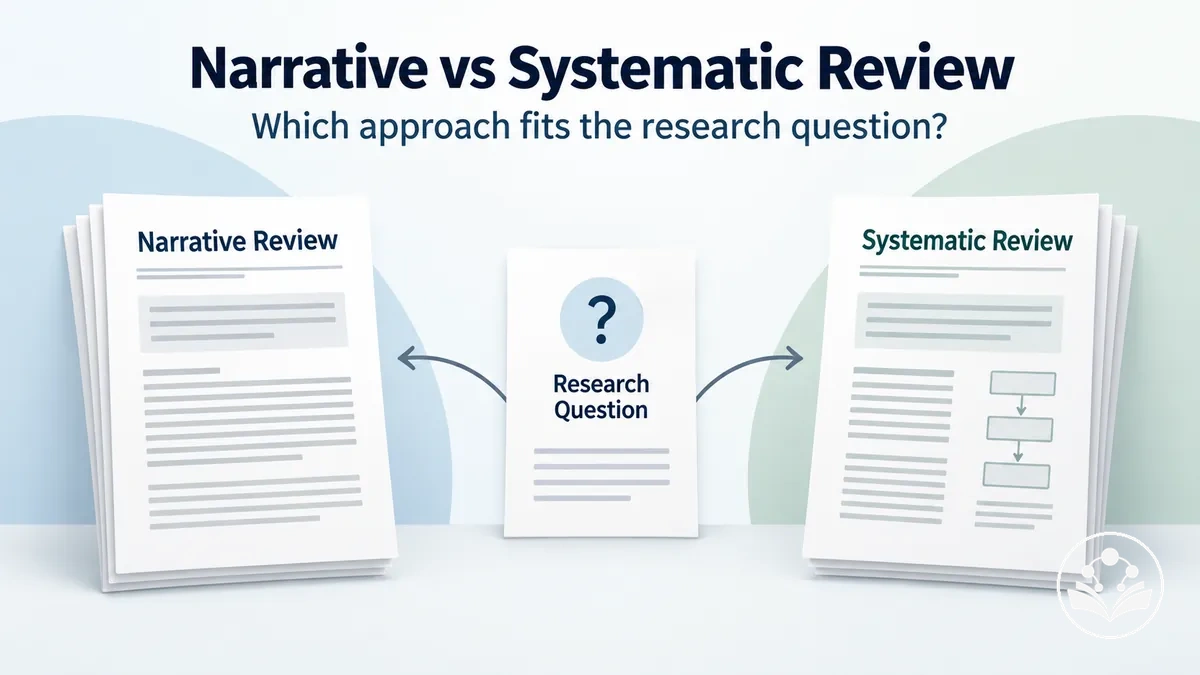
Narrative Review vs Systematic Review: Differences and Method Fit
A narrative review typically fits broad, interpretive, or conceptually integrative questions, while a systematic review typically fits focused questions that require prespecified eligibility criteria, systematic evidence identification, and transparent study selection. Choose the approach from the research question and required methodological structure, not from a hierarchy: either type can be rigorous or weak depending on execution and reporting.
Which review approach fits the question?
Use the question's purpose and evidence-handling requirements as the decision basis.
Narrative review
Question pattern
Broad, interpretive, contextual, or conceptually integrative.
Evidence process
Search, selection, and synthesis can be structured while remaining more adaptive to the review purpose.
Stronger fit when
Contextual explanation or integration across varied concepts, perspectives, or evidence is central.
Systematic review
Question pattern
Focused and sufficiently well defined for explicit eligibility and selection rules.
Evidence process
Search methods, eligibility criteria, and study selection are explicit and commonly prespecified.
Stronger fit when
A systematic attempt at comprehensive evidence identification, traceability, reproducibility, or bias-control procedures is central.
Decision rule: match the review design to the question, scope, and required process. The review label does not guarantee methodological quality.
Both approaches synthesise literature. Stanford Medicine's Lane Medical Library describes narrative reviews as synthesising literature across a topic, while systematic reviews use explicit methods to identify and select evidence for a defined question.
The practical comparison is therefore about methodological structure, transparency, reproducibility, interpretive flexibility, evidence-selection logic, and practical burden. Greater structure can improve traceability, while greater flexibility can support broader contextual explanation; neither feature guarantees quality.
Table of Contents⌄
Matching the Review Approach to the Research Question and Purpose
The research question and review purpose should govern review-approach selection because they determine what evidence must be identified, how narrowly the question should be bounded, and how much methodological structure the synthesis requires.
A focused question that requires explicit evidence identification and selection generally creates a stronger fit for a systematic review, whereas a purpose centred on broader interpretation or conceptual integration can support a narrative review.
Method fit therefore depends on the combined pattern of question focus, scope, breadth, and methodological requirements rather than on one isolated feature.
A clear review question formulation establishes the purpose and boundaries needed to evaluate these decision variables.
The criteria below organise conditions that can shift suitability toward a narrative or systematic review; they do not score or rank the two approaches.
Question focus: A narrowly defined question that requires an explicit answer from identified evidence tends to favour a systematic review, while a question seeking broader interpretation or conceptual understanding can favour a narrative review.
Scope and breadth: A purpose that deliberately spans concepts, contexts, or perspectives can make the interpretive flexibility of a narrative review useful; a deliberately bounded scope supports the more structured eligibility and selection logic of a systematic review.
Comprehensive evidence identification: When the review purpose requires a systematic attempt to identify evidence meeting stated eligibility criteria, systematic searching and documented study selection favour a systematic review. A narrative review can be suitable when comprehensive evidence identification is not the defining requirement of the question.
Prespecification: When eligibility criteria and key methods need to be established before evidence selection and synthesis, the greater prespecification of a systematic review fits that requirement. When the purpose requires more adaptive conceptual development, a narrative approach can allow greater flexibility, provided the author explains the scope and rationale transparently.
Interpretive flexibility: Questions that require contextual explanation, conceptual integration, or connection across different perspectives can favour a narrative review because author judgment forms a larger part of the synthesis. Questions requiring a more consistently specified evidence-selection process favour a systematic approach.
Transparency and reproducibility expectations: When readers need explicit documentation of how evidence was identified, screened, and included so that the process can be examined or repeated, a systematic review provides the stronger methodological fit. Narrative reviews can also be transparent, but reproducibility depends on how explicitly their search, selection, and interpretive decisions are reported.
Taken together, these criteria establish suitability through their combined conditions rather than through a single deciding rule.
For example, a question about how a concept has been interpreted across disciplines may justify a narrative review when the purpose is contextual and conceptual integration, while a focused question about the effects of a defined intervention may justify a systematic review when the purpose requires prespecified eligibility criteria and comprehensive evidence identification.
The same broad topic can therefore support different review approaches when its research question and intended purpose change.
Where the purpose extends beyond this narrative-versus-systematic comparison, researchers can choose a review approach by matching the distinct review task to the question rather than treating one method as universally preferable.
When a narrative review fits the question
A narrative review can fit when the question and purpose call for interpretive synthesis, contextual explanation, conceptual integration, or flexibility across a broad scope rather than the same prespecified evidence-identification process used in a systematic review.
This fit is especially relevant when the task is to explain how concepts, perspectives, or bodies of literature relate, while keeping the review's scope and author judgment transparent.
Interpretive flexibility allows a narrative review to connect evidence from different perspectives and develop a contextual explanation rather than restricting synthesis to a narrowly specified set of comparable studies.
Sukhera, writing in the Journal of Graduate Medical Education, describes narrative reviews as able to include a wide variety of studies and provide an overall summary with interpretation and critique.
A broad or conceptually oriented question can therefore change the review task from identifying evidence under a tightly prespecified process to explaining relationships across relevant literature.
For example, a question seeking to integrate different theoretical perspectives on a concept can suit a narrative review because conceptual integration is central to the purpose.
A question seeking to explain how an issue is understood across different contexts can also favour a narrative approach when contextual explanation requires interpretive synthesis across varied evidence.
This flexibility does not make evidence selection arbitrary: the author should make the scope, rationale, and relevant methodological decisions sufficiently transparent for readers to understand how the synthesis was developed.
When a systematic review fits the question
A systematic review can fit when a focused question requires explicit methods, prespecification, and transparent evidence identification and study selection.
The method is particularly suitable when eligibility criteria can be defined in advance and the review purpose requires a systematic attempt to identify and synthesise the relevant evidence.
A focused scope makes it possible to connect the research question to prespecified eligibility criteria, a comprehensive search, and documented study selection.
University College London Library Services states that systematic reviews should answer a specific, well-defined research question and apply explicit eligibility criteria to determine which studies address it.
These methodological requirements support transparency and can improve reproducibility and bias control, although the extent achieved still depends on execution and reporting quality.
The systematic-review label itself does not guarantee complete evidence retrieval, absence of bias, or reproducible results.
A focused evidence-synthesis question can therefore favour a systematic review when prespecified methods and transparent reporting are important to the purpose.
Broader evidence-mapping purposes may require a different design; the boundary is clearer when considering systematic versus scoping review purposes.
Suitability depends on whether the question requires the explicit methodological structure of a systematic review rather than on the review label alone.
Why method fit matters more than a review hierarchy
Method fit is a more useful basis for judging appropriateness than a review hierarchy because a review label alone does not establish quality.
The research question and research purpose determine which methodological demands matter, while rigor depends on whether the chosen review approach addresses those demands appropriately.
A review can therefore be fit-for-purpose yet still have weak execution quality or reporting quality, just as a method commonly associated with greater structure does not establish quality merely by its label.
Breadth can support a knowledge task that requires wide contextual coverage but become a limitation when the research question requires tightly bounded evidence; interpretive flexibility can support conceptual explanation but reduce reproducibility when decisions are insufficiently documented.
Greater procedural reproducibility can support scrutiny of how evidence was handled, while transparency is valuable across review approaches because it makes methodological and interpretive decisions easier to evaluate.
These attributes are therefore conditional trade-offs rather than markers of universal superiority: method fit, rigor, execution quality, transparency, and reporting quality must be judged together against the intended research purpose.
How Narrative and Systematic Review Methodologies Differ
Narrative review methodology and systematic review methodology can both define scope, identify evidence, select material, synthesise findings, and document decisions, but they apply these methodological dimensions with different degrees of explicitness and prespecification.
Narrative reviews commonly allow greater flexibility in how scope, evidence identification, and synthesis develop around the review purpose, whereas systematic reviews use a more explicitly planned methodological process tied to a focused research question.
Javeed Sukhera, writing in the Journal of Graduate Medical Education, describes systematic reviews as commonly using a prespecified method for a narrower question, while narrative reviews can integrate a wider variety of studies with interpretation and critique.
These distinctions affect procedural transparency and reproducibility without establishing that either review label guarantees methodological quality.
The comparison below organizes the same methodological dimensions across both approaches rather than ranking them.
It shows where procedural explicitness, prespecification, and flexibility typically differ while keeping each dimension at methodology-summary level.
Methodological dimension
Narrative review methodology
Systematic review methodology
Scope
May address a broader topic or integrate varied perspectives, with scope shaped by the research purpose and stated review boundaries.
Typically addresses a focused research question with scope defined through an explicit methodological plan.
Evidence identification
The search strategy may be selective or structured to different degrees; its extent and rationale should be documented sufficiently to clarify how evidence was identified.
The search strategy is planned systematically to identify evidence relevant to the defined question and eligibility criteria.
Study selection
Selection may rely more on author judgment and stated relevance to the scope, so transparency depends on documenting the basis for inclusion.
Study selection applies explicit eligibility criteria established through the review method, supporting traceability of inclusion and exclusion decisions.
Synthesis
Often uses interpretive synthesis to integrate findings, concepts, contexts, or perspectives with greater analytic flexibility.
Uses a planned synthesis appropriate to the included evidence; synthesis may be qualitative or quantitative and is not synonymous with meta-analysis.
Documentation
Procedural documentation can vary in detail, so reporting the search, selection, and analytic decisions improves transparency.
Prespecification and explicit documentation are central methodological expectations, supporting transparency and reproducibility of the review process.
The table describes methodological tendencies rather than fixed rules.
Narrative reviews can use structured search strategies, explicit selection logic, and detailed documentation, while a systematic review can fall short of its intended transparency or reproducibility when prespecified methods are not executed or reported clearly.
Procedural explicitness can strengthen traceability, while flexibility can support interpretive work when it matches the research purpose; neither attribute substitutes for sound execution.
Method labels therefore describe methodological conventions, while execution quality depends on how clearly and consistently those conventions are applied and documented.
Search strategy, eligibility criteria, and study selection
Narrative and systematic reviews can both use a search strategy and a study selection process, but the degree of prespecification and documentation commonly differs.
Narrative reviews may use selective or structured search methods according to their search scope and purpose, whereas systematic reviews typically define search methods and eligibility criteria more explicitly before study selection.
This difference affects how readily readers can trace evidence identification and assess potential selection bias.
The comparison organizes search scope, eligibility criteria, study selection, and documentation by their typical degree of explicitness and the resulting implications for transparency and reproducibility.
Search and selection attribute
Narrative review
Systematic review
Search strategy and scope
Search scope may be broad or selective and may develop with the review purpose; transparency increases when sources, search methods, and boundaries are reported.
Search scope is typically planned against a defined research question, with sources and search methods documented to make evidence identification traceable.
Eligibility criteria
Inclusion criteria and exclusion criteria may be stated with different degrees of formality, with author judgment often playing a larger role in determining relevance.
Eligibility criteria are typically prespecified as explicit inclusion criteria and exclusion criteria before screening. University of Michigan Library guidance recommends developing eligibility criteria before article screening begins.
Study selection
The selection process may be more interpretive, so documenting why material was included is important for evaluating the resulting evidence base and potential selection bias.
Study selection applies predefined eligibility criteria to retrieved records, with decisions and reasons for exclusion documented to improve transparency and traceability.
Documentation
Reporting detail can differ by review purpose and method; explicit documentation helps readers understand evidence identification and selection decisions.
Prespecified and documented search and selection methods are intended to support transparency and reproducibility, but those properties still depend on how completely the methods are executed and reported.
The methodological distinction is therefore one of typical procedural explicitness, not a claim that narrative reviews have no search method or that systematic searches are perfectly exhaustive.
Poor reporting can limit reproducibility even when systematic methods are intended to support it, so sources, search dates, eligibility rules, and selection decisions need sufficient documentation for the process to be assessed.
The detailed mechanics of designing and conducting the literature search process belong to the dedicated search-method context rather than this comparison.
Evidence synthesis and reporting expectations
Narrative and systematic reviews can both integrate evidence into conclusions, but they commonly differ in how explicitly the evidence synthesis and reporting process is structured and documented.
Narrative reviews often allow greater interpretive flexibility when connecting findings, concepts, or contexts, while systematic reviews usually require clearer documentation of how evidence was grouped, analysed, and carried forward into conclusions.
The key distinction is therefore not whether synthesis occurs, but how transparent the synthesis approach and analytic decisions are to the reader.
For either review approach, the grouping rationale should explain why particular studies, findings, or themes are considered together, and reporting should make the relevant analytic decisions visible enough to support traceability from included evidence to conclusions.
Greater documentation can make it easier to examine how interpretations were formed and, where the method permits, can support reproducibility; limited reporting can make that reasoning harder to reconstruct.
Narrative reviews may rely more heavily on explicit author interpretation, while systematic reviews generally place stronger emphasis on documenting synthesis decisions in relation to prespecified methods, but the transparency achieved still depends on execution and reporting quality.
Reporting expectations should therefore make the chosen synthesis approach, grouping rationale, analytic decisions, and connection to conclusions sufficiently clear for readers to evaluate how the evidence was integrated.
Rigor, Transparency, Bias, and Reproducibility Across the Two Approaches
Rigor, transparency, bias control, and reproducibility are related quality attributes, but they are not interchangeable.
Rigor concerns the appropriateness and consistency of methodological execution; transparency concerns how clearly decisions and procedures are documented; bias control concerns the safeguards used to reduce or expose influences such as selection bias; and reproducibility concerns whether key procedures can be followed again from the reported information.
A review label alone does not establish the achieved level of rigor, transparency, bias control, or reproducibility.
The table separates these quality dimensions and shows how methodological conditions such as prespecification, explicit selection decisions, and reporting quality influence their interpretation across narrative and systematic reviews.
Quality attribute
Narrative review
Systematic review
Rigor
Rigor depends on whether the scope, evidence selection, interpretation, and synthesis are appropriate to the question and applied consistently. Greater methodological flexibility does not by itself indicate weak rigor.
Prespecified methods can support methodological rigor when they are appropriate to the question and executed consistently. The systematic-review label does not by itself demonstrate high execution quality.
Transparency
Transparency increases when authors explain the scope, evidence-selection rationale, analytic decisions, and basis for conclusions, improving auditability and traceability.
Explicit protocols, eligibility decisions, search documentation, and synthesis reporting can strengthen procedural transparency and auditability when reported clearly.
Bias control
Clear selection reasoning and acknowledgement of author judgment help readers assess susceptibility to selection bias, although less prespecification can leave more decisions open to interpretation.
Prespecification, explicit eligibility criteria, and documented selection decisions can constrain discretionary choices and support assessment of selection bias, but they do not make a review bias-free.
Reproducibility
Reproducibility of key procedures depends on how fully search, selection, synthesis, and interpretive decisions are documented; flexible methods can still be traceable when reporting is sufficiently explicit.
Detailed reporting of prespecified methods can make key procedures easier to reproduce, but incomplete reporting or inconsistent execution can prevent reproduction even when systematic methods are intended to support it.
These differences describe methodological conditions rather than guaranteed outcomes.
Method labels signal methodological intentions or conventions, but they do not by themselves prove rigor, transparency, bias control, or reproducibility.
Narrative reviews can demonstrate rigor and auditability when their decisions are explicit and defensible, while systematic reviews can fall short on these attributes when execution quality or reporting quality is weak.
Quality should therefore be evaluated through the methods used, the decisions documented, and the evidence connecting those decisions to the review's conclusions.
How narrative reviews establish rigor and transparency
A narrative review can demonstrate rigor by making its purpose, scope, evidence-selection rationale, interpretive logic, and synthesis decisions sufficiently explicit for readers to evaluate.
Transparency does not remove author judgment, but it makes the basis for that judgment visible.
The resulting trustworthiness depends on how clearly and consistently these choices are implemented and reported.
The most useful transparency practices expose the boundaries of the review, the reasoning behind evidence choices, and the logic used to move from evidence to conclusions.
Define the purpose and scope: State what the narrative review is trying to explain and where its boundaries lie, so readers can interpret the review within a clear context rather than infer an unstated remit.
Explain the evidence-selection rationale: Describe why particular sources, studies, or bodies of literature were considered relevant, making author judgment visible and reducing hidden subjectivity in evidence selection.
Make the interpretive logic explicit: Explain how findings, concepts, or perspectives were connected and why particular interpretations were adopted, so readers can scrutinize the reasoning rather than see only the final conclusion.
Document synthesis decisions and limitations: Clarify how evidence was grouped or weighed and identify important constraints in the available literature or review process, which helps readers judge how strongly the conclusions are supported.
Report decisions clearly: Connect purpose, scope, evidence choices, synthesis decisions, and conclusions through transparent reporting, improving evaluability without imposing a universal protocol.
Two narrative reviews on the same topic can therefore differ in trustworthiness when one makes its scope, evidence choices, interpretive logic, and limitations explicit while the other leaves those decisions opaque; transparency makes the reasoning assessable, but it does not automatically guarantee high quality.
How systematic reviews support reproducibility and bias control
A systematic review supports reproducibility and bias control through explicit methods, prespecification where appropriate, and sufficiently detailed reporting that makes key methodological decisions inspectable.
A protocol, documented eligibility criteria, search methods, screening procedures, and data extraction decisions can make the review process easier to audit and repeat.
These benefits depend on execution quality and transparent reporting rather than arising automatically from the systematic-review label.
The main reproducibility-enabling practices make planned and completed decisions visible enough for readers to assess procedural transparency and potential sources of bias.
Prespecification and protocol: Recording planned methods and eligibility decisions makes the intended process visible and allows relevant deviations to be identified, supporting auditability and bias control.
Search documentation: Reporting the sources searched, search strategies, and search dates makes evidence identification inspectable and gives others the information needed to assess or attempt to reproduce the search.
Eligibility criteria: Stating explicit inclusion and exclusion criteria makes the basis for selecting evidence visible and helps readers evaluate whether those criteria were applied consistently.
Screening procedures: Documenting how records were assessed against the eligibility criteria exposes the selection process and helps readers identify where selection bias could enter.
Data extraction and decision recording: Describing how relevant information was extracted and how important review decisions were recorded improves traceability from included studies to the synthesis.
Transparent reporting: Reporting the methods actually executed, including relevant deviations from the protocol or prespecification, supports reproducibility by allowing readers to compare the planned methodology with the completed review.
Together, these practices can support reproducibility and bias control only when they are implemented and reported with sufficient detail; incomplete reporting can leave searches or review decisions difficult or impossible to reproduce even when the work is labelled a systematic review.
Reproducibility of the review process is distinct from certainty in the underlying evidence.
Transparent methods can make evidence identification, selection, and synthesis more inspectable, but they cannot remove limitations or biases already present in the included studies.
A reproducible process therefore supports evaluation of how the review was conducted without guaranteeing the quality or certainty of its conclusions.
Advantages, Limitations, and Practical Trade-Offs
Narrative review trade-offs and systematic review trade-offs change with the research question, required methodological transparency, and available resources.
A narrative review can provide flexibility and interpretive breadth, but those features can increase reliance on author judgment and make selection subjectivity more important to evaluate.
A systematic review can support comprehensiveness, transparency, and reproducibility through more explicit methods, but that methodological structure can increase time, resource demand, and coordination.
Method fit therefore depends on whether each practical advantage serves the review purpose under its actual constraints.
The comparison separates shared practical dimensions so that each advantage is considered with its corresponding limitation and the condition in which that trade-off matters.
Practical dimension
Narrative review trade-off
Systematic review trade-off
Flexibility and interpretive breadth
Greater flexibility can support interpretive breadth across concepts, contexts, and varied evidence, but it places more weight on author judgment and requires clear reasoning to make those choices assessable.
More prespecified methods can constrain flexibility, which supports consistency when the question requires explicit procedures but may be less suited to purposes that depend on adaptive conceptual interpretation.
Breadth and comprehensiveness
A broad scope can integrate diverse perspectives without requiring comprehensive identification of every eligible study, but conclusions must be interpreted within the stated evidence-selection boundaries.
A systematic attempt at comprehensiveness can improve traceability of the eligible evidence base, but its practical value depends on whether comprehensive evidence identification is necessary for the research question.
Transparency and reproducibility
Transparency and reproducibility depend on how explicitly the review reports its scope, evidence choices, and synthesis reasoning; flexible methods can remain assessable when these decisions are visible.
Prespecified and documented procedures can support transparency and reproducibility, but incomplete execution or reporting can limit both despite the systematic-review label.
Time and resources
Less procedural prespecification can reduce some practical burden when comprehensive searching and formal screening are not required, although time still depends on scope, evidence volume, and synthesis demands.
Comprehensive searching, screening, documentation, and other structured procedures can require greater time, resources, and team effort; the magnitude depends on the question, evidence base, and review design.
Selection subjectivity
Greater reliance on author judgment can increase susceptibility to selection subjectivity when evidence-selection reasoning is unclear, while explicit rationale makes those judgments easier to scrutinize.
Prespecified eligibility and documented selection decisions can constrain discretionary choices, but they do not eliminate bias arising from execution or methodological decisions.
Evidence quality and interpretation
Interpretive synthesis can connect heterogeneous evidence, but the resulting conclusions remain constrained by the relevance and evidence quality of the material considered.
Structured identification and synthesis can make the relationship between included evidence and conclusions more traceable, but systematic methods cannot remove limitations in the underlying evidence quality.
The same feature can therefore change from an advantage to a limitation under different conditions.
For example, flexibility can be useful when a research question requires conceptual integration across diverse literature, but it can become problematic when the intended interpretation requires highly traceable evidence selection and the review leaves author judgment unexplained.
Conversely, comprehensiveness and extensive documentation can support method fit when reproducibility is central to the question, while their time and resource demands can reduce feasibility when those methodological requirements are not necessary for the review purpose.
Practical choice should therefore match the required breadth, transparency, evidence quality considerations, and available resources rather than treating either review approach as universally preferable.
Narrative review trade-offs: flexibility, interpretive breadth, and selection subjectivity
A narrative review can gain flexibility and interpretive breadth by allowing the author to integrate concepts, contexts, and multiple perspectives across a broad scope.
That same flexibility increases reliance on author judgment, making transparent boundaries and explicit reasoning more important for interpretation.
Greater discretion is not automatically a weakness, but it raises the importance of showing how evidence was selected and connected to the review's conclusions.
The trade-off is best understood by pairing each narrative-review strength with the constraint it creates under different transparency and scope conditions.
Flexibility → greater dependence on explicit judgment: Flexibility allows the review to adapt its emphasis to a conceptually broad question, but the resulting interpretive freedom places more responsibility on the author to explain the scope, selection rationale, and reasoning behind important choices.
Interpretive breadth → greater need to clarify boundaries: Integrating multiple perspectives can produce richer contextual insight and conceptual integration, but readers need clear boundaries to understand which perspectives were included, which were left outside the review, and how author judgment shaped the synthesis.
Selective evidence identification → potential limits on search completeness: A narrative review may not require complete identification of every potentially relevant study when the purpose is interpretive rather than exhaustive, but lower search completeness can increase selection subjectivity when the evidence-selection rationale is not transparent.
For a conceptually broad question, interpretive synthesis may therefore be useful because it can connect evidence that would be difficult to reduce to one tightly bounded comparison.
The practical meaning of this trade-off depends on transparency: readers need enough information about scope, evidence-selection reasoning, and limitations to judge how flexibility, author judgment, search completeness, and selection subjectivity shaped the interpretation.
Systematic review trade-offs: comprehensiveness, transparency, time, and resources
A systematic review can increase methodological explicitness and intended comprehensiveness through prespecification, transparent criteria, and documented evidence identification, improving traceability of how the review was conducted.
Those strengths can also increase time, coordination, team effort, and resource demand because the planned methods must be executed and reported across the review process.
The resulting feasibility depends on the scope, available resources, evidence base, and execution quality rather than on the systematic-review label alone.
These systematic review trade-offs pair methodological strengths with the workload or evidence constraint that affects their practical value.
Comprehensiveness and transparency → greater methodological burden: A comprehensive search and transparent eligibility criteria can make evidence identification and selection more traceable, but broader searching, screening, and documentation can increase the time and resources required as the scope and volume of potentially relevant evidence expand.
Reproducibility and bias control → dependence on execution and reporting: Prespecification and explicit reporting can support reproducibility and bias control by making methodological decisions inspectable, but achieved reproducibility still depends on how consistently the planned methods are executed and how completely they are reported.
Structured review procedures → greater coordination needs: Search, screening, data handling, and synthesis activities can require substantial team effort and coordination, although the resource demand differs with the research question, review scope, evidence volume, and methodological design.
Transparent synthesis → limits imposed by evidence quality: A transparent process can show how conclusions were derived from the included studies, but it cannot remove weaknesses, biases, or other limitations in the primary-study quality; those evidence limitations still constrain interpretation.
A reproducible and comprehensive process can justify the additional workload when the research purpose requires traceable evidence identification, explicit bias-control procedures, and methods that others can inspect or attempt to reproduce.
When those requirements are not central to the research purpose or cannot be supported with the available time, resources, and team effort, feasibility may favour considering a different review approach rather than reducing the systematic process until its intended methodological requirements are no longer met.