
Summary vs Synthesis in a Review Article
Summary explains what an individual source contributes; synthesis organises evidence around a shared issue and makes relationships across sources explicit. Use summary for necessary source-specific context, and use synthesis when a claim depends on agreement, disagreement, qualification, extension, or variation across studies; analysis then explains why that evidence pattern matters.
At a glance: when the writing function changes
Choose the function by the relationship the review needs to represent, not by the number of citations in the paragraph.
One source → relevant contribution
Keeps the source-specific finding, argument, method, sample, definition, or context identifiable.
Multiple sources → explicit relationship
Organises evidence around a shared issue and shows convergence, contradiction, qualification, extension, or variation.
Evidence pattern → qualified implication
Explains why the cross-source relationship matters and keeps the interpretation proportionate to method, context, and evidential limits.
Decision rule: establish source context with summary; make a cross-source claim with synthesis; explain the significance of that pattern with analysis.
Both functions can appear in the same review: summary supplies source-specific context, while synthesis becomes necessary when the argument depends on how sources relate. The decisive distinction is the unit of attention and whether the cross-source relationship is made explicit.
Table of Contents
How Summary and Synthesis Differ in a Review Article
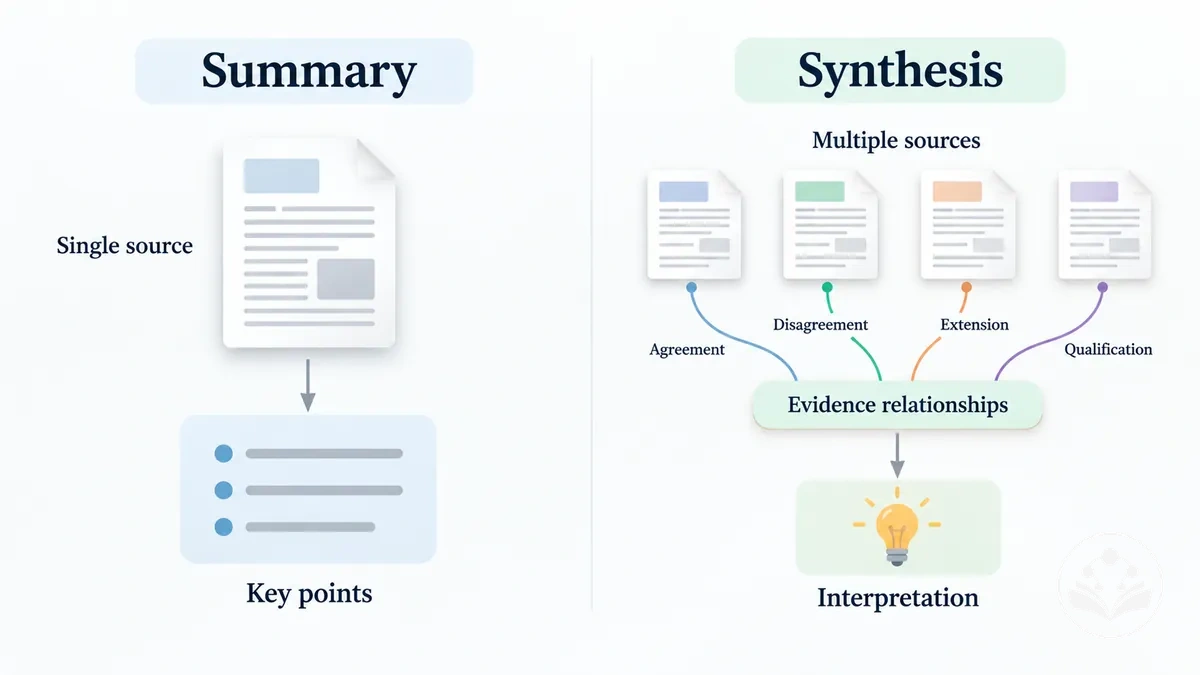
Summary and synthesis differ across the same functional dimensions: source focus, organisation, relationship among sources, writer contribution, and analytical value.
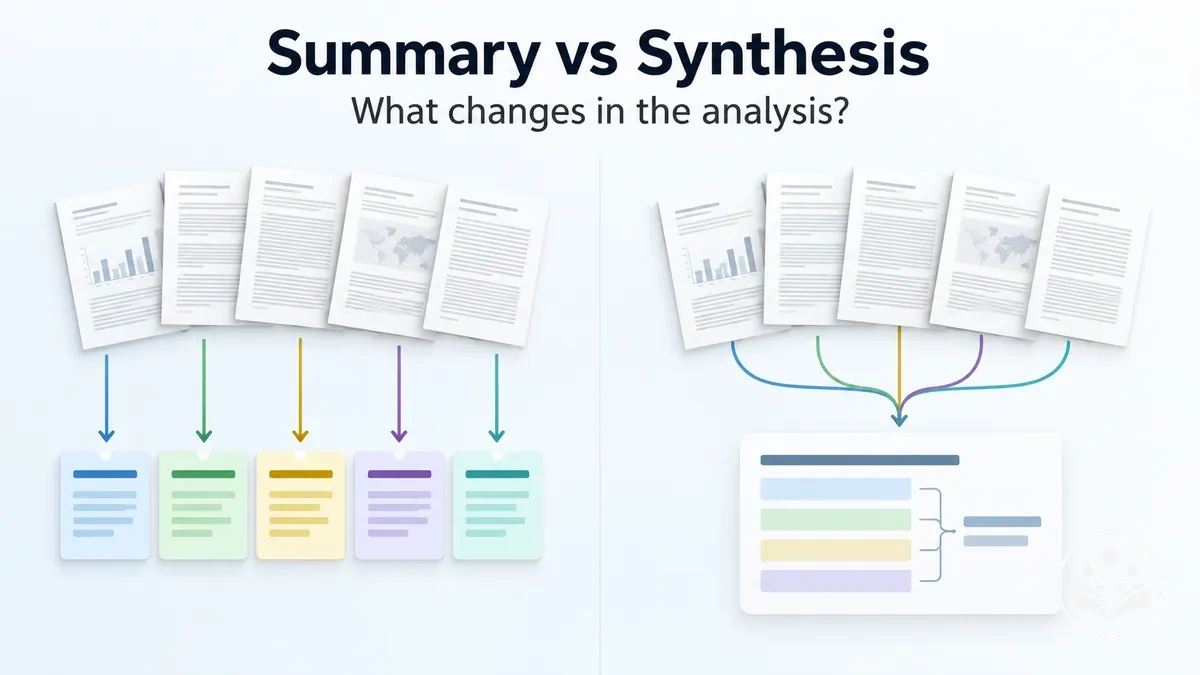
Summary can report the key points of an individual source accurately, while synthesis reorganises evidence from multiple sources around a shared issue, pattern, or claim and makes their relationships explicit.
The comparison graphic makes the shift from source-centred reporting to connected evidence visually recognisable, including the different role of interpretation.
The table then aligns the same dimensions so that the functional differences and their analytical implications can be compared directly.
| Dimension | Summary | Synthesis | Analytical implication |
|---|---|---|---|
| Source focus | Focuses on the relevant key points or contribution of an individual source. | Focuses on evidence from multiple sources in relation to a shared issue or claim. | Cross-source meaning becomes available when the sources are considered in relation to one another. |
| Organising unit | Organises material around the source being summarised. | Organises material around a shared theme, issue, pattern, or claim across sources. | The organising logic shifts from source-centred reporting to an issue-led account of the evidence. |
| Relationship among sources | Does not require an explicit relationship with other sources. | Relates multiple sources through connections such as agreement, disagreement, extension, or qualification. | Explicit relationships allow combined evidence to support interpretation beyond isolated source reports. |
| Writer contribution | Selects and condenses source-specific information relevant to the review. | Selects, groups, and relates evidence from different sources around the shared issue or claim. | The writer contribution makes cross-source relationships visible rather than merely placing source reports together. |
| Resulting analytical value | Establishes what a particular source contributes to the topic. | Establishes what the evidence shows when multiple sources are considered together. | The analytical value depends on how accurately the identified relationships support subsequent interpretation and claims. |
The consequential difference is not simply how much is written or whether several sources appear in the same passage.
Synthesis changes how evidence is organised and related across multiple sources, providing a basis for interpretation when a review article needs to make a cross-source claim.
Summary explains what an individual source contributes
A summary condenses the relevant ideas, findings, or argument of an individual source without requiring a relationship to other sources.
It reports the source's key points while retaining the source-specific context needed to understand its contribution to the immediate review point.
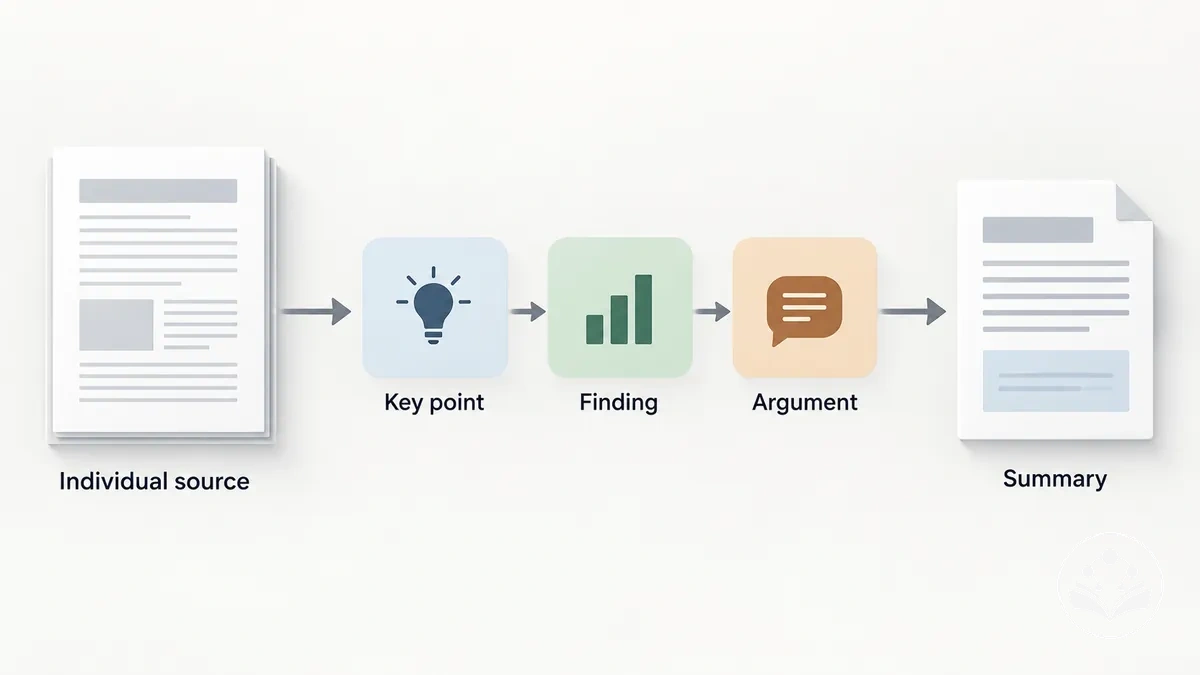
The retained details may include a finding, argument, method, sample, or other context when that information is relevant to what the source contributes.
Accurate reporting can therefore establish one source's contribution clearly while remaining separate from synthesis.
Synthesis connects what multiple sources show together
Synthesis combines and relates evidence from multiple sources so their combined meaning becomes visible.
It connects findings around a shared issue or claim by making relationships among the sources explicit rather than treating citation proximity as the relationship itself.
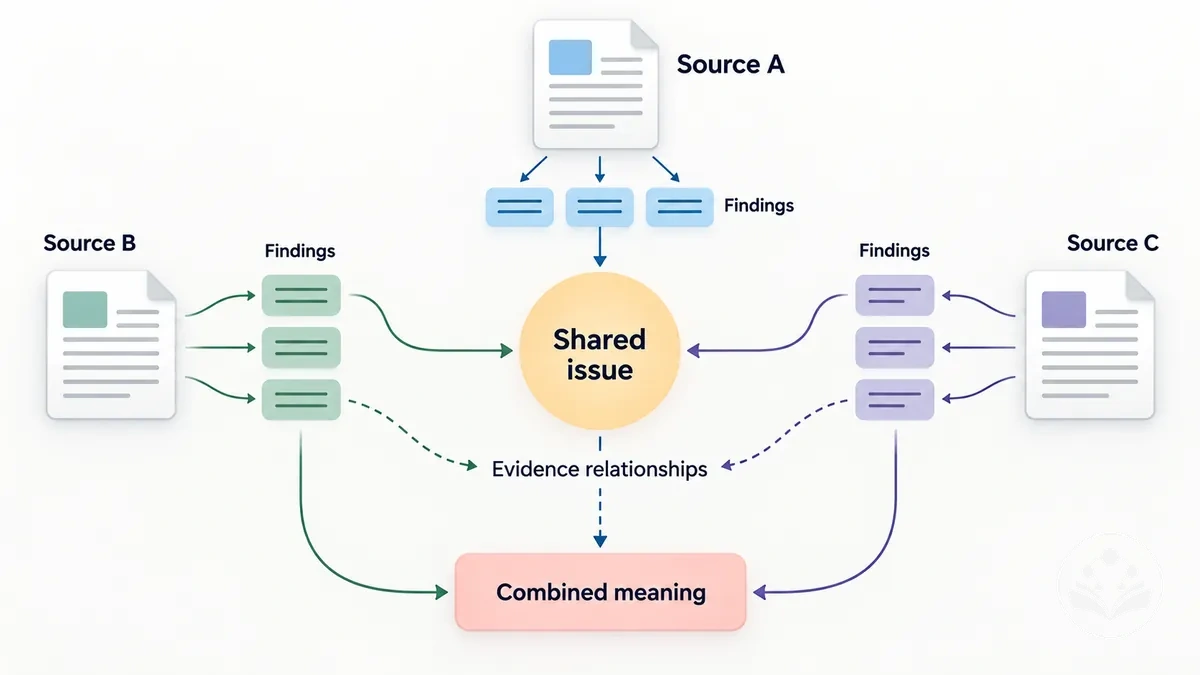
Those relationships may involve agreement, disagreement, extension, or qualification, and their implication depends on differences in findings, method, or context.
Synthesis therefore represents connected evidence by explaining what the source relationships mean when the evidence is considered together.
Synthesis connects evidence; analysis explains why those connections matter
Synthesis identifies an evidence relationship across sources, such as convergence or conflict, while analysis interprets the significance of that relationship and its implication for the review's reasoning.
The two functions can operate together without being identical or functioning as completely separate stages.
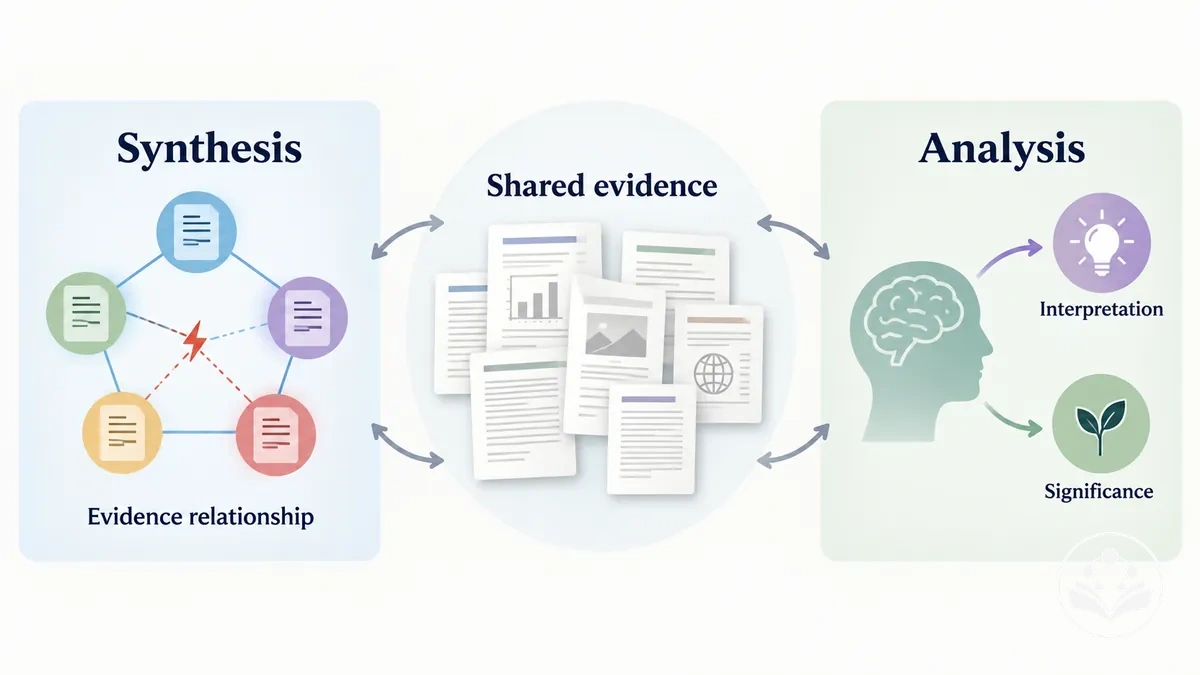
Synthesis
Identifies the relationship in the evidence—for example, convergence across sources while also noting methodological or contextual variation.
Analysis
Interprets the significance of that relationship—for example, convergence may support a consistent interpretation while methodological or contextual differences limit its strength or scope.
Synthesis establishes the cross-source relationship; analysis explains why that relationship matters.
What Changes When a Review Moves From Summary to Synthesis
Moving from summary to synthesis changes the organising unit and how evidence is treated: source-led reporting of individual sources shifts toward a shared issue or claim that supports cross-source comparison.
The change is therefore one of organising logic, with source reports becoming evidence that is related rather than simply presented in sequence.
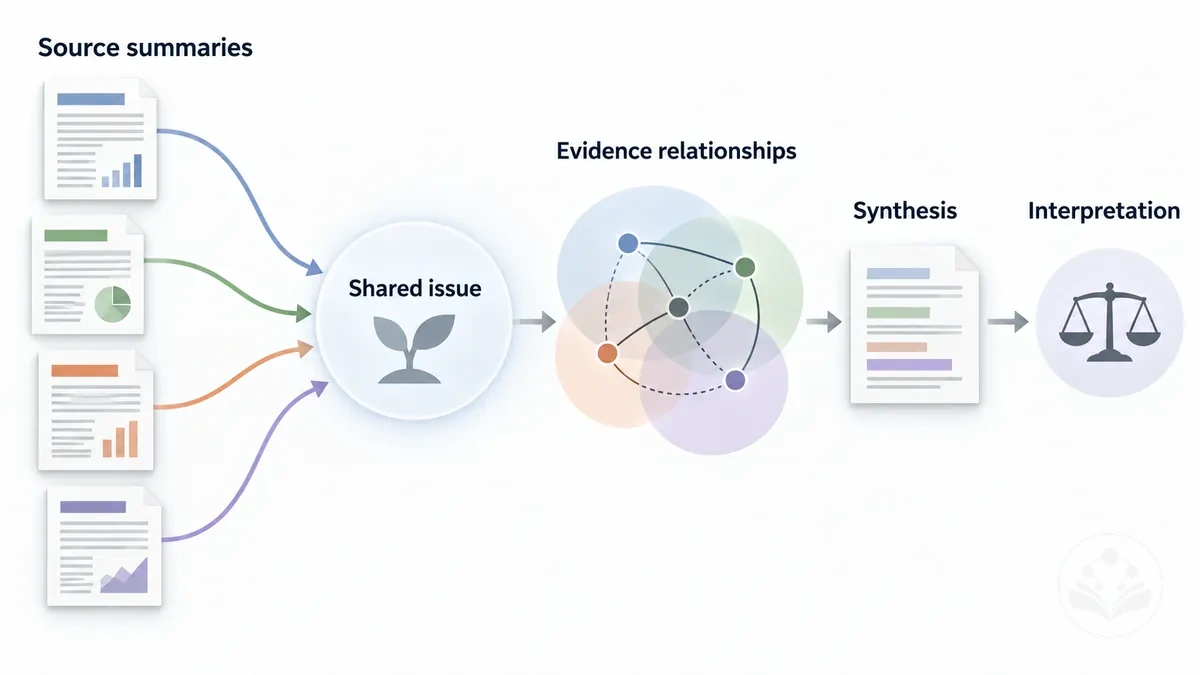
Within that issue-led structure, synthesis compares evidence to identify relationships such as recurring patterns, differences, or qualifications across sources.
Those relationships can support interpretation of what the evidence means for the shared issue, although the strength of that interpretation depends on the evidence and its context.
The analytical shift therefore connects three dimensions—organising unit, comparison, and interpretation—that can be examined separately without treating synthesis as a step-by-step procedure.
The organising unit shifts from individual sources to a shared issue or claim
In synthesis, the organising unit shifts from individual sources to a shared issue, concept, relationship, or claim.
Instead of making source identity the paragraph focus, issue-led organisation groups relevant evidence around the shared point, with each source serving as supporting evidence where its contribution is relevant.
Source-led
Source A reports one pattern. Source B is then reported separately. The sources remain the organising units.
Issue-led
The shared claim leads, and evidence from Sources A and B is related as supporting, qualifying, or differing on that point.
This organising logic makes cross-source comparison explicit while still allowing source-specific context where it matters; broader decisions about how to organise the literature belong beyond this paragraph-level distinction.
Evidence is compared for agreement, disagreement, method, and context
Evidence comparison in synthesis is useful when the dimension being compared changes how the findings can be interpreted.
Agreement and disagreement reveal relationships among findings, while method and context can qualify their comparability or help explain observed variation.
The four comparison dimensions connect an observed evidence relationship to the implication it may support:
- Agreement: When findings converge on the same pattern, that convergence may strengthen support for the pattern, subject to the quality and comparability of the evidence.
- Disagreement: When findings conflict, the disagreement may require explanation or qualification rather than treating either finding as automatically invalid.
- Method: Differences in study design or measurement can affect comparability and may help explain why findings vary across studies.
- Context: Differences in population, setting, or other relevant conditions may help account for variation and can limit how broadly a shared interpretation applies.
A difference matters to synthesis when it has an evidential implication, not merely because two sources are different.
Identifying these comparison dimensions establishes what should be related; the fuller process used to synthesize studies extends beyond this criteria-level comparison.
The combined evidence supports an interpretation rather than a sequence of source reports
Combined evidence supports a qualified interpretation by showing an evidence pattern across sources rather than leaving the material as a sequence of separate source reports.
The interpretation depends on what the relationships among findings imply for the review's claim, while uncertainty remains where method, context, population, setting, or evidential strength differ.
For example, if several sources show a similar pattern but use different methods or study different contexts, the cross-source pattern may support a cautious claim that the finding is consistent across some conditions rather than universal.
The implication should therefore reflect both the pattern and its limits, so the interpretation remains proportionate to the collective evidence.
Where Summary Fits Inside a Synthesis-Led Review Article
Summary remains useful inside a synthesis-led argument when the reader needs source-specific context, such as a relevant finding or method, to understand the evidence being discussed.
It supports synthesis by supplying necessary local source context without replacing the relationship across studies that the argument needs to establish.
- Sentence-level job
- Report source-specific context, such as a finding, method, definition, sample, or condition that the reader needs.
- Paragraph-level job
- Relate evidence across sources when the paragraph's claim depends on a shared pattern, difference, or qualification.
Summary and synthesis are therefore not a rigid either-or choice: the immediate writing job determines which function is needed.
Functional fit depends on whether the immediate writing job is to establish source context or relate evidence across sources.
Use summary when source-specific context matters
Use summary when the reader needs source-specific context to understand why a particular source detail matters to the immediate analytical point.
The relevant detail may be a finding, method, definition, sample, or contextual condition that must remain identifiable before it can support comparison or interpretation with other evidence.
- Distinctive finding: Summarise the relevant finding when its source-specific result supplies evidence needed for the analytical point.
- Method: Summarise a methodological detail when it affects how the source can be compared with other evidence.
- Definition: Summarise a source's definition when its meaning or scope affects interpretation of the point being discussed.
- Sample: Summarise relevant sample characteristics when they affect the applicability or comparability of the finding.
- Contextual condition: Summarise a setting or condition when it qualifies how the source's evidence applies to the analytical point.
For example, a sentence can briefly report that a source used a different method when that detail helps explain why its finding is not directly comparable with the others.
The summary supplies necessary supporting context, while the shared analytical point remains the paragraph focus.
Use synthesis when a claim depends on relationships across studies
Use synthesis when a claim depends on relationships across studies rather than on what any one study reports.
Such a claim requires cross-source evidence because its support comes from how findings relate, including convergence, contradiction, qualification, extension, or context-sensitive variation.
The relevant relationship state determines the implication that the combined evidence may support:
- Convergence: When studies show a similar pattern, their agreement may support a claim that the pattern recurs across the conditions represented by those studies.
- Contradiction: When studies conflict, the contradiction may support a claim that the evidence is mixed or that an explanation or limitation requires consideration.
- Qualification: When one study narrows or conditions a pattern found in others, synthesis may support a more limited claim that reflects those conditions.
- Extension: When evidence extends a finding to another relevant condition or context, the relationship may support a broader claim only within the additional scope represented by that evidence.
- Variation: When findings vary with context, population, setting, or method, synthesis may support a context-sensitive claim rather than treating the variation as a universal difference.
For example, a claim that a pattern appears across different study contexts cannot be supported adequately by a single-source summary because the claim depends on the relationship among studies.
Each relationship type therefore supports only the implication warranted by the cross-source evidence and its conditions.
Signs a Review Is Still Too Descriptive
A review is too descriptive when source reporting is present but important relationships among studies or their combined significance remain unstated.
The diagnostic problem is not description itself; it is description substituting for synthesis where the review needs to make an analytical connection across sources.
Paragraphs proceed source by source rather than around shared points
Source-by-source paragraph progression may signal that source identity, rather than a shared point, is controlling the paragraph focus.
Repeated author-led openings, one-source-at-a-time reporting, or abrupt switches between studies can leave evidence isolated when the paragraph does not make an analytical claim that relates the sources.
The interpretation depends on what governs the paragraph: an author-led sequence reports Source A and then Source B as separate contributions, whereas claim-led organisation uses both sources in relation to the same shared point.
The differentiating check is whether an analytical claim determines which evidence is included and how the sources relate, rather than whether an author name happens to open a sentence.
If the shared point governs source selection and relationships, author-led wording can still be legitimate; if source identities govern the paragraph without a cross-source claim, the pattern remains a useful diagnostic signal.
This check helps avoid summary-only review writing without expanding the diagnosis into broader review-writing mistakes.
Connections among studies remain implicit
Relationships among studies remain implicit when multiple citations or source findings appear together but the text does not state how the evidence relates.
Citation proximity alone does not create an explicit relationship; the paragraph needs to make clear whether the sources show agreement, contrast, qualification, extension, or another relevant connection.
Juxtaposition only
“Source A reports the pattern. Source B reports a narrower pattern.”
The reader sees two findings but must infer the relationship.
Explicit synthesis
“Source B qualifies Source A's finding by limiting the pattern to a narrower context.”
The relationship and its effect on meaning are stated directly.
The diagnostic check is whether the relationship and its effect on the evidence are explicit through precise reasoning, not merely through citation proximity or formulaic transitions.
Evidence is reported without explaining what it means together
Evidence reporting remains analytically incomplete when a paragraph identifies an evidence pattern but does not state the implication of the combined evidence.
The diagnostic check is whether the paragraph moves from what the findings collectively show to an interpretation of what that pattern supports, complicates, qualifies, or leaves uncertain.
Pattern: several studies report a similar finding, while results differ under some contexts.
Interpretation: the combined evidence supports the pattern under the represented conditions but leaves uncertainty about whether it extends to the differing contexts.
This qualified implication adds analytical value without making a stronger claim than the evidence pattern warrants.
Summary and Synthesis Using the Same Set of Sources
For a controlled hypothetical example, the summary and synthesis versions use the same evidence set and answer the same review question: how consistently do three sources describe a shared pattern across different contexts? Holding the evidence constant makes changes in organisation and reasoning visible without changing the underlying source material.
Source A
Reports the pattern in one context.
Source B
Reports the same general finding in another context, but under a narrower condition.
Source C
Reports a different finding under a third condition.
The evidence stays constant. Only the organisation of that evidence and the reasoning used to relate the findings change between the summary and synthesis versions.
A source-by-source summary paragraph
The same hypothetical evidence set is used here, but the paragraph is intentionally organised as a source-by-source summary.
Each finding is reported accurately in sequence so the effect of keeping the sources largely separate remains visible.
Source A reports the pattern in one context.
Source B reports the same general finding in another context, although under a narrower condition.
Source C reports a different finding under a third condition.
The sequence therefore presents the evidence as three separate source reports rather than organising the findings around a shared analytical point.
The paragraph is competent as summary, but its analytical value is limited by the limited cross-source relationship among Source A, Source B, and Source C.
The paragraph focus remains on separate sources and their individual findings rather than on what their relationship means when the evidence is considered together.
A synthesis paragraph organised around a shared point
The same hypothetical evidence is now organised around the shared point of whether the pattern remains consistent across different contexts.
This focus makes the relationship among Source A, Source B, and Source C central to the paragraph rather than treating each finding as a separate report.
Across the three sources, the evidence suggests that the pattern is present under some contexts but is not consistent across all of them.
Source A reports the pattern in one context, and Source B shows agreement on the general finding in another context while qualifying it with a narrower condition.
Source C, however, reports a different finding under a third condition, creating disagreement across the represented contexts.
Considered together, the relationship among the findings supports a qualified interpretation: the pattern appears across the contexts represented by Source A and Source B, but the evidence does not support treating it as consistent across every represented context.
The shared point therefore controls how the source facts are related and used in the interpretation.
The relationship language makes agreement between Source A and Source B explicit while contrasting their findings with Source C in relation to context.
The interpretive move then evaluates the evidence as a whole without adding evidence beyond the hypothetical findings.
What the synthesis adds beyond the source summaries
Synthesis adds analytical value by shifting the organising unit from separate source reports to a shared point, making cross-source relationships explicit, and supporting a qualified interpretation of the evidence pattern.
The resulting claim reflects what the sources mean collectively while remaining limited by the same underlying evidence.
Because the two example paragraphs use the same source material, the comparison isolates changes in organisation and reasoning rather than changes in evidence.
The matched features show where those changes add collective meaning.
| Feature | Source-by-source summary | Synthesis paragraph | Analytical effect |
|---|---|---|---|
| Organising unit | Separate reports of Source A, Source B, and Source C. | The shared point of whether the pattern is consistent across the represented contexts. | Source material is organised around an issue rather than source identity. |
| Cross-source relationship | The sources remain largely separate in sequence. | Agreement between Source A and Source B is related to the disagreement represented by Source C. | The relationships among findings become explicit rather than remaining implicit between separate reports. |
| Evidence pattern | Each finding is presented individually. | The findings form a pattern of agreement under some represented contexts and disagreement under another. | The evidence can be considered collectively without removing contextual differences. |
| Writer interpretation | The paragraph reports what each source contributes with limited cross-source interpretation. | The paragraph interprets what the relationship among the findings implies for the shared point. | The writer can state a qualified implication while preserving the limitation created by variation across contexts. |
| Resulting claim | No collective claim beyond the separate source reports is developed. | The pattern appears across the contexts represented by Source A and Source B but is not treated as consistent across every represented context. | The claim reflects the evidence as a whole without extending beyond what the hypothetical findings support. |
The analytical gain comes from making the evidence pattern and its cross-source relationships available for interpretation, not from changing the evidence or making it inherently stronger.
Synthesis can support a more collective claim, but its analytical value remains bounded by the context and limitation of the evidence being related.
Unresolved patterns, contradictions, or absences may later become inputs when writers move from synthesis to research gaps, but their presence does not by itself establish that a research gap exists.