
What Is a Review Article in Academic Research?
A review article is a scholarly publication that synthesises and critically interprets existing published research within a defined scope rather than primarily reporting a new primary study. It should show what is currently known, where findings agree or conflict, where evidence remains limited, and which questions remain unresolved.

Review article at a glance
A review article moves from a defined scope and relevant literature to an integrated interpretation. Each stage constrains what the next stage can support.
-
Define the scopeSet the topic or concepts, population or setting, time period, and eligible evidence that bound the review.
-
Build the evidence baseUse research that fits the scope; source volume alone does not establish relevant coverage.
-
Synthesise across studiesConnect findings to expose patterns, agreements, contradictions, trends, and research gaps.
-
Critically interpretConsider evidential strength, consistency, methodological limitations, and context before expressing confidence in an interpretation.
-
State bounded conclusionsExplain the current state of knowledge and uncertainty without extending conclusions beyond the represented evidence.
Primary distinction: a review article primarily synthesises and interprets existing research; an original research article primarily reports a new primary study, new data, or a new primary analysis.
Specific review methods vary by discipline and review type, but the common function is to turn a defined body of research into a coherent, evidence-bounded interpretation.
Table of Contents
What a Review Article Should Accomplish
A review article should consolidate the current state of knowledge on a defined topic, synthesise and evaluate the available evidence, clarify important agreements or controversies, and identify uncertainty or research gaps.
These complementary functions help readers understand what the evidence indicates, how findings relate across studies, and which questions remain unresolved.
The emphasis placed on each purpose can differ by discipline and review type.
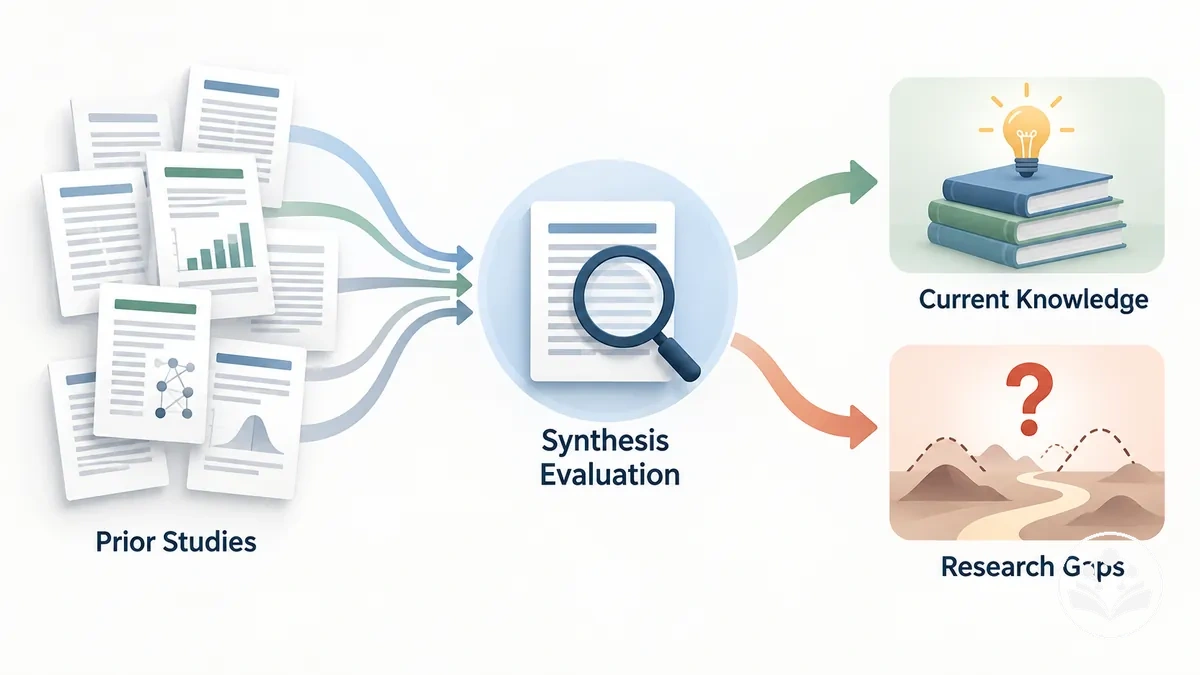
The purpose of synthesis is to connect relevant findings rather than merely accumulate source summaries.
Evaluation helps readers interpret the strengths, limitations, and significance of the evidence, while examining agreements and controversies clarifies where interpretations converge or remain disputed.
Identifying uncertainty separates better-established understanding from questions that the available evidence does not yet resolve.
Research gaps can then frame implications for future research without implying that every review must pursue these functions to the same degree.
- Consolidate knowledge: synthesise relevant findings into an organised account that clarifies what is currently known.
- Evaluate evidence: assess findings and their interpretation so readers can understand the strengths, limitations, and significance of the evidence.
- Explain agreements and controversies: show where studies support similar interpretations and where findings or conclusions remain contested.
- Identify uncertainty and research gaps: distinguish supported understanding from unresolved questions or areas where evidence remains limited.
- Frame implications: use unresolved questions and identified gaps to indicate issues that future research could address.
Different disciplines and review types may therefore emphasise different scholarly purposes rather than producing identical outcomes.
These purposes define the general knowledge contribution of a review, while review article writing covers the broader activity of developing that contribution.
How Scope Defines What a Review Article Covers
Review scope is the set of boundaries that defines which part of a topic and which body of evidence a review is intended to represent.
These boundaries establish what falls inside or outside the review's coverage.
Scope therefore limits the conclusions that can reasonably be drawn from the evidence represented in the review.
Scope can be delimited along several dimensions, including topic focus and concepts, population or setting, time period, and eligible evidence.
Each dimension establishes an included range and an excluded range, which shapes the resulting evidence base.
Changing those boundaries can change which studies are represented and therefore how broadly the review's conclusions can apply.

- Topic focus: defines the part of the broader subject included in the review; issues outside that focus remain outside its coverage, so conclusions apply to the defined topic boundary.
- Concepts: define the ideas, phenomena, or relationships represented; related concepts outside that defined range are excluded from the review's claims.
- Population and setting: define which people, groups, environments, or contexts are represented; populations or settings outside those boundaries are not directly represented by the same evidence base.
- Time period: defines the temporal range represented by the review; literature outside that period falls beyond its coverage, limiting conclusions about evidence from other periods.
- Eligible evidence: defines which categories of research or literature can form the evidence base; evidence outside those categories is not represented, so conclusions remain bounded by the included evidence.
Scope is a property of what a review covers, whereas a scoping review is a particular review type rather than another term for scope; distinctions among review article types are a separate issue.
The relevant point here is that scope defines the coverage and interpretive limits of an individual review.
Core Analytical Elements of a Review Article
The core analytical elements of a review article are its evidence base, synthesis, and critical interpretation, which work as interdependent functions rather than isolated tasks.
The evidence base provides the selected research, synthesis connects findings and relationships across that research, and critical interpretation considers the significance and limitations of the combined evidence.
Together, these elements support an evidence-bounded understanding of the topic.
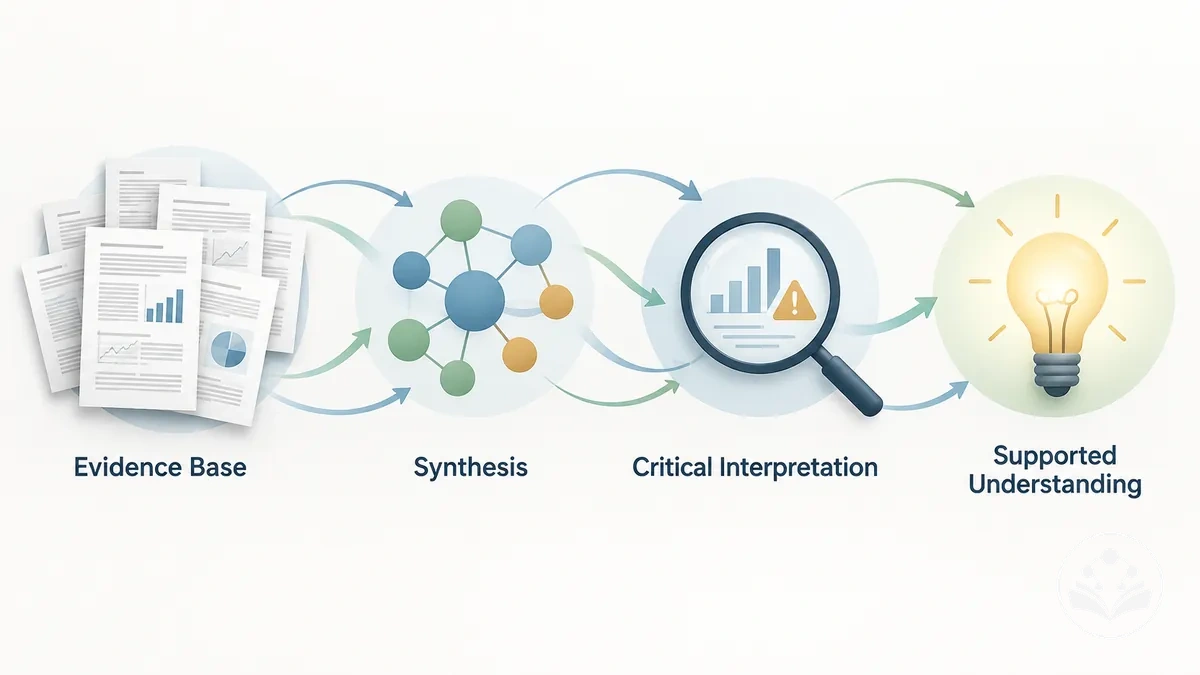
Analytical quality depends on the connection among these elements: synthesis depends on a relevant evidence base, while critical interpretation depends on the patterns and relationships made visible through synthesis.
A large volume of citations does not by itself establish analytical quality because citation quantity does not show whether findings have been meaningfully integrated or interpreted.
The analytical contribution therefore comes from how the evidence base, synthesis, and critical interpretation connect to produce a supported understanding of the topic.
A Relevant Body of Existing Research
An evidence base is relevant when its existing research fits the review's defined scope and represents the published studies needed to address that focus.
Relevance means that the included research contributes evidence directly connected to the topic or question rather than merely increasing the volume of literature cited.
The relationship between scope fit and coverage distinguishes evidential relevance from mere source volume.

Coverage affects claim support because the evidence base can support interpretation only within the areas and conditions represented by the included research.
If relevant parts of the defined scope are weakly represented, the resulting interpretive limits should remain correspondingly narrow rather than extending conclusions beyond the available evidence.
More sources are therefore not equivalent to better evidence coverage: evidential fit, relevance, and appropriate coverage matter more than raw source count.
Synthesis Across Studies
Synthesis connects findings across multiple studies so that relationships among the evidence become visible rather than remaining as isolated source descriptions.
It can reveal patterns, agreements, contradictions, trends, and research gaps that shape an integrated interpretation of the current state of knowledge.
A study-by-study summary describes sources separately, whereas synthesis connects their findings to show how the evidence relates across studies.
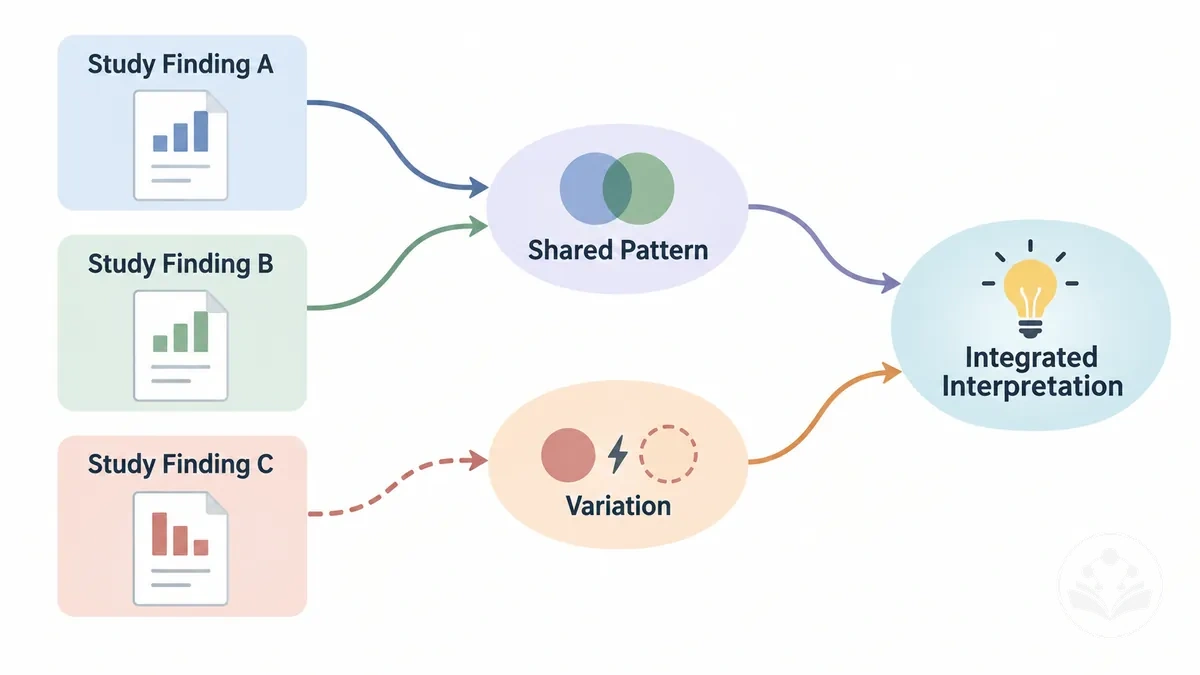
For example, several studies may report findings that point toward a shared pattern, while another reports a different result under a different context; synthesis relates those findings rather than treating each one independently.
The integrated interpretation may indicate an overall trend while retaining the contradiction as a source of uncertainty rather than implying complete agreement.
Where findings remain inconsistent or relevant evidence is limited, synthesis can identify research gaps and constrain the implications drawn from the available evidence.
Critical Evaluation and Interpretation of the Evidence
Critical evaluation assesses what the evidence supports, suggests, or cannot support within the review's scope; it is an evidence-led assessment rather than unsupported opinion or fault-finding.
Interpretation explains the significance of the combined evidence by relating its strengths and limitations to the meaning that can reasonably be drawn from it.
Evaluation and interpretation therefore remain connected because the condition of the evidence affects the weight given to a conclusion.
What changes interpretive weight
- Consistency across findings
- Greater consistency can strengthen support for an interpretation; contradictions call for qualification and preserved uncertainty.
- Methodological limitations
- Limitations can weaken evidential strength without automatically invalidating a finding.
- Context
- Differences in populations, settings, conditions, or study circumstances can narrow how broadly findings apply.
The resulting conclusion should therefore reflect evidential strength, consistency, methodological limitations, and context rather than treating every finding as carrying equal interpretive weight.
Defining Characteristics of a Scholarly Review Article
A scholarly review article has observable characteristics that distinguish it as an evidence-based synthesis of a defined area of academic research rather than a generic descriptive essay.
These characteristics appear in how the review establishes its focus, grounds its discussion in research, integrates evidence, and qualifies its interpretation.
The substantive characteristics move from the boundaries of the review and its evidence base toward the way that evidence is integrated, evaluated, and reflected in conclusions.
- Defined focus: the scholarly review article addresses a clearly bounded topic, question, or research area, which establishes what its discussion and interpretation are intended to cover.
- Traceable evidence: substantive statements are grounded in identifiable sources and citations, allowing readers to connect the review's account to the underlying research.
- Integration across studies: findings from multiple sources are connected through synthesis and cross-study relationships rather than presented only as separate summaries, creating an evidence-based account of the research area.
- Critical balance: the review reflects agreements, differences, limitations, and uncertainty in the evidence, so interpretation does not depend only on findings that support one position.
- Qualified conclusions: conclusions reflect the scope and strength of the reviewed evidence, keeping the significance of the interpretation proportionate to what that evidence can support.
Formal appearance alone does not establish these substantive characteristics.
Length, technical language, tables or graphs, extensive references, or a scholarly-looking format can vary by discipline, journal, and review type; their presence does not by itself demonstrate defined focus, traceable evidence, integration, critical balance, or qualified conclusions.
Claims Are Grounded in the Reviewed Literature
A scholarly claim should be traceable to evidence in the reviewed literature, with its strength proportionate to the support that evidence provides.
Key distinction: traceability is not the same as warrant
It connects a statement to a source, but citation presence alone does not establish that the evidence is strong enough for the claim.
Claim wording should match the available support and include qualification when the evidence does not warrant high confidence.
Wording rule: substantial convergence may justify greater confidence within the represented conditions; mixed or limited evidence calls for explicit disagreement, contextual variation, or uncertainty.
A grounded claim links its statement to the reviewed evidence and its limitations, whereas an unsupported generalisation asserts a broader conclusion than the cited evidence can support.
Neither citation quantity nor source prestige alone determines warranted confidence in a claim.
Conclusions Reflect Agreements, Uncertainties, and Evidence Limits
A review conclusion should reflect the evidence state, so its strength mirrors the agreements, uncertainty, and evidence limits present in the reviewed literature.
Consistent findings may support greater confidence, whereas disagreement, sparse evidence, or context-dependent findings warrant greater qualification.
The implication should remain limited to what the evidence supports rather than extending beyond its applicability or implying unsupported causality.
Different evidence states therefore warrant different levels of confidence and different limits on the conclusion:
- Consistent evidence: substantial agreement across relevant findings can support a more confident conclusion within the conditions represented by the evidence.
- Mixed or conflicting evidence: mixed evidence or disagreement among relevant findings increases uncertainty, so the conclusion should acknowledge competing patterns or interpretations rather than imply uniform support.
- Sparse evidence: limited evidence restricts confidence and may reveal knowledge gaps or unresolved questions; any future-research implication should remain connected to those identified limitations.
- Context-dependent evidence: findings that differ across populations, settings, conditions, or other contexts limit broader applicability, so the conclusion should specify the context in which the supported interpretation holds.
Where knowledge gaps are identifiable, their implication follows from unresolved questions or specific evidence limits rather than from a generic assumption that more research is required.
How a Review Article Differs from an Original Research Article
A review article primarily synthesises and interprets existing studies, whereas an original research article primarily reports a new primary study or primary analysis.
The central distinction therefore concerns the evidence source each article draws on and its primary scholarly function.
The comparison applies the same four dimensions to both article types: evidence source, primary purpose, typical analytical activity, and nature of contribution.
These criteria distinguish their usual scholarly functions while allowing for differences among disciplines and research designs.
| Dimension | Review article | Original research article |
|---|---|---|
| Evidence source | Draws mainly on existing studies and published evidence. | Draws mainly on a primary study, new data, or a new primary analysis. |
| Primary purpose | Synthesises and interprets a defined body of existing research. | Reports and explains findings generated through primary research or analysis. |
| Typical analytical activity | Compares, integrates, and interprets findings across studies. | Analyses data or observations generated or assembled for the primary study. |
| Nature of contribution | Contributes an integrated interpretation, conceptual framing, or identification of patterns and gaps. | Contributes new empirical findings, primary observations, or results from a new analysis. |
The evidence-source difference means that a review article usually bases its synthesis on existing studies, while an original research article reports results arising from a primary study, new data, or primary analysis.
Their primary purposes follow that distinction: one integrates and interprets an existing evidence base, while the other reports findings produced through original research.
Their analytical activities and contributions also differ, although practices vary across disciplines and article designs.
A review article can still be a scholarly research output and may contribute a new interpretation, conceptual framework, or research direction without reporting a new primary study.
Terminology can vary by academic context, so the boundary between a review article versus literature review should be treated separately from the comparison with original research.
That terminology boundary does not change the primary distinction between synthesising existing studies and reporting new primary research.
A review article versus article review is also a separate distinction: the former synthesises a research field or defined body of literature, whereas the latter evaluates or discusses a single article.
Keeping those terms separate prevents a different scholarly task from being conflated with the comparison between review and original research articles.