
Review Article vs Article Review: How the Academic Writing Tasks Differ
A review article synthesizes a body of existing research across multiple studies to explain patterns, relationships, and gaps, whereas an article review focuses on one selected article and combines accurate summary with critical evaluation of its claims, evidence, reasoning, and contribution. The labels can vary by discipline or publication, so the assignment brief or publication context is decisive.
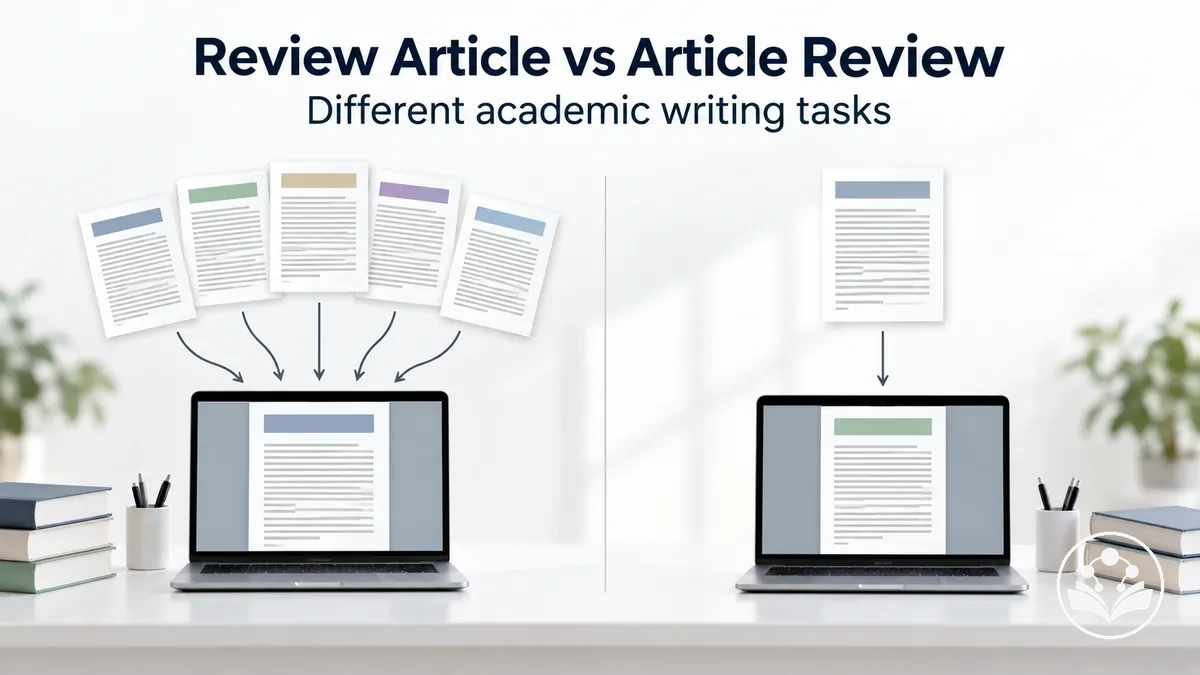
Review article or article review? Compare the task signals
Classify the assignment by its evidence object first, then confirm the choice with the required analytical verbs and expected output.
Review article
- Evidence object
- A body of relevant published research.
- Core operation
- Synthesize and interpret relationships across multiple studies.
- Typical output
- An integrated account of patterns, agreements, differences, and—when supported—research gaps.
- Brief signals
- A topic or research question, multiple scholarly studies, and instructions to compare, integrate, or synthesize.
Article review
- Evidence object
- One assigned or selected article as the focal text.
- Core operation
- Summarize the article accurately, then critique or evaluate its claims, evidence, reasoning, method, or contribution.
- Typical output
- A reasoned judgement about the article's strengths, limitations, support, or contribution.
- Brief signals
- A supplied or selected article and instructions to summarize, critique, evaluate, assess, or appraise it.
Decision rule: relationships across multiple studies point to a review article; judgement of one selected article points to an article review. When terminology varies, follow the assignment brief or publication requirements.
Because academic labels are not fully standardised, use the task's evidence object and required analytical operation—not the word “review” by itself—to identify what is expected. The sections below compare source scope, analytical work, writing structure, and assignment signals.
Table of Contents
Purpose and Source Scope: One Article vs a Body of Research
A review article uses a broader body of published research, typically drawing on multiple studies for synthesis, while an article review ordinarily centres on one assigned or selected article for evaluation.
This difference in source scope reflects a difference in purpose: the review article develops an account across an evidence base, whereas the article review evaluates a focal text.
The unit of analysis determines what the writer gathers and how that material contributes to the expected output.
For a review article, the review article definition and purpose focus on bringing evidence from relevant published research into a synthesis, although the breadth and method of that evidence base vary by review type.
For an article review, the selected article remains the principal unit of analysis, while supporting literature may be used when the assignment permits or requires it.
The comparison therefore concerns the role and breadth of the evidence, not a prescribed source count.
The source-scope difference can be visualised as multiple studies contributing to a review-article synthesis, compared with one focal article serving as the main object of an article-review evaluation.

The table aligns both academic writing tasks across purpose, unit of analysis, source scope, and expected analytical output so that the evidence burden of each task remains directly comparable.
| Dimension | Review Article | Article Review |
|---|---|---|
| Purpose | Synthesise published research to develop an integrated account of a topic or question. | Evaluate a selected article by examining its content, reasoning, evidence, or contribution. |
| Unit of analysis | A body of relevant published research. | One assigned or selected article as the focal text. |
| Source scope | Multiple studies within an evidence base whose breadth and selection method vary by review type. | The selected article is central; supporting sources may be permitted or required by the assignment. |
| Expected analytical output | A synthesis that connects findings, patterns, or relationships across the source set. | An evaluation of the focal article supported by accurate representation of what it presents. |
For example, a university assignment asking a student to evaluate a supplied journal article makes that article the focal evidence object, while a publication task asking an author to synthesise research on a topic requires gathering a broader relevant evidence base.
In practical terms, the writer must identify the required source scope first, then gather and process evidence according to the task's purpose.
Review Articles Synthesize Published Research Across Multiple Studies
A review article connects findings across multiple studies through synthesis rather than treating each source as an isolated summary.
It compares evidence to identify cross-source relationships and integrates those relationships into an interpretation of the published research.
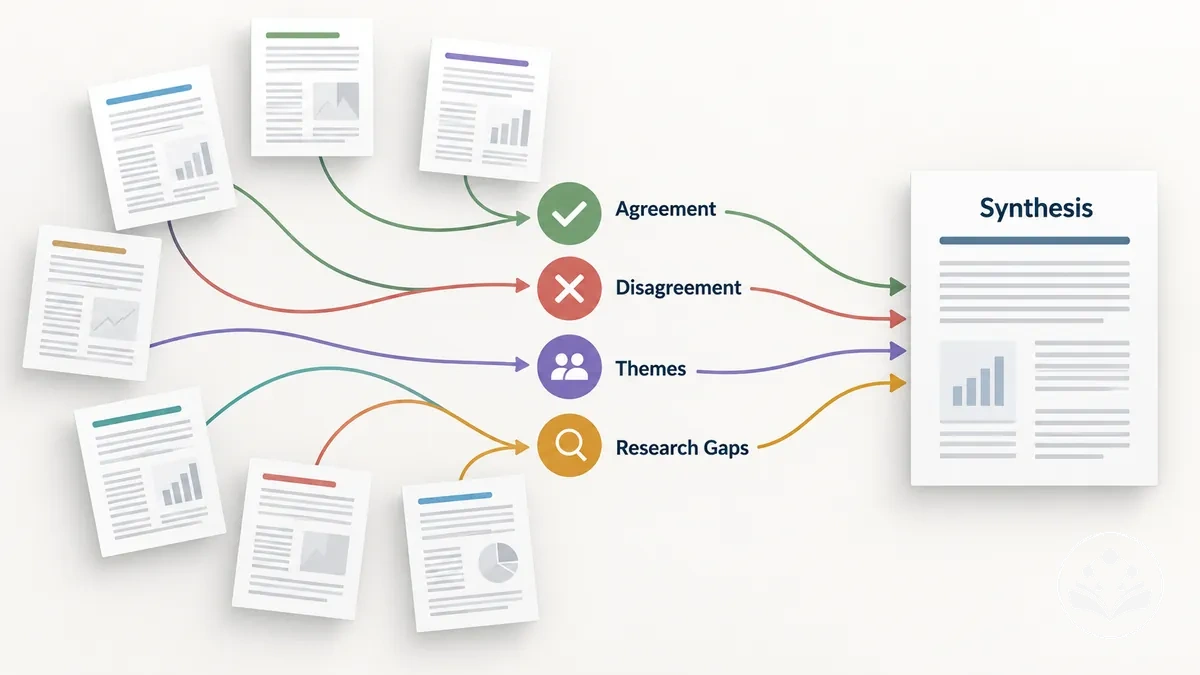
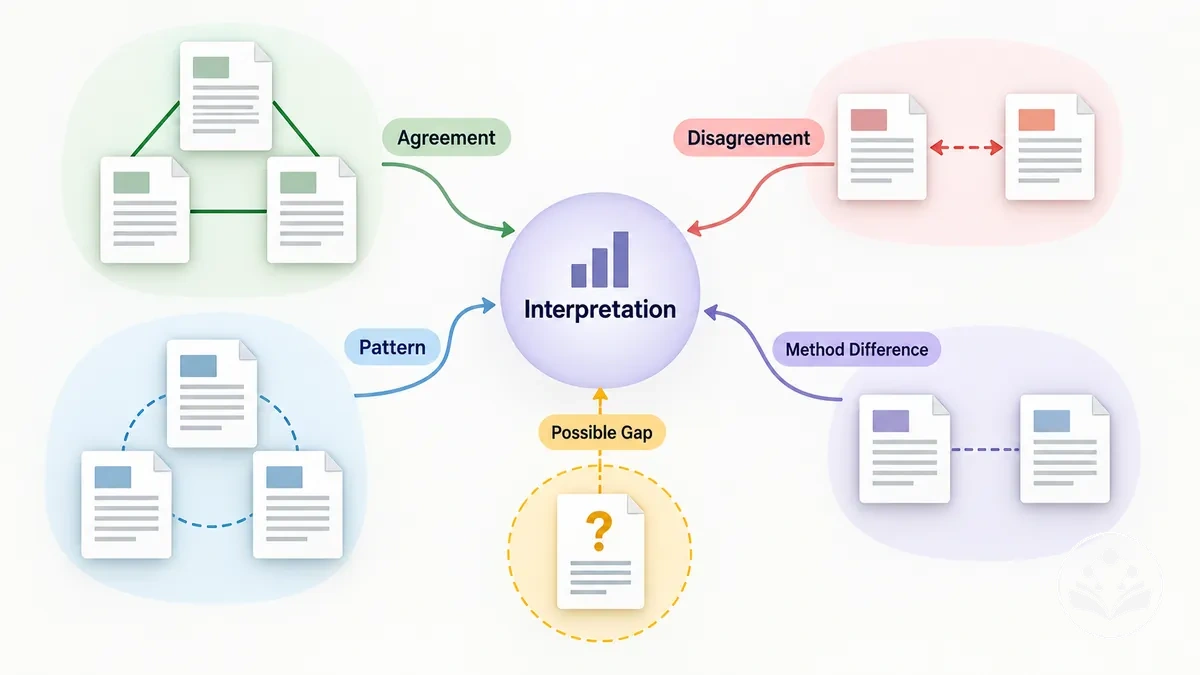
Those relationships can include agreement among findings, disagreement between studies, recurring themes across the body of evidence, and research gaps that may emerge when relevant questions or evidence remain insufficiently addressed.
Their significance depends on the scope and evidence being reviewed, so a difference between studies does not by itself establish a research gap.
Source volume and method vary by review type, but synthesis still produces an integrated interpretation by connecting findings across sources.
The diagram organizes these cross-source relationships visually rather than prescribing a review method.
Article Reviews Usually Evaluate One Selected Article
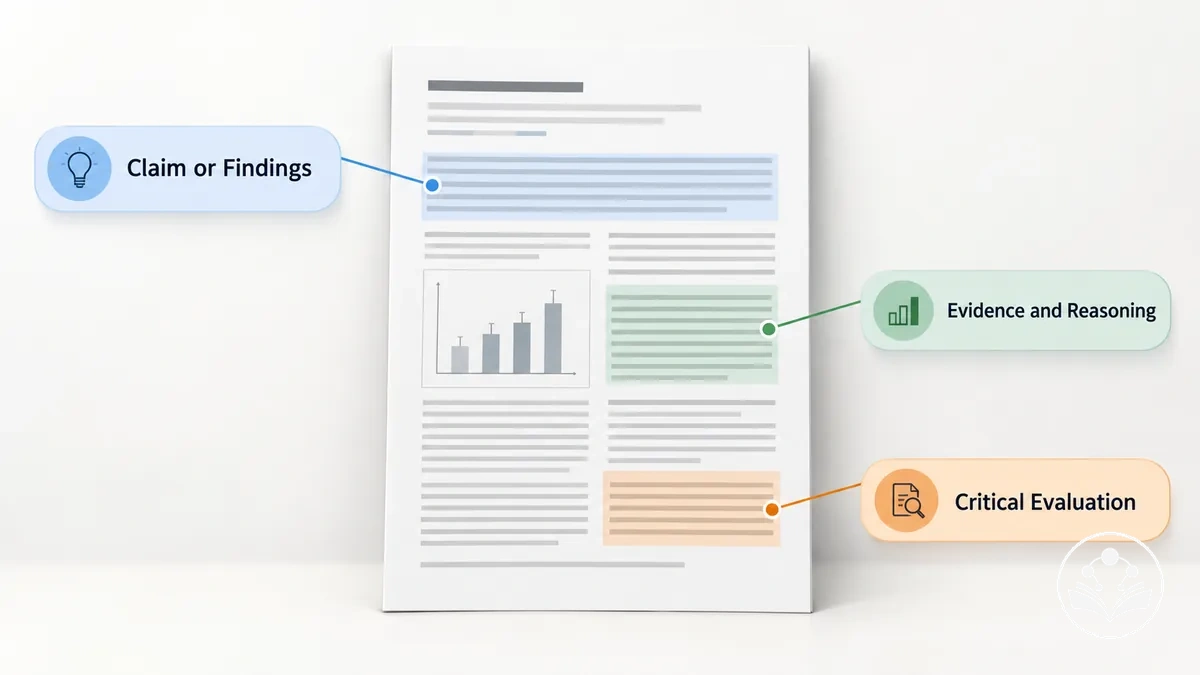
An article review usually takes one selected article as its main object of evaluation, summarizing what that article argues or reports before moving to critical evaluation.
The reviewer therefore examines the focal article's central argument or findings, evidence, reasoning, and contribution rather than synthesizing an entire field of published research.
The evaluation should first represent the article accurately, then assess how its claims or findings are supported and what contribution or limitation follows from that analysis.
These criteria organize the evaluation of the focal article by separating what the article says from what the reviewer judges:
- Accurate representation: identify the article and summarize its central argument or findings without replacing them with the reviewer's interpretation.
- Evidence and reasoning: examine how the article supports its claims and assess relevant strengths or limitations in the evidence and reasoning.
- Contribution or limitation: evaluate what the article contributes within its stated context and identify limitations that are supported by the analysis.
Some assignments may permit or require supporting readings for comparison or context, but those sources do not necessarily replace the selected article as the focal object.
The annotated example separates what the article says through its claims and evidence from the evaluative judgement applied by the reviewer.
How the Analytical Work Differs
Both a review article and an article review require analytical work, but they apply it to different evidence objects and produce different types of resulting claim.
A review article primarily builds cross-source relationships through synthesis and interpretation, whereas an article review primarily summarizes and evaluates the claims, evidence, and reasoning of the focal article.
The comparison therefore turns on the analytical operation performed on the evidence.
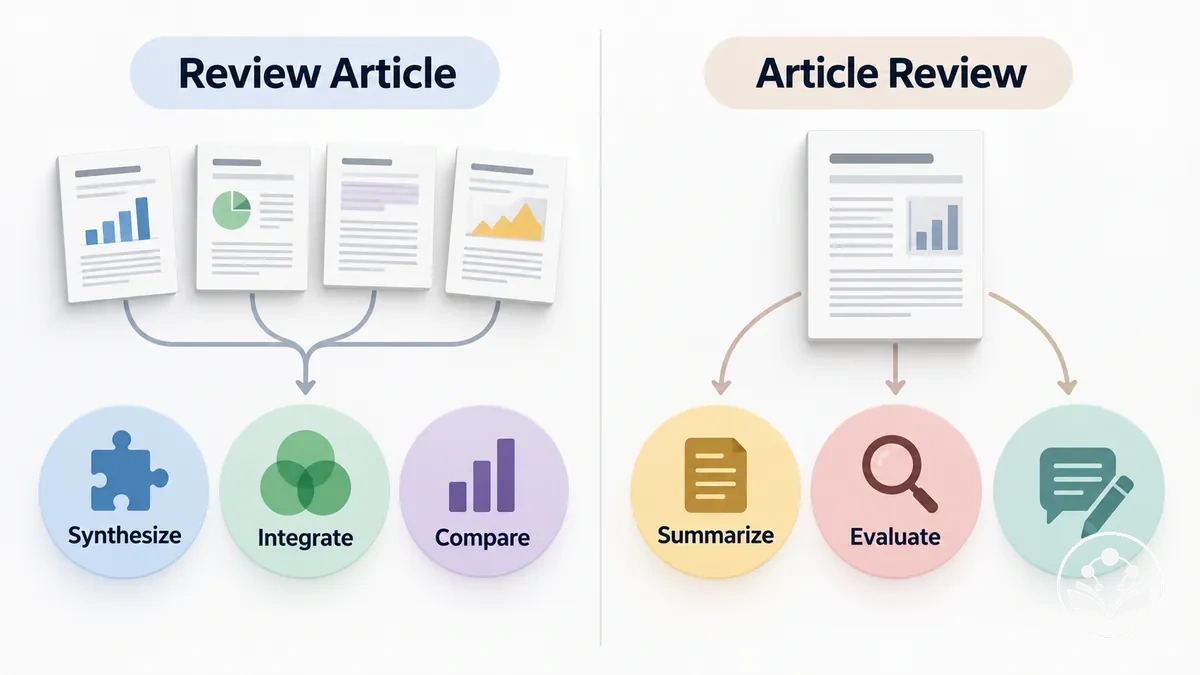
In a review article, the writer synthesizes, integrates, and compares findings across sources to interpret patterns or differences and build an integrated claim; individual studies may also be evaluated where relevant.
In an article review, summary establishes what the selected article says before evaluation examines how its evidence and reasoning support its claims and what judgement can be made about its contribution or limitations; supporting comparisons may also be used when the assignment calls for them.
The following contrast organizes these analytical verbs and resulting claim types without treating either task as limited to a single operation.
- Review article: synthesize findings → integrate cross-source relationships → compare patterns or differences → interpret the combined evidence → build a resulting claim across the reviewed research.
- Article review: summarize the focal article → examine its claims and evidence → evaluate its reasoning → interpret strengths or limitations in context → form an evaluative resulting claim about the article.
The image makes the predicate-level distinction visible by showing two analytical lanes and the evidence object associated with each, rather than reproducing the full contrast block.
For example, on the same academic topic, a review article might compare findings across several studies and conclude that the evidence shows a recurring pattern with important differences between contexts.
An article review of one study on that topic might instead conclude that the study's interpretation is well supported in one respect but limited by a particular feature of its evidence or reasoning.
This distinction between cross-source synthesis and focal-article evaluation provides the analytical boundary for broader review article writing: the defining difference is what the writer does with the evidence, not source count alone.
Review Articles Integrate Patterns, Agreements, and Gaps Across Sources
Review article synthesis integrates studies by relating their evidence to one another rather than reporting each source as a separate summary.
The analytical focus is on how studies agree with, differ from, or cluster around shared patterns and what those cross-source relationships support in the interpretation.
Integration begins with shared or contrasting attributes across studies, which may reveal agreements, disagreements, recurring patterns, or methodological differences in the evidence.
The reviewer interprets what those relationships imply across the relevant body of research instead of treating an accumulation of individual summaries as synthesis.
Methodological differences can help explain contrasting findings, while evidence that leaves an important question unresolved may suggest a research gap; a disagreement, methodological difference, or missing detail is not by itself a research gap.
The diagram maps these relationships among studies rather than presenting a procedural workflow, keeping the movement from cross-source comparison to interpretation central.
Article Reviews Combine Summary With Critical Evaluation
An article review combines summary with critical evaluation: the summary accurately represents what the selected article says, while the critical evaluation judges how well its claim is supported by evidence or method and what the work contributes.
- Represent the article accurately. State its central claim or finding before judging it; summary establishes what the article says and supplies the basis for critique.
- Test how the claim is supported. Connect the claim to the evidence, reasoning, or method used to support it, and make the judgement within the article's stated scope.
- State the evaluative implication. Identify a relevant strength or limitation, then explain what it means for the article's contribution or how far its claim can reasonably be interpreted.
The resulting judgement should follow from the analysis rather than from unsupported praise or criticism.
How Their Writing Structures Differ
Review article structure and article review structure differ because each organizes writing around a different task purpose rather than one universal template.
The comparison below treats structure by function—opening function, evidence organization, analytical core, and conclusion—rather than prescribing fixed heading names.
| Structural Function | Review Article | Article Review |
|---|---|---|
| Opening/framing | Frames the topic, question, scope, or purpose that will guide the review. | Identifies and contextualizes the selected article and establishes the basis for its review. |
| Evidence organization | Organizes relevant research into themes, patterns, relationships, or other groupings that support synthesis. | Organizes the selected article's claims, evidence, or method so that summary can support subsequent evaluation. |
| Analytical core | Integrates evidence across the reviewed research through synthesis and interpretation. | Evaluates the focal article's claims, evidence, reasoning, method, strengths, limitations, or contribution. |
| Closing judgement or conclusion | Draws together the synthesis and states the implications or conclusions supported by the reviewed evidence. | Brings the evaluation together into a reasoned overall judgement about the selected article within the assignment's scope. |
These functions may appear under different headings or in a different order depending on the journal, discipline, review type, or assignment brief.
The useful distinction is therefore how each structure supports its analytical purpose, not whether it follows one fixed sequence of section names.
Review Article Structure Organizes a Broader Evidence Synthesis
Review article structure is organized to support evidence synthesis across a body of research rather than to impose one fixed manuscript template.
Its structural functions help the writer frame a coherent question or theme, organize relevant studies, integrate findings, and reach a synthesis-based conclusion; the following components describe functional roles rather than mandatory heading names.
- Framing: frames the topic, question, scope, or theme so the reviewed evidence is interpreted within a coherent boundary.
- Evidence organization: organizes studies around a justified question, theme, method, or other framework so relationships among sources can become visible.
- Integration: connects findings across studies to support interpretation rather than leaving them as separate source summaries.
- Conclusion: draws together the integrated evidence and states the implications or conclusions supported by the synthesis.
Organizing a review primarily source by source without integrating relationships among findings can weaken its analytical purpose, a boundary also addressed in common review article writing mistakes.
The exact organization may vary by review type, journal, discipline, and research question, but its functional role remains to support cross-source integration.
Article Review Structure Organizes Identification, Summary, and Evaluation
Article review structure normally supports four related functions: identification and context, accurate summary, critical analysis, and an overall evaluation or conclusion about the selected article.
These functions organize the focal article so that its content is represented accurately before the review develops a reasoned judgement.
The components below describe a typical functional organization rather than a fixed order, because assignment instructions may change their sequence or emphasis.
- Identification and context: identifies the selected article and establishes the context needed to understand what is being reviewed.
- Summary: summarizes the article's main argument or findings accurately so the later evaluation addresses what the article actually presents.
- Critical analysis: analyses relevant claims, evidence, reasoning, or method to establish the basis for evaluative judgement.
- Overall evaluation or conclusion: evaluates the analysis as a whole and draws it into a reasoned conclusion about the article within the scope of the assignment.
Whatever order the assignment instructions specify, summary should support evaluation rather than dominate the article review.
How to Identify Which Task an Academic Assignment Requires
Identify the required task from the assignment brief by combining four signals: the object of analysis, source breadth, analytical verbs, and expected output.
The word “review” alone is not decisive because departments and disciplines may use overlapping terminology for different academic tasks.
The strongest diagnosis comes from reading the signals together.
A supplied or selected article points toward an article review when that article is the main object of analysis, while instructions to locate and integrate multiple studies point toward a review article.
Analytical verbs such as synthesize, integrate, and compare across studies suggest cross-source synthesis, whereas critique, evaluate, and assess usually indicate judgement of a focal article.
The rubric and deliverable description should then confirm what kind of resulting output the assignment expects.
| Signal in the Brief | What It Indicates | Likely Task Implication |
|---|---|---|
| A specific article is supplied or the student is told to select one article | The object of analysis is likely a focal article rather than a body of research. | Often points toward an article review, especially if the brief also asks for summary, critique, or evaluation. |
| The student must locate and use multiple studies | The source breadth extends across a research body rather than one focal text. | Often points toward a review article when those studies must be integrated into a broader interpretation. |
| Verbs such as synthesize, integrate, compare, or identify patterns | The analytical operation involves relationships across sources. | Suggests a review article or another synthesis-based task, depending on the stated deliverable. |
| Verbs such as critique, evaluate, assess, or judge | The brief emphasizes critical judgement of evidence, reasoning, method, or contribution. | Often points toward an article review when the judgement is directed at one selected article. |
| Deliverable wording describes an integrated account of research versus an evaluation of one article | The expected output clarifies the claim type the writer must produce. | An integrated research account points toward a review article; an evaluative judgement of a focal article points toward an article review. |
For example, a brief labelled “literature review” might still be ambiguous if it also supplies one article and asks for critique.
In that situation, the rubric, source requirements, and deliverable wording should determine the task, while the neighbouring distinction between a review article versus literature review can clarify the terminology without replacing the assignment-specific evidence.
Treat several signals together rather than allowing any single keyword to determine the task.
Signals That the Task Requires a Review Article
An assignment brief points toward a review-article task when it centres on a topic or research question, requires engagement with multiple scholarly studies, and asks the writer to compare or synthesize evidence into an integrated account.
Several of these signals together are more informative than the task label alone.
- Topic or research question: when the assignment asks the writer to examine a broader topic or research question rather than one focal article, the object of analysis points toward a body of evidence.
- Multiple scholarly studies: when the task requires the writer to locate or use multiple scholarly studies relevant to that topic or question, the required evidence extends across sources rather than remaining centred on one text.
- Compare and synthesize: when the instructions ask the writer to compare findings, synthesize evidence, identify relationships, or integrate research, the analytical work points toward cross-source synthesis.
- Integrated account: when the expected output is an integrated account of the literature that connects findings across the reviewed evidence, the deliverable supports a review-article interpretation.
Specific search, screening, and reporting requirements may vary with the review type, so these criteria do not imply that every review article follows the same method.
The assignment brief should therefore be read for the combined task signals and any review-type requirements it explicitly specifies.
Signals That the Task Requires an Article Review
An assignment brief points toward an article-review task when it supplies or asks the writer to choose a selected article and then asks the writer to summarize, critique, or evaluate that focal text.
A supplied article combined with evaluative instructions is a particularly strong signal because the article remains the central object of the task.
- Supplied or selected article: when the assignment provides a supplied article or requires a selected article, that focal text becomes the principal object to be examined.
- Summarize: when the brief asks the writer to summarize the article's argument or findings, accurate representation establishes the basis for later analysis rather than serving as the entire task.
- Critique or evaluate: when the instructions ask the writer to critique or evaluate the article's claims, evidence, reasoning, or method, the task requires evaluative analysis of the focal article.
- Overall judgement: when the expected output includes an overall judgement about the article's contribution, quality, strengths, or limitations, the deliverable further signals an article review.
Supporting sources may still be permitted or required for context, comparison, or evidence when the assignment brief specifies them.
Their inclusion does not necessarily displace the selected article as the focal object of evaluation.
When the Brief Uses Critique or Critical Appraisal
Neither critique nor critical appraisal determines the task by itself because institutions may define and use these terms differently. Interpret the wording by checking what object is being evaluated and which criteria the assignment requires.
Critique
Often focuses on a selected article's argument, evidence, strengths, and limitations.
Example: “Critique the author's argument and evidence.”
Critical appraisal
Places more specific emphasis on stated evaluative criteria such as validity, relevance, bias, or applicability.
Example: “Critically appraise the study's validity and applicability.”
If a selected article is to be critiqued, the task centres on evaluating that article's argument and evidence; if the brief specifies appraisal criteria such as validity, bias, relevance, or applicability, the judgement should be tied to those criteria. The assignment's own criteria and rubric control the final task interpretation.